When you need reliable 12V DC to 110/120V AC power, a heavy duty power inverter is essential. This guide targets buyers seeking high-capacity inverters for RVs, trucks, solar setups, or off-grid cabins. The top picks below are chosen for true wattage capability, safety features, and practical usability. Each product section explains who it’s best for and why it was selected, plus a clear caution when applicable.
| Product | |||
|---|---|---|---|
| LVYUAN 5000W | 5000W | 10000W | heavy load RVs and off-grid systems |
| EFFORTWAY 5000W | 5000W | 10000W | campers and long trips needing stable power |
| BELTTT 3000W | 3000W | 6000W | mid-range solar or mobile setups |
| Jlouneo 4000W | 4000W | 8000W | full-time RV living and backup power |
| ROARBATT 4000W | 4000W | 8000W | quiet operation and long duty cycles |
LVYUAN 5000 Watt Power Inverter
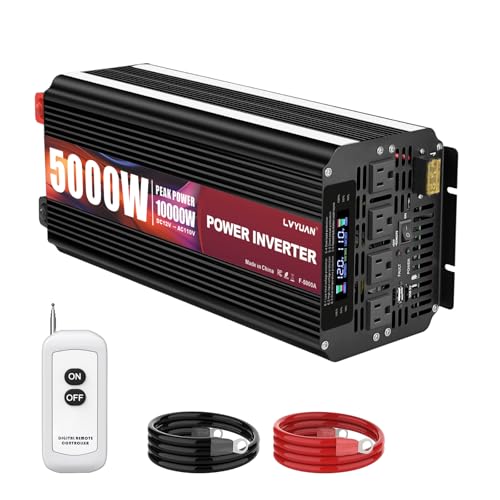
3000-5000W class devices are common in mobile and off-grid setups. This LVYUAN model converts 12V to 110V/120V with 5000W continuous and 10000W peak, suitable for high-load appliances in RVs, solar arrays, or large vehicles. It includes 4 AC outlets plus a hardwire terminal for flexible connections. An LCD display provides real-time voltage, battery level, and load information for safe operation.
Best for: high-demand loads in RVs and off-grid cabins where durable wired connections are useful. Better for users needing multiple sockets and a clear performance readout. Caution: check battery capacity and ensure your system can handle sustained 5000W to avoid overloading.
EFFORTWAY 5000W Inverter With LCD and Remote

This 5000W unit delivers 12V to 110/120V with two key user interfaces: an LCD display and a wireless remote. It’s designed for RVs, motorhomes, and off-grid solar systems, boasting >90% efficiency. The remote control can extend convenience up to 150 feet, and the LCD shows input/output voltage, battery capacity, load, and error codes for troubleshooting.
Best for: users who value remote operation and crisp status monitoring. Choose this if you want handy remote control for on-the-go power management. Limitation: remote setup requires inverter to be off before turning on with the remote to avoid startup issues.
BELTTT 3000W Pure Sine Wave Inverter

Pure sine wave output makes it compatible with sensitive electronics and entertainment gear. The 3000W continuous rating with up to 6000W peak suits mid-range solar and off-grid needs. An intelligent LCD displays input/output, battery, and load, and a hardwire port expands installation options. It emphasizes reliability for home-like electronics.
Best for: users powering home theater gear, TVs, and imaging devices in off-grid or mobile setups. Limitation: 3000W continuous may fall short for larger appliances like induction stoves or high-wraw motors in some scenarios.
Jlouneo 4000W Pure Sine Wave Inverter

This 4000W inverter targets full-time RV living and off-grid backup. It provides 4000W continuous power and 8000W peak. The unit features dual LCD displays, remote control, and a hardwire port. It is built for 12V AGM, GEL, or lithium battery systems and includes a low standby current for energy efficiency.
Best for: long-term off-grid power and RV use where reliability and battery compatibility matter. Caution: designed for 12V systems; confirm battery type to avoid mismatch with higher voltage configurations.
ROARBATT 4000W Pure Sine Wave Inverter

ROARBATT delivers a 4000W continuous, 8000W peak pure sine wave inverter with 4 AC outlets and dual USB ports. It emphasizes protection features (over-voltage, under-voltage, overload, short circuit, overheat) and a quiet cooling fan. Its aluminum housing is built for durability in mobile and off-grid environments.
Best for: users needing clean power for sensitive electronics and longer operation with solid protection. Limitation: higher output devices may require dedicated ventilation to keep temperatures within safe range during heavy use.
Buying Guide: Heavy Duty Inverters — Key Considerations
What wattage do you really need?
Match continuous output to the expected load. If you routinely run refrigerators, microwaves, and power tools, choose a unit with at least 20-30% headroom above the highest anticipated continuous draw.
Pure sine wave vs modified sine wave
Pure sine wave inverters are safer for sensitive electronics and appliances, while modified sine wave inverters can handle simple devices but may cause noise or shorter lifespans in some equipment.
Efficiency and standby current
High efficiency conserves battery life. Look for models with low no-load current to minimize energy drain during standby.
Protection and safety features
Essential protections include over-voltage, under-voltage, overload, short-circuit, overheat, and grounding. Isolated input/output can further reduce interference with connected devices.
Installation and port options
Consider the number of AC outlets, the availability of a hardwire terminal, USB ports, and remote control. For mobile use, a compact form factor and flexible wiring are advantageous.
Battery compatibility
Confirm compatibility with your 12V battery system (AGM, GEL, lithium, etc.). Some inverters specify intended battery chemistry and warnings about mismatches.
Remote control and monitoring
Remote operation can simplify power management in campers and vehicles. LCD displays provide quick status checks on voltage, load, and battery state.
FAQ
- What continuous wattage should I choose for an RV? – Choose an inverter with a continuous rating that exceeds your total essential load, plus a safety margin for startup surges.
- Is a pure sine wave inverter necessary for my fridge? – For most modern fridges, a pure sine wave inverter is preferable to avoid startup issues and noise.
- Can I run induction appliances on these inverters? – Induction appliances may require higher surge capacity; check peak wattage and test within safe limits.
- Do I need remote control? – Remote control is convenient for mobile setups; it is optional if you prefer manual operation.
- How important is the efficiency rating? – Higher efficiency reduces energy drain from the battery, extending runtime between charges.
- What about protection features? – A robust inverter should include multiple protections to protect both the device and the battery system.