When a power outage hits, you need a reliable backup that fits your home’s needs and your budget. This guide highlights five top options, showing who they’re best for and why they stand out. It’s ideal for homeowners who want smooth power restoration, RV-ready portability, or emergency whole-home capability. Below is a quick summary of the chosen products to help you compare at a glance.
Quick Comparison Table
| Product | Best For | Key Benefit | Notable Limitation |
|---|---|---|---|
| Westinghouse 12500 Watt Dual Fuel | Medium-to-large homes | Gas or propane flexibility, multiple outlets | Heavier and louder than compact inverter models |
| Westinghouse 14500 Peak Watt Tri-Fuel | Larger homes or frequent outages | Gas/propane/natural gas tri-fuel versatility | Higher initial cost |
| DuroMax XP13000EH | Full-home backup on a budget | Dual fuel power with electric start | Bulkier, heavier unit |
| DuroStar DS13000MX | Emergency power with safety features | CO alert, dual fuel, transfer-switch-ready | Limited fuel tank size for longer outages |
| Westinghouse 6500 Watt Dual Fuel | Smaller homes or apartment houses | Solid dual-fuel capability and safety outlets | Lower peak watts than larger models |
Westinghouse 12500 Watt Dual Fuel Back-up Generator

Best for households needing strong, flexible output with both gasoline and propane options. This model delivers 9500 running watts on gasoline and 12500 peak watts, with a gas-to-propane switch for fuel flexibility. Features include remote start, a digital hour meter, a VFT display for real-time voltage and frequency, and a transfer-switch-ready setup. It powers essential circuits with multiple outlets and a 6.6-gallon tank for extended runtime. The kit includes an oil shutdown feature for engine protection. Best for medium-to-large homes and property-braced outages.
- Best for: Smaller to mid-sized homes with critical circuits prioritized.
- Why chosen: Strong dual-fuel power, remote start convenience, and transfer-switch compatibility.
- Caution: Heavier and louder than inverter generators; storage and transport require planning.
Westinghouse 14500 Peak Watt Tri-Fuel Generator

This tri-fuel powerhouse is ideal for larger homes or properties that demand longer outages with maximum flexibility. It runs at 11,500 watts on gasoline, 10,500 watts on natural gas, or 13,500 watts peak on propane. A heavy-duty 550cc engine drives long runtimes on sizable tanks, and it’s transfer-switch ready for seamless switching. Best for households that want multiple fuel options and substantial backup capacity.
- Best for: Homes with higher power needs and access to multiple fuel sources.
- Why chosen: Highest continuous output among the listed models with flexible fuel options.
- Caution: Higher fuel consumption when running at peak and larger footprint.
DuroMax XP13000EH Dual Fuel Portable Generator

Choose this if you want a strong, dual-fuel option with electric start and a robust engine. The XP13000EH delivers up to 13,000 watts and supports whole-home backup when paired with an appropriate transfer switch. It’s designed to power essential loads with reliability and is marketed as a leader in dual-fuel technology. It’s suitable for storm preparation and longer outages where fuel availability varies.
- Best for: Homeowners seeking robust, flexible power with easy electric start.
- Why chosen: High peak/watt balance and dual-fuel versatility.
- Caution: It’s a larger unit that requires proper space and ventilation.
DuroStar DS13000MX 13,000-Watt Dual Fuel

This model is a strong choice for emergency backup with dual-fuel capability, remote electric start, and transfer-switch readiness. It’s designed to handle whole-home loads when configured with the appropriate transfer equipment. A notable safety feature is its carbon monoxide alert, which helps protect occupants during outages. Best for: families seeking reliable power with added safety features.
- Best for: Emergency preparedness with safety features and fuel flexibility.
- Why chosen: CO alert adds safety in situations with limited ventilation.
- Caution: Higher fuel consumption under full-load operation; ensure proper exhaust clearance.
Westinghouse 6500 Watt Dual Fuel Generator
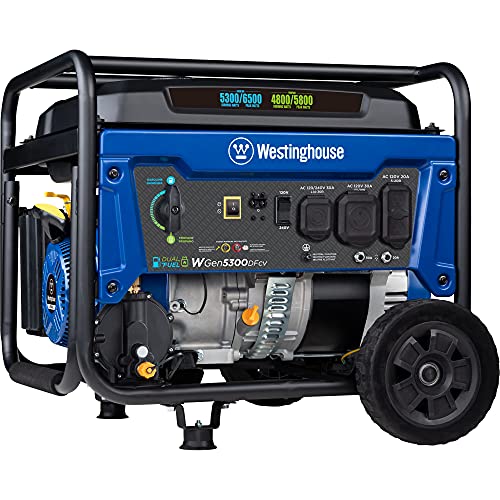
Best for compact spaces or smaller homes, this dual-fuel unit provides solid power for essential circuits with a 5–20R receptacle, RV outlet, and transfer-switch-ready configurations. It includes a 4.7-gallon fuel tank and a built-in fuel gauge for easy monitoring. It’s a practical option when space constraints or budget are priorities.
- Best for: Small homes, apartments, or limited outdoor space.
- Why chosen: Balanced power with essential outlets and transfer-switch readiness.
- Caution: Peak watts are lower than larger models; plan load carefully.
Buying Guide: Key Considerations For Choosing A Home Backup Generator
What size generator do you need? Start by listing critical loads (refrigerator, sump pump, furnace/AC, lights) and total their watts. Choose a generator with a watt rating that comfortably covers these loads plus a buffer for startup surges. Dual-fuel models offer flexibility when gasoline is scarce, while tri-fuel units maximize options when natural gas lines are available. Consider portability versus permanent installation and whether you need transfer-switch readiness for seamless in-home power transfer.
How important are runtime and fuel capacity? Look at tank size and fuel efficiency for longer outages. Units with larger tanks and efficient engines reduce refueling needs during a storm. Remote start adds convenience for frequent outages or cold climates. Safety features like CO detectors and rubber outlet covers improve household safety during operation. For larger homes, prioritize higher continuous watts and multiple outlets to avoid overloading circuits.
What about installation and maintenance? Transfer switches simplify safe power transfer to home circuits. Automatic low oil shutdown protects engines, while hour meters help track maintenance intervals. Warranty terms and service availability are practical considerations, especially in regions prone to outages. Read user manuals to understand start-up procedures, maintenance intervals, and fuel storage requirements.
FAQ
- What size generator do I need for a typical home outage? – Assess essential loads and select a generator with continuous watts that exceed that total, plus a buffer for startup surges.
- Is dual-fuel necessary? – Dual-fuel offers flexibility when one fuel source is unavailable, improving reliability during extended outages.
- Do I need a transfer switch? – A transfer switch enables safe, automatic or manual redirection of power to essential circuits without backfeeding the grid.
- Are CO detectors important? – Yes. CO safety features help shut the unit down if dangerous fumes are detected, protecting occupants.
- What maintenance should I plan for after an outage? – Regular oil changes, air-filter checks, spark plug inspection, and fuel stabilizer use extend engine life and reliability.
- Can I run a generator indoors? – No. Operate generators outdoors in a well-ventilated area to prevent carbon monoxide buildup.