If you’re powering an enclosed trailer, you need a generator that provides clean, reliable power without excessive noise or fumes. This guide highlights five suitable options and explains which buyers they’re best for. It covers payload-friendly inverter models for sensitive electronics, all-purpose dual-fuel units, and compact solutions for RV and camping use. The buying guide explains key considerations like power output, run time, fuel type, noise, and safety features to help you compare quickly.
| Product | Best For |
|---|---|
| Westinghouse 4650 Peak Watt Portable Generator | RV-ready power with multiple outlets, large tank, and included accessories |
| PowerSmart 3600-Watt Portable Inverter Generator | Quiet camping and light RV loads with clean power |
| PowerSmart 4300-Watt Portable Generator | Home backup and larger RV loads with inverter tech |
| WEN 6800-Watt Dual Fuel DF680iX | Backup power with dual-fuel versatility and CO safety |
| Oxseryn 4400 Watts Inverter Generator | Open-frame portability with multiple outlets and ECO mode |
Westinghouse 4650 Peak Watt Portable Generator
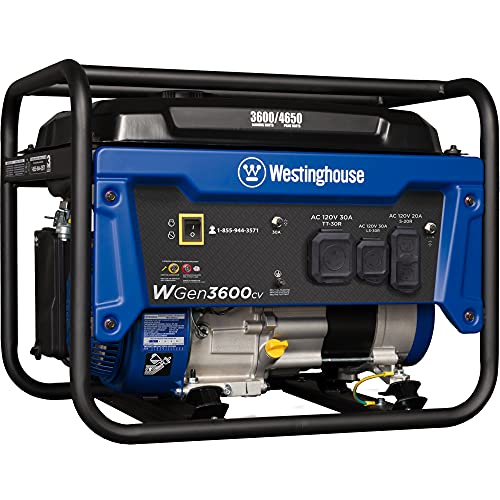
Best for: RV owners who need a reliable, ready-to-plug-in unit with multiple outlets. This model delivers 3600 running watts and 4650 peak watts, with a 4-gallon tank that yields up to 14 hours per tank. It features two 5–20R 120V outlets, plus RV-ready TT-30R and L5-30R receptacles, making it versatile for trailers and camping setups. A CO sensor adds safety, and the package includes oil, a funnel, tools, and manual for quick start. Limitations include fuel consumption at higher loads and the need for regular maintenance to keep the CO sensor accurate over time.
PowerSmart 3600-Watt Portable Inverter Generator

Best for: Campers and light RV use needing clean power for sensitive electronics. This model provides up to 3600 starting watts and 3200 running watts with inverter tech that yields a clean sine wave (<3% THD). It runs on a 149cc four-stroke engine and offers up to 8 hours of runtime at 25% load with a 1.3-gallon tank. It’s ideal for laptops, CPAP machines, and small appliances, though its runtime may be shorter under heavier loads compared with larger units.
PowerSmart 4300-Watt Portable Generator with Inverter Technology

Best for: Home backup and campers needing higher power without sacrificing clean power. This unit delivers 4300 surge watts and 3500 rated watts with a 223cc four-stroke engine. It provides a pure sine wave (<3% THD) to protect sensitive electronics. Fuel efficiency is improved by Eco-Mode, and a 1.98-gallon tank offers about 6.5 hours at 50% load. Choose this if you anticipate longer outages or larger RV loads; avoid if you need ultra-quiet operation in tight campsites, as higher output typically raises noise.
WEN 6800-Watt Dual Fuel RV-Ready Generator

Best for: Homes and trailers needing flexibility with fuel sources and safety features. This dual-fuel unit runs on gasoline (6800 surge, 5100 rated) or propane (6000 surge, 4500 rated). It includes a bonded-neutral 240V configuration for Level 2 EV charging and a CO watchdog to shut down on toxic fumes. It is a strong choice for reliability in outlets and backup power, but the dual-fuel setup requires carrying both fuel types and periodic maintenance for dual-fuel engines.
Oxseryn Power Equipment 4400 Watts Inverter Generator
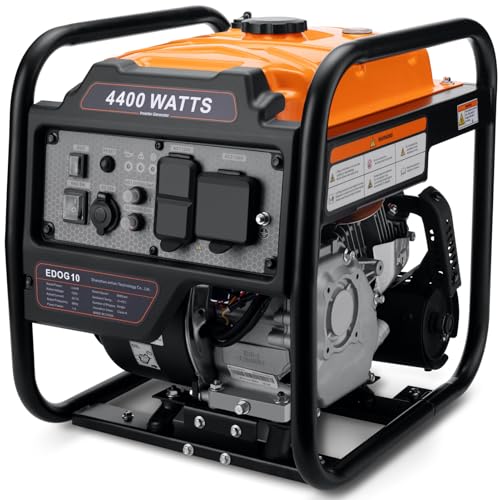
Best for: RV enthusiasts seeking a balance of portability, runtime, and multiple outlets. The unit delivers 4400 peak watts and 3400 running watts with ECO mode for longer runtimes—up to 14 hours at 25% load. It offers 2x120V AC ports, 1x12V DC, and an RV outlet, making it versatile for trailers and campsites. Limitation: precise fuel economy depends on load and ECO mode effectiveness, so expect variability with heavy use.
Buying Guide
Power needs: Estimate total wattage of devices you plan to run simultaneously. Inverter generators largely suit sensitive electronics due to clean sine waves. For trailers with AC units, plan for higher surge watts and consider dual-fuel options for longer outages.
Key Purchase Considerations
- Power output: Choose a model with sufficient peak and running watts for your load profile.
- Run time and fuel: Larger tanks or efficient Eco modes extend operation between refuels.
- Fuel type: Gasoline is common, but dual-fuel options add versatility for outages or remote sites.
- Portability: Compact frames with wheels handle better in trailer setups; lighter units are easier to move.
- Outlets: Ensure the generator has the right outlets (RV TT-30R, L5-30R, 120V duplex) for your trailer.
- Safety: CO sensors and automatic shutoffs improve safety in enclosed spaces.
- Noise level: Inverter generators tend to be quieter, which matters for campgrounds and residential areas.
Usage Scenarios
- RV camping: Look for RV-ready outlets and sufficient surge watts to start air conditioners.
- Emergency home backup: Higher running watts and longer runtimes ensure essential devices stay powered.
- Portability needs: Lighter units and open-frame designs are easier to store in trailers and trucks.
Safety and Maintenance Tips
- Place generators outside the trailer with proper ventilation to avoid CO buildup.
- Regularly check oil levels and fuel quality; change oil as recommended by the manufacturer.
- Use proper fuel stabilizers when storing units for extended periods.
- Keep fire extinguishers nearby and follow local safety guidelines for generator use in enclosed spaces.
FAQ
- What size generator do I need for an enclosed trailer?
Assess total wattage of all devices you’ll run. For air conditioners, a unit with at least 3600-4300 watts running power is typical, with higher surge capacity for startup. Inverter models are preferred for sensitive electronics.
- Is a dual-fuel generator better for trailers?
Yes, dual-fuel options provide flexibility if gasoline is scarce or during extended outages. They let you switch between fuel sources as needed.
- Why choose an inverter generator?
Inverter models deliver clean power with stable voltage, which protects electronics and appliances in small trailers and camping setups.
- How loud are these generators?
Inverter generators are generally quieter. Typical ranges vary by model, with some designed for quiet camping environments.
- What maintenance is required for trailer use?
Regular oil changes, air-filter checks, spark plug inspections, and fuel system care are common. Store with stabilizer if not used often.