When choosing a gas powered generator for home use, you want a reliable unit that can run essential appliances during outages. This guide highlights top options ideal for home backup, with a focus on multi-fuel flexibility, run time, and ease of use. The selections suit varying home sizes and needs, from mid-size loads to whole-home backup. The table below compares five strong choices to help you decide quickly.
| Product | Output (W) | Fuel | Best For |
|---|---|---|---|
| Westinghouse 12500 Watt Dual Fuel | 12500 peak / 9500 running (gas) | Gas, Propane | Mid-to-large homes needing reliable dual-fuel power |
| Westinghouse 14500 Peak Tri-Fuel | 14,500 peak / 11,500 running (gas) | Gas, Propane, Natural Gas | Larger homes with long outages |
| DuroStar DS13000MX | 13,000 | Gas, Propane | Home backup with fuel flexibility |
| Generac 12,500 Tri-Fuel | 12,500 starting / 9,500 running (gas) | Gas, Propane, Natural Gas | Emergency power with multi-fuel options |
| DuroMax XP13000EH | 13,000 | Gas, Propane | Whole-home backup with electric start |
Westinghouse 12500 Watt Dual Fuel

Power features include 9500 running watts and 12500 peak watts on gasoline, with an 8500 running and 11200 peak on propane. Remote start via key fob offers convenient operation, and a 6.6-gallon fuel tank supports up to 12 hours of runtime. It includes outlets suited for household use and transfer switch readiness, making it a practical choice for homes that may need to interface with a transfer switch. Best for homeowners needing dual-fuel capability with long run times. Limitations include the weight and size, which may require assistance for transport and setup.
Westinghouse 14500 Peak Tri-Fuel

This tri-fuel generator handles gasoline, propane, and natural gas. It delivers up to 14,500 peak watts and 11,500 running watts on gas, with similar scalable performance on propane and natural gas. A heavy-duty engine and long runtimes make it suitable for larger homes or prolonged outages. It includes features to monitor fuel and output, and transfer switch readiness for a seamless installation. Choose this if you need maximum flexibility across fuel sources. A limitation is that tri-fuel models can be more expensive and heavier than standard single-fuel units.
DuroStar DS13000MX

The DS13000MX offers 13,000 watts of power with dual-fuel capability for gasoline or propane. It supports electric start for quick power restoration and is designed for whole-home backup and job-site needs. Best for users who want strong power with fuel flexibility and a reliable starting mechanism. A caveat is the higher initial investment and the need for a suitable fueling plan during extended outages.
Oxseryn 4400-Watts Inverter
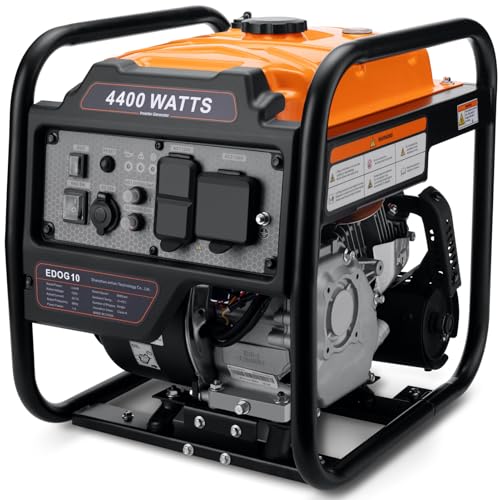
For smaller homes or RV use, the Oxseryn inverter provides 4400 peak watts and 3400 running watts with ECO mode for fuel efficiency. It includes two 120V outlets, a 12V DC port, and a 30A RV port, with up to 14 hours of runtime at 25% load on a 2-gallon tank. Best for lightweight, portable backup or supplemental power. Favorable for portability, but not ideal for high-load whole-home needs.
Buying Guide: Key Considerations For Home Backup Generators
- Fuel flexibility: If you may rely on natural gas or propane, tri-fuel models offer flexibility during supply interruptions. Consider dual-fuel options for a balance of power and fuel availability.
- Power needs: Calculate essential loads (refrigerator, sump pump, lighting, heating/cooling) to estimate required running watts. For whole-home backup, aim for higher running watts and a robust starting wattage.
- Run time and tank size: Larger fuel tanks extend operation between refuels. Inverter models excel in efficiency for sensitive electronics but may have lower peak output.
- Transfer switch compatibility: If you plan to connect to a home transfer switch, verify outlet configurations and switch readiness. This ensures safe, automatic or manual switching during outages.
- Noise and portability: Inverter generators typically run quieter and are lighter, suitable for neighborhoods or camping. Open-frame models often offer higher output but can be louder.
- Safety features: Look for CO sensors, low-oil shutdown, and overload protection to prevent damage and ensure safe operation.
Frequently Asked Questions
- What size generator do I need for a typical home backup?
– Assess essential loads and aim for a running wattage that covers those items with some headroom. For larger homes, look at 10,000–15,000 running watts ranges. - Is tri-fuel better than dual-fuel for emergencies?
– Tri-fuel offers more fuel source options, which can be beneficial if one fuel runs short. A dual-fuel unit can be sufficient if you have a reliable supply of two fuels. - Do inverter generators provide enough power for home use?
– Inverters excel in efficiency and electronics safety but may not meet whole-home needs without higher watts. They are ideal as supplemental or RV backups. - Should I buy a generator with Electric Start?
– Electric start improves convenience, especially during cold or stressful outage situations. It is common on mid-to-large units. - What maintenance is required for home generators?
– Regular oil changes, air filter checks, and spark plug inspections are typical. Follow the manufacturer’s intervals for fuel stabilizer and battery maintenance. - Can I connect a generator directly to my home’s circuits?
– That requires a transfer switch or an interlock device installed by a qualified electrician to ensure safe operation and prevent backfeeding.
This selection emphasizes options suitable for home backup, balancing power, fuel flexibility, and user-friendly features. The five highlighted models are designed to support essential circuits and critical appliances during outages, with considerations for size, run time, and fuel availability.