Choosing a reliable dual fuel generator provides flexibility during outages, camping trips, or remote work sites. This guide highlights five top dual fuel models that balance power, fuel options, and safety features. Each selection supports gasoline and propane, with features like electric start and CO sensors to help protect your family and equipment.
| Product | Fuel Options | Power (Gas / Propane) | Key Safety Features |
|---|---|---|---|
| WEN 5,600-Watt Dual Fuel Portable Generator (DF5600X) | Gasoline & Propane | Gas: 4500 running / 5600 surge; Propane: 4050 running / 5000 surge | CO Watchdog sensor |
| WEN Quiet and Lightweight 3600-Watt Dual Fuel RV-Ready (DF360iX) | Gasoline & Propane | Gas: 2900 running / 3600 surge; Propane: 2600 running / 3500 surge | CO Watchdog sensor; quiet operation |
| Westinghouse 12500 Watt Dual Fuel Backup Generator | Gasoline & Propane | Gas: 9500 running / 12500 peak; Propane: 8500 running / 11200 peak | Remote start; transfer switch ready; digital hour meter |
| Westinghouse 6500 Watt Dual Fuel Home Backup Generator | Gasoline & Propane | Gas: 5300 running / 6500 peak; Propane: 4800 running / 5800 peak | CO sensor |
| DuroStar DS13000MX 13,000-Watt Dual Fuel Generator | Gasoline & Propane | 13,000W (gas) / high power | CO alert; remote electric start |
Summary Note: This article presents five dual-fuel generators suitable for home backup and outdoor use. Each product can run on gasoline or propane and includes safety features such as CO sensors or alert systems and optional electric start options. Always follow local safety guidelines when operating generators.
WEN 5,600-Watt Dual Fuel Portable Generator (DF5600X)

The DF5600X provides dual fuel versatility, running on gasoline with 5600 surge watts and 4500 rated watts or propane with 5000 surge watts and 4050 rated watts. An electric start simplifies operation, and the unit includes the WEN Watchdog CO Shutdown Sensor to auto shut off if dangerous carbon monoxide levels are detected, enhancing home safety during outages or outdoor events.
WEN Quiet and Lightweight 3600-Watt Dual Fuel (DF360iX)

This model balances compact size with dual-fuel capability, delivering 3600 surge watts on gasoline and 3500 on propane, with 2900 running watts gasoline and 2600 running watts propane. It is designed for quiet operation and safe power delivery to sensitive electronics, making it suitable for RVs and small home backup scenarios. A CO sensor adds a layer of protection for indoor use or camp setups.
Westinghouse 12500 Watt Dual Fuel Backup Generator

Designed for real-world power needs, this Westinghouse unit provides 9500 running and 12500 peak watts on gasoline, and 8500 running with 11200 peak watts on propane. It includes remote electric start, a transfer switch-ready design, and a digital hour meter to monitor runtime. It supports multiple outlets and a robust 457cc engine for durable performance during extended outages.
Westinghouse 6500 Watt Dual Fuel Home Backup Generator
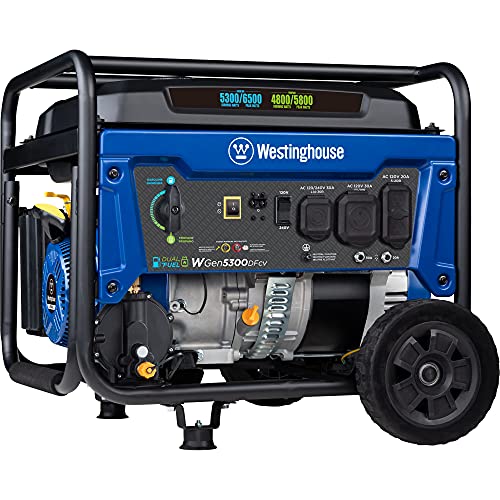
This unit offers gasoline and propane options with 5300 running watts and 6500 peak watts on gas, and 4800 running watts with 5800 peak watts on propane. A 4.7-gallon tank and up to 14.5 hours of runtime provide extended power when outages last longer than a day. It includes multiple outlets with rubber covers and a complete plug-and-play kit for quick setup, including a wheel kit for mobility.
DuroStar DS13000MX 13,000-Watt Dual Fuel Generator

The DS13000MX delivers high-end dual-fuel performance with 13,000 watts of power on gasoline and ample runtime on propane. It features remote electric start for ease of use during outages and is designed as a whole-home backup solution with transfer switch readiness. A CO alert enhances safety by automatically shutting down during dangerous fumes, ensuring safer operation in various environments.
Buying Guide: Key Purchase Considerations And Comparisons
- Power requirements: Assess your essential circuits and total wattage needs. If you anticipate running the central air, well pumps, and lighting, prioritize higher running watts and peak ratings, and ensure the generator can handle startup surges from appliances.
- Fuel reliability and availability: Dual-fuel units offer flexibility in fuel availability. Consider your access to gasoline and propane in your area, plus storage considerations and shelf life.
- Starting method: Electric start is convenient, especially during cold weather or after a power outage. Manual recoil start is a backup option but may be less convenient in emergencies.
- Safety features: CO detection sensors and automatic shutdown help reduce risks. Look for units with clearly labeled outlets, transfer switch compatibility, and proper enclosure design for outdoor use.
- Run time and fuel tank size: Longer runtimes reduce refueling needs during outages. Compare tank capacities and efficiency at varying loads to estimate how long a session can last.
- Portability vs. capacity: Wheel kits and lighter frames aid mobility for camping or job sites, while larger models provide more continuous power for home backup.
- Noise considerations: Quieter generators are preferable for residential use and RV setups. Check decibel ratings at a representative load to choose a suitable option.
- Outlets and transfer switch readiness: Ensure the generator has the necessary outlets (5-20R, TT-30R, L14-30R, etc.) and verify compatibility with your home transfer switch if needed.
- Maintenance and warranty: Consider engine displacement, oil shutdown features, and the warranty terms. A longer warranty often indicates build quality and confidence from the manufacturer.
- Environmental impact: CO shutdown sensors and clean power output protect sensitive electronics. Dual-fuel flexibility can also influence emissions and fuel usage patterns.