Flexible solar power panels offer lightweight, curved-surface charging options for campers, boaters, RV owners, and travelers. This guide highlights five top options that balance portability, durability, and performance. Each product is evaluated for who it’s best for, where it excels, and a practical limitation to consider.
Buyer’s quick reference: the table below summarizes who each option is ideally suited for, helping you compare at a glance.
| Product | Best For |
|---|---|
| GCUSSZ 1000 Watt Kit | Large off-grid setups on boats or RVs requiring multiple panels |
| Renogy 100W Flexible | Lightweight, curved-surface installations on RVs or cabins |
| Renogy 200W Flexible | Higher daily power needs on curved surfaces |
| DOKIO 600W Flexible Kit | Moderate-to-large off-grid systems with expandability |
| Callsun 400W Flexible Set | Marine decks or large curved roofs with weather resistance |
GCUSSZ 1000 Watt Flexible Solar Panel Kit

Best for high-capacity, flexible off-grid projects. This kit includes two 500-watt flexible panels with a 40A solar charge controller. The monocrystalline silicon cells promise decent performance in low-light conditions, and the flexible design supports curved surfaces on RVs, boats, yachts, cars, and other irregular rooftops. It’s well-suited for users who need a scalable solution that can parallel-expand in the future.
- Best for: larger off-grid setups where panel count and system voltage matter
- Why selected: strong adaptability for curved surfaces and a capable charge controller for moderate-to-large battery banks
- Limitation: requires careful wiring planning for expansion and may need additional hardware for multi-panel configurations
Renogy 100W Flexible Solar Panel 12V
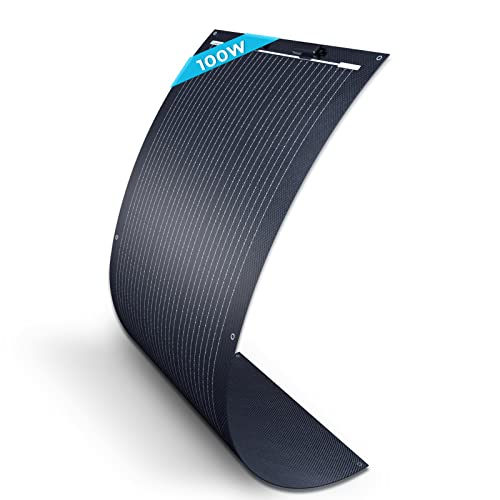
Best for lightweight, curved-surface installations on RVs, boats, or cabins. The 100W flexible panel is bendable within 240 degrees and weighs far less than rigid panels, offering an aesthetically discreet, black-glare-free appearance. It benefits from half-cut PERC cell technology to improve light capture and electrical performance, making it a solid choice for modest daily power needs in mobile setups.
- Best for: compact, curved installations with quick deployment
- Why selected: strong combination of low weight, flexible fit, and efficient cell technology
- Limitation: 100W capacity may require multiple panels for larger energy demands
Renogy 200W Flexible Solar Panel 12V

Best for higher daily power needs on curved surfaces. The 200W panel provides more electricity while remaining lighter than a rigid 200W option. It uses the same 240-degree bend capability and half-cut PERC technology to boost output. It’s a good pick for RVs, marine vessels, or cabins where space is limited but energy demand is steady.
- Best for: doubling daily energy output on curved roofs
- Why selected: higher wattage with flexible form for limited-space installations
- Limitation: heavier than 100W options; may require mounting planning for optimal angle
DOKIO 600W Flexible Solar Panels Kit

Best for larger off-grid systems with expandability. This kit combines six 100W panels totaling 600W, allowing series or parallel wiring for flexible configurations. Ideal for campers, RVs, boats, or trailers needing more solar input. The setup emphasizes safety and cooling, suggesting ventilation space and avoidance of mounting on combustible materials.
- Best for: scalable, mid-to-large flexible solar arrays
- Why selected: modularity and expansion potential fit growing power needs
- Limitation: installation requires planning around heat management and ventilation
Callsun 400W Flexible Solar Panel Set
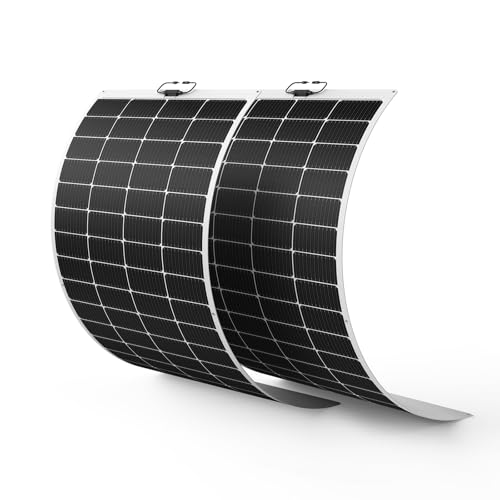
Best for marine decks and large curved roofs where weather resistance matters. This 2x200W set features a white design that helps reflect heat and maintain efficiency in hot climates. ETFE-coated panels provide durability against harsh elements, with a lightweight construction that makes handling easier during marine or RV installations.
- Best for: marine-grade applications and large curved surfaces
- Why selected: heat-reflective design and durable ETFE coating
- Limitation: fewer panels than some modular kits; plan for expansion if more power is needed
Buying Guide: Flexible Solar Panels
What to ask when choosing flexible solar panels for your vehicle, boat, or cabin:
- Power needs: How much daily energy do you require? Start with your battery bank capacity and estimated sun hours to choose wattage and panel count.
- Surface compatibility: How curved is the mounting surface? Look for panels with a wide bend angle (up to 240 degrees) for irregular rooftops.
- Weight and thickness: Do you need a lightweight solution for portable use? Ultra-thin panels are easier to carry but may have a different mounting method.
- Durability: Is the panel designed for outdoor exposure? ETFE coatings and dual-layer protection improve resistance to hail, UV, and weathering.
- Install and wiring: Are series or parallel configurations supported? Ensure your charge controller and inverter setup match the chosen wiring scheme.
- Ventilation and heat management: Will the installation stay cool? Proper ventilation preserves efficiency and prolongs life.
FAQ
- Q: Do flexible panels work in low light? A: Yes, many use high-efficiency monocrystalline cells that perform better than average in dim conditions.
- Q: Can I install flexible panels on curved surfaces? A: Yes, most options are designed to bend up to 240 degrees to fit curved surfaces.
- Q: Will flexible panels replace a roof panel? A: They are designed to supplement or replace specific areas, not necessarily replace an entire rigid roof in all cases.
- Q: Do I need special mount hardware? A: Depending on surface and panel design, you may need adhesives, mounting brackets, or clamps suitable for curved surfaces.
- Q: Is a charge controller always required? A: Yes, to regulate charging to the battery bank and prevent overcharging and damage.
- Q: Are flexible panels waterproof? A: Most are designed for outdoor use with weather-resistant coatings, but follow mounting and enclosure guidelines for full protection.