Answering the question for RV owners: flexible solar panels adapt to curved roofs, weigh less, and install faster than rigid panels. This guide highlights five top options that balance efficiency, durability, and ease of installation. Best for travelers with curved RV roofs, boaters needing stealthy setups, and campers seeking lightweight, portable power solutions. Below is a quick comparison to help you pick the right panel for your needs.
| Product | Best For | |
|---|---|---|
| BougeRV Arch Pro 200W | Curved RV roofs and boats needing stable output | 25% high-efficiency N-type cells with bypass diodes |
| Renogy Solar Panels 200W Flexible | All-around RV, marine, and cabin use with light weight | 240° bendability; half-cut PERC tech |
| Renogy 100W Flexible Solar Panel | Smaller RVs or limited roof space | Compact 100W with 240° bend and PERC tech |
| ECO-WORTHY 260W Flexible Kit | Off-grid RV and boat setups needing higher daily output | Two 130W panels; 30A controller; 4 components included |
| GCUSSZ 1000W Flexible Kit | High-demand, off-grid power for larger rigs | Two 500W panels; high-flexibility; robust mounting |
BougeRV Arch Pro 200W Flexible Panel

The BougeRV Arch Pro 200W panel uses upgraded bypass diode technology to maintain stable output in low-light or partial shading. It features high-efficiency N-type 16BB cells with a quoted 25% conversion rate and is designed for 12V, 24V, or 48V battery configurations when wired in series. Best for: RV roofs that experience shade or angled light, and users who want reliable energy when boondocking. Limitation: open-circuit voltage may not suit some power stations; verify compatibility before purchase.
Renogy 200W Flexible Solar Panel

This panel delivers high power with 200W capacity and a 240° bend radius, enabling installation on curved surfaces. It weighs about half as much as rigid panels and has an all-black, glare-free appearance. Best for: RVs needing substantial daily output on curved roofs without heavy lifting. Caution: ensure your charging system can handle the higher output and check mounting surface compatibility.
Renogy 100W Flexible Solar Panel
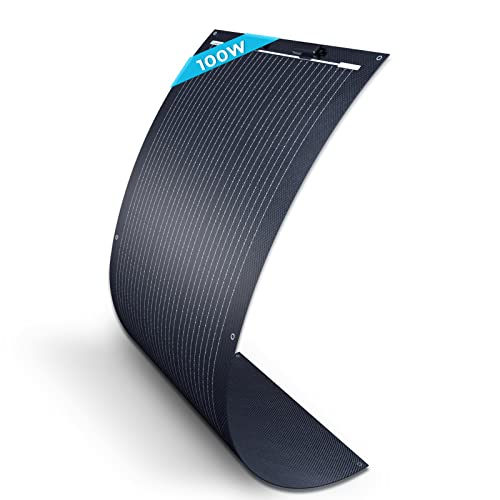
Renogy’s 100W option uses half-cut PERC cells to improve energy capture on curved surfaces, delivering a lighter-weight solution for smaller RVs or spaces with limited roof area. Best for: compact RVs, campers, or boats where space and weight matter. Limitation: lower wattage means smaller daily energy output compared with 200W models.
Renogy Flexible 100W Alternative

This Renogy model emphasizes extreme flexibility with ultra-thin lamination, making it difficult to notice on the roof when installed. Best for: stealthy solar setups on RVs with tight roof profiles. Caution: extremely thin panels may be more delicate during handling and mounting.
GCUSSZ 1000W Flexible Kit

This kit aggregates two 500W flexible panels with a 40A controller, suitable for RVs that require sustained power across larger living spaces. Best for: larger RVs, boats, or off-grid setups needing significant daily energy. Limitation: higher wattage demands a robust charging system and more complex installation.
Buying Guide
- What roof shape and space do you have? Flexible panels excel on curved surfaces but verify fit and seam configurations for mounting.
- What is your daily energy need? For higher daily usage, prefer 200W or larger kits; for light use, 100W panels may suffice.
- Do you need easy installation or stealth installation? Ultra-thin laminations are discreet but can be more fragile.
- How does your battery system integrate with the panel? Check open-circuit voltage and series connections to match your 12V, 24V, or 48V system.
- What weather and shading conditions will you encounter? Panels with bypass diodes and PERC cells handle partial shading better.
Frequently Asked Questions
- Are flexible RV solar panels as efficient as rigid panels? They can be comparably efficient but are designed for curved surfaces and lighter weight, which may trade off some peak efficiency for form factor.
- Can I install flexible panels on a fiberglass roof? Yes, many models are designed for fiberglass surfaces, often using strong butyl or adhesive mounting methods and weatherproof junction boxes.
- Will high-wattage flexible panels require a specialized controller? Larger kits may pair with 30A or higher controllers; verify compatibility with your battery bank.
- How important is bend radius? A higher bend tolerance (e.g., 240°) allows installation on more curved shapes; check product specs before mounting.
- What maintenance is needed? Clean surfaces to prevent dirt buildup; inspect wiring and junction boxes for exposure to moisture and wear.
- Should I buy a kit or individual panels? Kits simplify wiring and controller choices and are often a cost-effective option for RV setups.