Flat-tooth saw blades offer a flat-tooth design that can reduce tear-out in certain woods and provide a consistent cutting feel for ripping and cross-cutting tasks. This guide highlights five top flat-tooth blades ideal for table saws, explaining who should choose each blade and why. Best for woodworkers who want cleaner edges, lower tear-out, and predictable performance across varying thicknesses. The following table summarizes key attributes for quick comparison.
| Product | Blade Diameter | Arbor | Teeth | Kerf |
|---|---|---|---|---|
| CMT Orange Tools 256.050.10 | 10″ | 5/8″ | 15 + 1 Flat | 0.102″ |
| FOXBC 10-Inch Flat Tooth | 10″ | 5/8″ | 24 | Thin Kerf |
| CMT Orange Tools 285.624.10 | 10″ | 5/8″ | 24 | 0.126″ |
| Freud LU83R010 Industrial 10-in 50T | 10″ | — | 50 | — |
| Freud LM72R010 Heavy-Duty Rip | 10″ | 5/8″ | 24 | 0.126″ |
CMT Orange Tools 256.050.10 Combination Saw Blade

The CMT 256.050.10 combines a flat-tooth edge with an ATB (Alternate Top Bevel) arrangement, delivering balanced performance for both crosscuts and rips. Best for woodworkers needing a versatile blade that minimizes chipping on hardwoods while maintaining a clean cut in softwoods. Best for shop setups that require one blade to handle multiple tasks.
Best for: hobbyists and contractors who want a single blade capable of light to moderate crosscuts and rips without changing blades frequently.
Limitations: The flat tooth design may not excel in ultra-dense hardwoods as a dedicated ripping blade; consider a dedicated ripping blade for heavy-duty hardwoods.
FOXBC 10-Inch Flat Tooth Ripping Blade
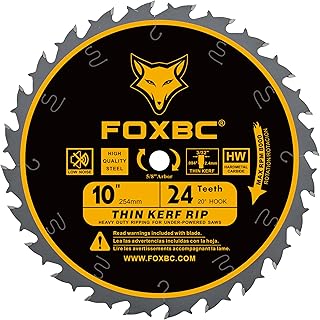
This 10-inch FOXBC blade is designed specifically for ripping with a flat-tooth geometry and a 5/8-inch arbor. The thin kerf helps reduce waste and delivers smoother feed on table saws. Best for users focusing on straight, long cuts in plywood and softwoods, with a note that rigidity can improve with a slower feed rate.
Best for: cabinet makers and builders who rely on straight, repeatable rips across large panels.
Limitations: The blade’s flush flat-tooth design may be less forgiving on figured woods or highly aggressive ripping tasks compared with heavier carbide-coated options.
CMT Orange Tools 285.624.10 Ripping Blade

This CMT 285.624.10 is built for ripping with a robust 24-tooth arrangement and a 0.126″ kerf, providing faster material removal for long, straight cuts. Best for users who routinely cut large boards and sheets where speed and efficiency matter. The flat-tooth approach helps reduce tear-out in many woods.
Best for: professional shops and serious hobbyists needing efficient long-rip performance.
Limitations: Slightly wider kerf compared with ultra-thin blades can produce more waste on very tight tolerances.
Freud LU83R010 Industrial 50T Thin Kerf
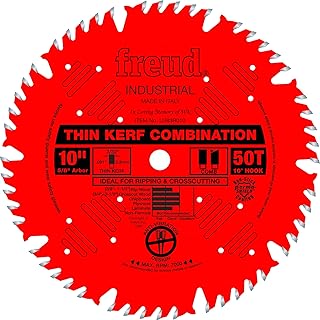
Freud LU83R010 uses TiCo high-density carbide and a thin kerf for smoother cuts with reduced waste. The blade is designed for a combination of performance and longevity, featuring non-stick Perma-Shield coating and anti-vibration slots to minimize chatter. Best for finish carpentry and cabinetry tasks where clean faces matter.
Best for: woodworkers who want a premium blend of durability and cut quality for mixed cuts.
Limitations: Premium blade materials can come at a higher cost; for simpler jobs, a standard blade may suffice.
Freud LM72R010 Heavy-Duty Rip Blade

Freud LM72R010 is built for heavy-duty ripping with a 0.126″ kerf and a 24-tooth configuration. The TiCo Hi-Density carbide ripping blend is designed to maximize performance during long rips and in dense woods. Best for contractor-grade work and shop floors where reliability and consistency matter most.
Best for: professional use where aggressive ripping and stability are critical.
Limitations: The texture and kerf may not be ideal for precision crosscuts on highly finished panels; consider a dedicated crosscut blade for that task.
Buying Guide: Flat-Tooth Blade Essentials
What is a flat-tooth blade and when should you use it?
A flat-tooth blade features teeth arranged to minimize tear-out by delivering smooth starts and steady cuts in wood. It is typically chosen for ripping and crosscutting where finish quality matters, especially on less dense or well-prepared boards. Look for blades with carbide teeth, thin kerf designs, and anti-vibration features for best results.
What blade geometry should I prioritize?
- Flat-tooth with ATB or similar edge geometry reduces chipping on face veneer and figured woods.
- Thin kerf reduces waste and requires less power, but may wear faster under heavy loads.
- Tooth count matters: fewer teeth for fast ripping; more teeth for finer crosscuts.
Which features affect durability and cut quality?
- TiCo or Hi-Density carbide blends extend blade life in demanding tasks.
- Non-stick coatings help accumulate less resin and sap, improving longevity.
- Anti-vibration slots reduce chatter for a truer cut and less heat buildup.
How to match blades to projects?
- Choosing for cabinetry or plywood work: opt for blades with a thin kerf and precision grind for clean edges.
- For dense hardwood ripping: prefer blades with robust carbide and ample tooth geometry to prevent binding.
- For general shop use: a versatile blade with both rips and crosscuts provides flexibility without changing blades.
Maintenance and safety tips
- Keep blades clean and free of resin buildup to preserve performance.
- Inspect for chipped teeth and replace when necessary to avoid kickback.
- Use appropriate speed and feed rates to prevent heat damage and warping.
Buyer-oriented comparison at a glance
- Best all-around blade: CMT 256.050.10 for mixed tasks and versatility.
- Best for dedicated ripping: FOXBC and Freud LM72R010 for aggressive rips with reliability.
- Best premium blend: Freud LU83R010 for a balance of finish quality and durability.
Frequently asked questions
- What is the advantage of a flat-tooth blade over a standard blade? The flat-tooth design can reduce tear-out in many woods and provide smoother rips with steadier starts.
- Is a thinner kerf better for all projects? Thinner kerf waste less material and reduces load but can wear faster under heavy use.
- Should I use different blades for plywood vs solid wood? Yes. Plywood often benefits from a blade with a fine finish and reduced tear-out, while solid wood may require a blade optimized for ripping.
- How important is a carbide blend? Carbide blends like TiCo improve blade life and cut quality under varied conditions.
- When should I replace a blade? Replace when teeth are chipped, dull, or the cut quality declines or the blade vibrates excessively.
- Do blades require special maintenance? Clean after use, inspect for damage, and store properly to extend life.