Answering the search intent for reliable, fast-charging solar generators, this guide highlights units that balance rapid recharging, multiple output options, and portability. The top picks cater to campers, RV travelers, emergency prepers, and tiny-home travelers who need quick recharging and flexible power. Below, you’ll find a quick buyer summary and five detailed product sections to help you compare performance, suitability, and limits at a glance.
| Product | Best For | Key Benefit |
|---|---|---|
| MARBERO Portable Power Station 88Wh | Lightweight outdoor use | Slim design with eight outputs |
| EBL Portable Power Station 1000W | Home backup and camping | High power with fast charging options |
| Jackery Solar Generator 1000 v2 | Off-grid living | Large capacity with fast charge option |
| EnginStar Portable Power Station | Compact emergency kit | Integrated 60W solar panel and multiple ports |
| Anker SOLIX C1000 Gen 2 | Emergency and travel | Ultra-fast recharge and robust output |
MARBERO Portable Power Station 88Wh
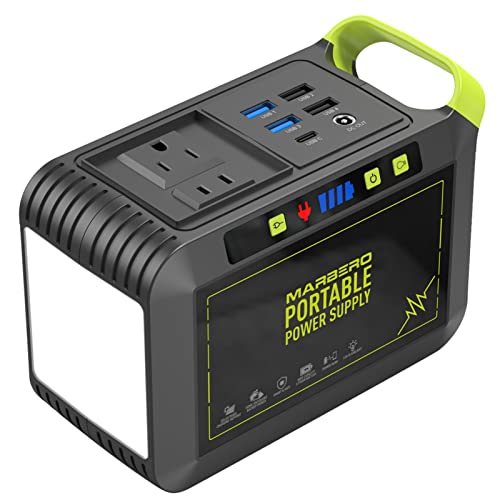
The MARBERO unit emphasizes compact portability with eight simultaneous outputs. It charges from 0 to 80% in about 2 hours using the included adapter and can also run on MARBERO’s 30W or 60W solar panels. This model is best for short trips, light-duty electronics, and users who prioritize a small, easy-to-carry power bank for camping or backyard use. A built-in BMS supports safety across multiple ports. Caution: While portable, its smaller battery capacity means it won’t run high-wattage appliances for long periods.
Best for outdoor portability and quick recharges
- 8 output ports support phones, tablets, laptops, and small appliances
- Lightweight with ergonomic handle and compact dimensions
- SIMPLY plug-and-play with compatible MARBERO solar panels
EBL Portable Power Station 1000W

The EBL model targets users needing substantial capacity and robust output. It provides a 1000W continuous rating with 999Wh capacity, plus a wide array of ports including USB-C, USB-A, and classic 12V outlets. Solar charging is supported, and pass-through charging allows running devices while recharging the unit. Best for campers, home backup, and RV use where higher wattage devices may need steady power. Caution: Solar charging effectiveness depends on sun conditions and panel specifications.
Best for high-demand devices and flexible charging
- Large capacity supports TVs, lights, small appliances
- Pass-through charging enables simultaneous use and recharge
- Multiple ports reduce need for extra adapters
Jackery Solar Generator 1000 v2

Jackery’s 1000 v2 blends portability with substantial power. It features 1,500W AC output (3,000W surge) and 1,070Wh capacity, with a focus on durable LiFePO4 chemistry and a lighter build for its capacity. One-hour fast charging is possible via emergency charging in the Jackery app, while other charging paths include a more deliberate 3-hour solar or alternator option. Best for off-grid living and emergencies where a reliable high-capacity system matters. Caution: Higher capacity means larger size and weight compared to ultra-light models.
Choose this if you need reliable power endurance
- High continuous and surge output supports larger appliances
- One-hour fast charging option via emergency mode
- LiFePO4 battery delivers long cycle life
EnginStar Portable Power Station

EnginStar emphasizes a compact footprint with a built-in 60W solar panel. At 296Wh and 300W output, it suits quick outdoor needs, camping, and emergency backups where portability matters most. It offers multiple ports, including USB-C and USB-A, plus a 110V pure sine wave AC outlet set. Best for ultralight travelers and quick-recharge scenarios. Caution: The included solar panel is modest; expect slower solar recharging in less-than-ideal sun conditions.
Best for ultralight and quick-turnaround use
- Carry-friendly size and weight
- Solar panel included for convenient outdoor charging
- Pure sine wave output protects sensitive electronics
Anker SOLIX C1000 Gen 2

Anker’s SOLIX C1000 Gen 2 emphasizes ultra-fast charging and strong reliability. It can deliver 2,000W continuous output (3,000W surge) and 1,024Wh capacity, with 49-minute recharge under optimal conditions. It supports two-way 140W USB-C charging and multiple ports for broad device compatibility. Best for emergencies, travel, and home backup where rapid recharging and dependable power are critical. Caution: The fastest recharge often depends on an adequate power source and proper settings via the app.
Best for quick top-ups and multi-device use
- Very fast recharging and high-output ports
- Balanced weight for its capacity
- Two-way USB-C charging boosts versatility
Buying Guide: What to Consider When Choosing a Fast-Charging Solar Generator
- Power needs: Evaluate your essential devices and total wattage. Look for higher continuous watts for appliances like mini-fridges or CPAP machines.
- Battery chemistry and longevity: LiFePO4 cells offer longer life and stability for frequent cycling. Consider estimated cycles and depth of discharge.
- Charging options: Prefer models with multiple input methods (AC, USB-C PD, car, solar). Fast-charging paths reduce downtime between uses.
- Solar panel compatibility: Some units include panels; others require separate panels. Check voltage, amperage, and MPPT support for efficient sun charging.
- Port variety and topology: Ensure a mix of AC outlets, USB-C PD, USB-A, car ports, and DC outputs to handle diverse devices without adapters.
- Portability and form factor: Weigh capacity against weight and handle design. Smaller units excel for trips; larger ones suit trailers and homes.
- Safety features: Look for BMS protection, overcharge/overdischarge, temperature safeguards, and short-circuit protection for peace of mind.
FAQ
- What does “fast charging” mean on a solar generator?
It refers to rapid recharging via high-widelity input paths, such as high-wattage AC adapters or high-power USB-C PD ports, allowing the unit to reach a large percentage quickly.
- Do solar panels always improve charging speed?
Solar panels help, but speed depends on sun conditions, panel wattage, and the generator’s MPPT efficiency. Clear sun yields faster solar charging.
- What size battery do I need for weekend camping?
That depends on devices used and duration. A 600–1,000Wh range covers lights, phones, small appliances, and basic electronics for several hours.
- Is LiFePO4 better than lithium-ion for portable power?
LiFePO4 offers longer cycle life and stability, which can translate to longer overall lifespan for repeated use in outdoor settings.
- Can I run a refrigerator from a solar generator?
Many models can power small fridges, but check the wattage rating and surge capacity. Choose a unit with ample continuous watts for reliable operation.