The following article highlights five top electric generator motor kits that are well-suited for hands-on STEM learning, classroom demonstrations, and DIY projects. Each kit offers a different balance of components, educational value, and ease of use, helping learners see electric generation in action—from basic hand-crank designs to motor-driven configurations. This guide compares key features to help educators, students, and hobbyists choose the right kit for experiments, projects, and science fairs.
| Product | Brand | Key Benefit |
|---|---|---|
| EUDAX 6 Set Mini Generator Motors Kit | EUDAX | Multiple voltage ranges; wind, sun, or manual power options |
| Thames & Kosmos Motors & Generators Kit | Thames & Kosmos | Guided experiments; transparent motor insight |
| Dowling Magnets Electric Generator Kit | Dowling Magnets | Motor-generator pair and experiments aligned to standards |
| CrocSee Micro 3 Phase AC Generator Kit | CrocSee | Three-phase learning with adjustable output |
| SAFIGLE Hand Crank Generator Kit | SAFIGLE | Portable, classroom-friendly, hands-on energy conversion |
Electric generator motor kits provide practical demonstrations of energy transformation, circuit behavior, and electromagnetism. This article profiles five relevant kits, drawing on their listed features to illustrate how each can fit different curricula—from introductory physics to advanced engineering concepts. Readers will find practical usage notes, experiment ideas, and considerations for selecting a kit that aligns with learning goals and safety requirements.
EUDAX 6 Set Mini Generator Motors Kit

The EUDAX kit is designed as a multi-functional beginner’s kit, featuring six mini generator motors, mounting brackets, and multiple propeller configurations. It supports DC voltages of 3V, 4.5V, and 12V, with rated speeds of 1500 RPM, 2500 RPM, and 6500 RPM, respectively. The set includes LEDs and quick connectors to enable immediate demonstrations of lighting LEDs as the motors generate electricity. Notably, the kit emphasizes versatility: wind, gears, pulleys, solar panels, or batteries can drive the motors to generate power, making it suitable for classroom experiments and DIY projects that illustrate energy conversion and basic circuitry.
Key considerations for this kit include voltage-speed relationships and the practical limits of small motors in educational setups. The included manual and LED components help learners visualize real-time results, while the compact dimensions (motor body ~24 mm diameter, ~22 mm height) keep the kit portable for demonstrations and small-group activities. Educators can design activities around determining which input (wind, hand crank, or solar) yields the highest LED brightness under a fixed load, reinforcing concepts of power, voltage, and current in a tangible way.
Thames & Kosmos Motors & Generators Science Kit

This kit presents a structured approach to understanding both electric motors and generators through guided lessons. Students can observe motor operation, then explore how a generator converts motion into electricity. The inclusion of a transparent plastic component allows learners to visualize internal workings, reinforcing concepts of electromagnetic induction, back-EMF, and coil/magnet interactions. The curriculum-style format—featuring 25 guided experiments—supports independent study, small group activities, and teacher-led demonstrations, while accommodating a range of grades typical for STEM education.
Considerations for use include the pacing of experiments to synchronize with lesson plans and whether the transparent components provide enough visibility for all learners. The kit’s age range (grades 3–6) aligns with elementary to early middle school curricula, making it a practical entry point for fundamentals of electricity and magnetism before progressing to more complex electronics projects.
Dowling Magnets Electric Motor Generator Kit

The Dowling Magnets kit focuses on exploring both motors and generators with hands-on projects that emphasize magnetism and electrical circuits. It includes several generator and motor configurations, a detailed teacher-tested guide, and alignment with Next Generation Science Standards. Learners can build a motor-generator pair, experiment with speed control, and power an LED, gaining practical insights into how electrical energy is produced, stored, and used. The kit’s emphasis on comprehensive instructional material makes it well-suited for school labs and structured home-learning environments.
Educational value centers on magnetism fundamentals, circuit design, and energy transfer. Because the guide is designed by an award-winning science educator, it can support standardized science objectives while enabling exploration beyond the core curriculum. Users should plan for sufficient workspace and consider safety practices when handling magnets and small electronics components during experiments.
CrocSee Micro 3 Phase AC Generator Kit
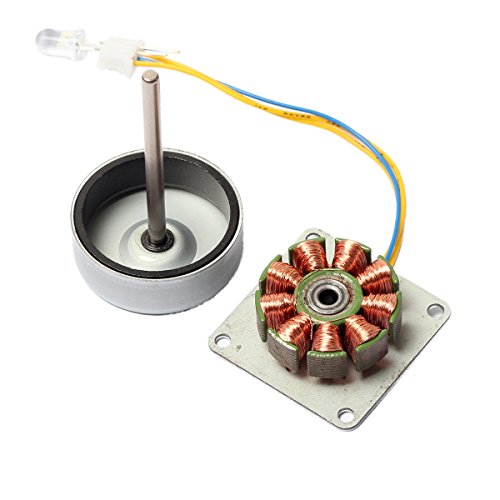
The CrocSee kit introduces a micro 3-phase brushless AC generator model, a compact platform for demonstrating AC generation principles. The kit provides a practical entry point for learning about three-phase output, voltage ranges from 3V to 24V, and current in the range of 0.1A to 1A. This setup is particularly valuable for students and hobbyists who want to explore how multi-phase systems behave under load and how phase relationships influence power delivery. The compact design makes it suitable for desk-top experiments or classroom demonstrations where space is limited.
Considerations include the need to manage a safe load and to understand how three-phase generation differs from single-phase systems. It also offers a gateway into more advanced topics such as synchronous speed, rotor dynamics, and efficiency under varying mechanical inputs. This kit is best used as a stepping stone toward more sophisticated energy conversion projects or STEM demonstrations.]
SAFIGLE Hand Crank Generator Kit

The SAFIGLE hand crank generator is a compact, portable educational tool designed for STEM exploration in classrooms and at home. It demonstrates electromagnetic energy conversion through hands-on operation, with a compact 17.3×8.8×12 cm form factor and a lightweight 120 g build suitable for repeated student use. The kit’s metal gears and impact-resistant plastic construction provide durability for classroom settings, while the included components enable a variety of experiments related to circuits, voltage, and energy relationships. The clear housing offers visibility into internal mechanisms, enhancing the learning experience and making it well-suited for science demonstrations.
Educators can design activities around measuring output under different crank speeds, assessing voltage generated with various loads, and comparing manual generation with motor-assisted methods. The kit’s portability and robust build make it a practical option for rotating science stations or popular science fairs where students showcase energy conversion concepts.
Buying Guide
Key purchase considerations help determine which kit best fits educational goals, classroom constraints, and student age. Consider voltage range, safety, and the type of energy conversion emphasized by the kit (hand-crank, wind, solar, or motor-driven generation).
- Educational scope: Look for kits with guided experiments or teacher resources if the goal is structured learning or standardized alignment.
- Hands-on experience: Choose kits offering multiple configurations (motors, generators, LED demonstrations) to reinforce energy transformation concepts.
- Durability and safety: For classroom use, durable construction and clear safety guidelines reduce maintenance and risk during activities.
- Scalability: Some kits support more advanced experiments, such as three-phase AC or motor-generator combos, which are valuable for longer-term projects or STEM fairs.
- Component quality and availability: Check for reliable gears, magnets, and electrical components, plus availability of replacement parts or add-ons.
When comparing kits, balance instructional depth with practicality. A beginner-friendly option with clear instructions and safe, visible demonstrations is ideal for younger students, while a more feature-rich kit with guided experiments and modular components suits older learners and more ambitious projects. Cross-curricular opportunities—linking physics with engineering, math, and technology—enhance the value of each kit by enabling comprehensive lesson plans that build critical thinking and problem-solving skills.