Finding a dependable home backup power source is essential for outages, outdoor living, and emergency preparedness. This guide highlights five top portable and stationary generators that balance safety, capacity, and convenience for American homes. Each option is evaluated on power output, charging speed, portability, and compatibility with common home appliances.
Overview of chosen products:
- bailibatt Portable Power Station 600W
- Jackery Portable Power Station Explorer 300
- Jackery HomePower 3600 Plus
- Anker SOLIX C1000 Gen 2
- WEN 5600-Watt Portable Generator
Portable Power Station 600W: Bailibatt 293Wh

The bailibatt 600W portable power station delivers a pure sine wave AC output (120V) with a 1200W surge capacity, suitable for essential home appliances under 600W total load. It offers diverse charging options with a 600W AC outlet, PD 100W USB-C, PD 24W USB-C, two fast-charge ports, a car port, and a DC port. Weighing about 7.7 pounds, this compact unit focuses on portability for home backup, camping, and travel. It supports large numbers of recharge cycles, making it a flexible on‑the‑go power source.
Key features in brief: 293Wh lithium battery, grade-A cells, lightweight design, multiple outputs for laptops, drones, cameras, and more. This model is designed to be a reliable backup option during outages or outdoor adventures while remaining easy to transport and use around a home or campsite.
Why consider this for home use
Ideal for powering essential devices during short outages, it complements a home energy plan without requiring a full generator installation. Its multiport approach supports both USB-C and AC devices, which helps charge laptops, smartphones, and cameras quickly.
Jackery Explorer 300: Portable Power Station

The Jackery Explorer 300 provides 293Wh of lithium battery capacity in a compact 7.1-pound frame. It recharges quickly via a 60W PD USB-C port and can reach 80% in roughly two hours from a wall outlet, with additional recharge options through car adapters or compatible solar panels. Two Pure Sine Wave AC outlets ensure safe operation of sensitive electronics, while the unit includes multiple ports (PD 60W USB-C, fast-charge port, USB-A, and DC car port) to handle several devices at once for camping, hiking, or emergency use.
Key features include a lightweight design, safe power delivery, and a portable footprint that fits easily into a car trunk or camping pack. Its balance of capacity and speed makes it a common choice for off-grid outings or as a safe backup for essential electronics during outages.
Why consider this for home use
Great for short-term outages or off-grid mini-homes, especially when space and weight are concerns. The Explorer 300 pairs well with portable solar setups for quiet, emission-free charging in remote or power-challenged environments.
Jackery HomePower 3600 Plus: Home Backup Power

The Jackery HomePower 3600 Plus is designed for substantial home backup, delivering 3600W AC output (7200W when used in parallel) and 3584Wh of capacity, expandable to as much as 21kWh per unit (up to 43kWh with multiple units). It is built for reliability during extended outages and heavy-duty tasks like pumps, heaters, and large appliances. The system emphasizes safety with high-temperature resistance and a long cycle life, offering thousands of cycles and potential multi-unit configurations for larger homes or off-grid living.
Key attributes include dual-voltage operation and an easy plug-and-play design with modular expansion via MTS (module transfer systems). This unit targets households seeking robust, scalable backup power without complex installation, suitable for kitchens, living areas, and essential utilities during emergencies.
Why consider this for home use
Best for households needing serious, long-duration backup power. Its expandability and high power rating suit RVs, cabins, or homes in areas with frequent outages or high energy demand during emergencies.
Anker SOLIX C1000 Gen 2: Fast Recharge & High Capacity
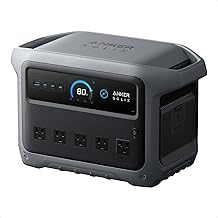
The Anker SOLIX C1000 Gen 2 delivers 2,000W continuous output with a peak of 3,000W and a 1,024Wh LiFePO4 battery. It features ultra-fast charging at up to 1,600W, enabling rapid recharging for outages or trips. The unit supports multiple ports for powering up to ten devices simultaneously and is designed to be compact and portable for use around the home or in a vehicle. Optional solar panels extend its off-grid capabilities, making it a versatile option for emergency preparedness and remote work setups.
Highlights include fast recharging, robust power output, and portability. The LiFePO4 chemistry provides enhanced thermal stability and longer lifespan, which is beneficial for frequent use in home backup scenarios and outdoor activities alike.
Why consider this for home use
Suitable for households that need reliable high-power backup with fast recharging and room for multiple devices. Its modular and portable design allows flexible placement in a home, workshop, or recreational vehicle.
WEN 5600-Watt Portable Generator: Electric Start

The WEN 5600-Watt Portable Generator combines strong performance with safety features, offering 5600 starting watts and 4500 running watts. It features electric start for quick ignition and a CO shutdown sensor to automatically shut off power if dangerous carbon monoxide levels are detected. This model is designed for home backup, RVs, and job sites requiring reliable power with a safeguard against CO exposure. It is suitable for running essential appliances, power tools, and lighting during outages or remote work scenarios.
Important considerations include the balance between startup power and continuous load, noise levels, and fuel management. The built-in safety feature provides peace of mind for family use, while the electric start improves ease of use during emergencies or busy days.
Buying Guide: Key Considerations For Choosing Home Power Solutions
- Power needs and output: Assess the total wattage of devices you plan to run during an outage. Pure sine wave inverters protect sensitive electronics; ensure your choice matches your load.
- Type and design: Portable power stations (battery-based) are quiet, emission-free, and ideal for short outages and camping. Gas generators offer higher sustained power but require fuel and produce noise and emissions.
- Battery chemistry and lifespan: LiFePO4 and other lithium chemistries offer longer cycle life and better thermal stability, which contributes to longevity and safety in home use.
- Recharge options: Consider wall charging, car charging, and solar recharging to fit your energy independence goals and location constraints.
- Expandability: For larger homes, consider modular systems or units that can be linked or expanded to increase total capacity.
- Safety features: Look for built-in CO detectors, automatic shutoffs, and proper venting for gas generators to protect occupants during outages.
- Portability and space: If you need to move the unit around the house or travel, prioritize lighter, more compact models with convenient carrying handles.
- Durability and warranty: Check materials, build quality, and the manufacturer’s warranty terms to ensure long-term reliability.
- Noise considerations: While gas generators are louder, many inverter generators are designed for quieter operation; consider the environment where it will be used.
- Cost of ownership: Include fuel, maintenance, battery replacement cycles, and potential solar charging investments when evaluating total cost of ownership.
In summary, selecting the right home power solution depends on your power requirements, environmental preferences, and how you plan to use the unit. Battery-powered options offer clean, quiet backup for essential devices and short outages, while higher-capacity generators provide more continuous power for larger loads or longer outages. Consider a mix of a primary portable power station for daily use and a larger backup generator for whole-house resilience if your needs justify it.