If you need portable, clean power that works with gasoline or propane, a dual-fuel inverter generator is a strong choice. These models balance quiet operation, efficient fuel use, and safe power for electronics. This guide highlights five solid options and who they’re best for, plus a buying guide to help you compare features like wattage, noise, and runtime. The top picks cover a range from compact daily-use units to higher-watt RV-ready machines. A quick summary table follows to aid quick comparison for decision-making.
| Product | Best For | Key Benefit |
|---|---|---|
| WEN 2800-Watt DF280iX | Campers and backyard power | Compact, quiet, dual-fuel versatility |
| WEN 3600-Watt DF360iX | Small RVs and silent neighborhoods | Very quiet with robust dual-fuel power |
| WEN 4800-Watt DF480iX | RVing and home backup | Higher running power, still inverter and quiet |
| WEN 6800-Watt DF680iX | Vehicle charging and larger loads | Higher surge and parallel-ready option |
| ERAYAK 4500W Dual-Fuel | Balanced weight and capacity | Compact design with dual-fuel flexibility |
WEN 2800-Watt DF280iX Dual-Fuel Inverter Generator

The DF280iX runs on gasoline (2800 surge / 2250 rated watts) or propane (2800 surge / 2000 rated watts). It produces clean power safe for smartphones, tablets, and laptops. A built-in CO watchdog automatically shuts off the unit if carbon monoxide levels become dangerous.
Best for: hikers, campers, and small outdoor setups needing light-to-moderate backup power with quiet operation. Caution: the propane running watts are lower than gasoline; plan accordingly if you expect long propane runs.
WEN 3600-Watt DF360iX Dual-Fuel Inverter Generator

This unit provides 3600 surge watts and 2900 running watts on gasoline, and 3500 surge / 2600 running on propane. It’s noted for extremely quiet operation comparable to a normal conversation and is well-suited for quiet neighborhoods, camping, and RV use with sensitive electronics protected by its inverter technology.
Best for: those who require very low noise while powering essential electronics. Caution: higher wattage than ultra-light models, so consider weight and transport needs.
WEN 6800-Watt DF680iX Dual-Fuel Inverter Generator

With 6800 surge watts and 5100 running watts on gasoline (through a 224cc dual-fuel engine), this model is built for heavier loads. It includes a bonded-neutral 240V configuration for low-power Level 2 charging of EVs and other devices. A CO shutdown sensor enhances user safety.
Best for: campers or small shops needing reliable higher-power supply and EV-friendly charging. Limitation: heavier and larger than smaller WEN models, reducing portability.
PowerSmart 3800 Watt Dual Fuel Inverter Generator
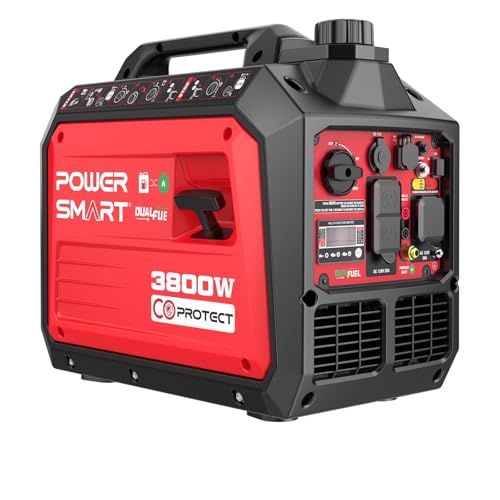
PowerSmart’s 3800-watt dual-fuel engine delivers 3300 running watts on gasoline and 3100 running watts on propane. It runs up to 10 hours on gas and up to 25 hours on propane, with a quiet operation level around 65 dBA at 23 feet. It’s designed for home backup, camping, and tailgating, producing clean power for electronics.
Best for: budget-conscious buyers who need longer propane runtime and quiet operation. Caution: ground clearance and weight should be checked for vehicle storage and portability.
Champion Power Equipment 4000-Watt DF-RV Dual Fuel

Champion’s 4000-watt dual-fuel model delivers 4000 starting and 3000 running watts on gasoline, plus 2700 running and up to 25 hours on propane. It features CO Shield auto shutoff and ultra-quiet operation at 64 dBA from 23 feet. A parallel kit option allows connecting with other units for more power.
Best for: RV users and home backup who want quiet operation and potential expansion. Limitation: requires separate parallel kit for extra power, which is an added cost.
WEN 5600X DF5600X Dual Fuel Portable Generator

The DF5600X offers 5600 surge watts and 4500 running watts on gasoline, plus 5000 surge and 4050 running on propane. Electric start adds convenience, and CO watchdog ensures safety. This model is appropriate for larger power needs and longer runtimes.
Best for: users needing substantial power with electric start and safety features. Caution: higher weight and longer run times may affect portability.
Buying Guide: Choosing Your Dual-Fuel Inverter Generator
What wattage do you need?
Match surge watts to the starting requirements of appliances and tools. If you expect to run refrigerators, power tools, or multiple devices simultaneously, opt for models in the 3000–6000 surge watt range with 2600–4500 running watts.
How important is noise?
Inverter generators are designed for quieter operation. If you’ll use the unit in neighborhoods, campsites, or around RVs, choose models noted for low dBA levels at a comfortable distance (e.g., 64–65 dBA or quieter typical for conversation level).
Propane vs gasoline?
Gasoline offers higher power but shorter runtimes; propane provides longer bar-of-fuel availability and cleaner burning. If you rely on long outages, propane can be a practical backup fuel. Consider dual-fuel units that switch fuel sources automatically or manually without interruption.
Portability and storage considerations
Weight and dimensions affect transport. For tailgating or camping, lighter units under 60 pounds are easier to handle. For home backup, consider wheels and handles for easier deployment, and check if a wheel kit is included or sold separately.
Safety features
Look for CO sensors and auto shutdowns, spark arrestors, and proper grounding. Inverter technology should deliver clean power with low total harmonic distortion (THD) to protect sensitive electronics.
Expansion potential
Some models offer parallel capabilities to connect with another inverter or a power station for extra capacity. If you anticipate higher loads later, this can be a valuable upgrade path.
Frequently Asked Questions
- What is the advantage of a dual-fuel inverter generator? It lets you run on gasoline or propane, providing flexibility during fuel shortages and extended outages while delivering clean power suitable for electronics.
- Are dual-fuel inverters suitable for RV use? Yes. Many models are RV-ready or RV-friendly with appropriate outlets and quiet operation, making them suitable for camping and travel.
- What does “inverter” mean for power quality? Inverter technology converts DC to stable AC with low THD, helping protect computers, phones, and sensitive devices from voltage fluctuations.
- Is parallel capability worth it? If you foresee needing more power later, parallel kits allow you to couple multiple units to boost capacity, but this adds cost and complexity.
- How should I store a dual-fuel generator for winter? Store away from moisture, follow fuel stabilization guidelines, and run the unit briefly before use to ensure fuel lines are clear.
- How do I calculate running time? Runtime depends on load and fuel type. Higher loads reduce runtime; lighter loads extend it. Check the manufacturer’s specifications for each fuel option.