Choosing a dual fuel RV generator can ensure you have reliable power whether you’re camping off-grid or plugged in at a campground. Dual fuel models run on gasoline or propane, offering flexibility and peace of mind. This guide highlights five top options, balancing wattage, noise, and safety features to help you compare effectively and find the right match for your RV and lifestyle.
| Product | Fuel Options | Key Benefit | Approximate Power |
|---|---|---|---|
| WEN DF360iX | Gas & Propane | Ultra-quiet, RV-ready inverter with CO watchdog | 3600 surge / 2900 running (gas) |
| WEN DF5600X | Gas & Propane | High output with built-in CO shutdown | 5600 surge / 4500 running (gas) |
| WEN DF480iX | Gas & Propane | Compact, quiet inverter with strong surge | 4800 surge / 4000 running (gas) |
| PowerSmart 3800 | Gas & Propane | RV-ready with 30A outlet and CO protection | 3800 starting / 3300 running (gas) |
| Westinghouse 4000 Dual Fuel | Gas & Propane | Remote start option with CO sensor | 4000 peak / 3300 running (gas) |
WEN DF360iX Dual Fuel RV-Ready Inverter

The WEN DF360iX provides dual-fuel flexibility with gasoline and propane compatibility. It delivers up to 3600 surge watts and 2900 running watts on gasoline and 3500 surge watts and 2600 running watts on propane. The unit is designed for quiet operation, with noise levels comparable to normal conversation, helping maintain a peaceful campsite. It also outputs clean power suitable for sensitive electronics such as smartphones, tablets, and laptops, reducing the risk of damage during use. A CO watchdog enhances safety by monitoring carbon monoxide levels and shutting down the engine if dangerous conditions arise.
WEN DF5600X Dual Fuel Portable Generator

The WEN DF5600X offers a robust dual-fuel design with gasoline and propane compatibility, delivering 5600 surge watts and 4500 running watts on gas, and 5000 surge watts with 4050 running watts on propane. It features electric start for quick power restoration and includes the CO Watchdog sensor to automatically shut off the unit if carbon monoxide is detected, enhancing family safety during RV trips or outdoor events. This model is suitable for higher-demand RV setups or backup power scenarios where more continuous output is needed.
WEN DF480iX Quiet Dual Fuel Inverter

The DF480iX is a compact, RV-ready inverter generator that runs on gasoline or propane, delivering 4800 surge watts and 4000 running watts on gas, with propane figures at 4320 surge and 4000 running watts. Its quiet operation level mirrors everyday conversation, aiding in maintaining a peaceful campsite environment. Like other WEN units, it provides clean power for electronics and includes safety features such as a CO watchdog for automatic shutdown under unsafe conditions. This model is ideal for mid-range RV power needs and portability.
PowerSmart 3800 Dual Fuel Inverter
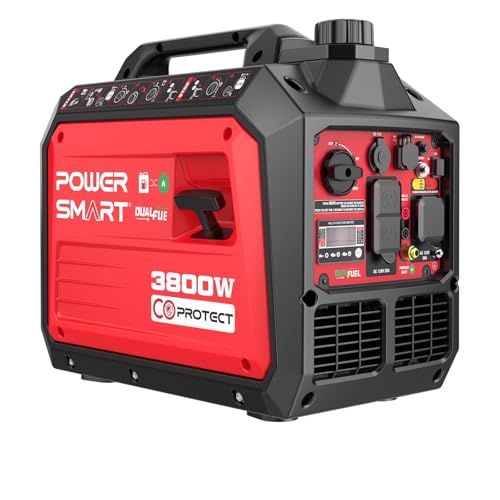
The PowerSmart 3800 inverter generator provides dual-fuel capability with gasoline starting watts of 3800 and running watts of 3300, and propane performance of 3500 starting watts and 3100 running watts. It includes a 30A outlet suitable for RV applications and emphasizes calm operation at about 59 dBA at 50% load. A CO protection system helps prevent hazardous exposure, and its dual-fuel design supports longer operation off-grid when campground fuel options are limited or when you want to maximize runtime.
Westinghouse 4000-Watt Dual Fuel Portable Inverter

The Westinghouse 4000-watt dual fuel inverter offers flexible gasoline and propane operation with a remote start option and CO sensor support. With 4000 peak watts and 3300 running watts on gas, it is designed to handle a wide range of RV appliances and devices. The unit emphasizes convenience, featuring a remote start capability and multiple outlets for versatile power distribution. It is positioned as a reliable choice for campers who value easy startup and safety features alongside solid runtime.
Buying Guide: Key Purchase Considerations for Dual Fuel RV Generators
- Power needs and outlet selection: Determine your essential RV loads (air conditioning, refrigerator, water heater, lights, and electronics). Look for models with enough surge wattage to handle startup surges and with RV-friendly outlets, such as a 30A RV outlet, in addition to standard 120V outlets.
- Fuel options and availability: Dual-fuel units offer gasoline and propane compatibility, increasing flexibility for prolonged trips or availability of fuel at campgrounds. Consider how easy it is to change fuels and the current state of the fuel systems (carburetion, purge requirements).
- Noise and comfort: Noise levels at typical campsite distances matter for comfort and compliance with campground rules. Compare dBA ratings at a standard distance (e.g., 23 feet) to choose a unit that minimizes noise impact.
- Safety features: Look for CO sensors or CO shutdown, automatic idle control, and low-oil shutoff. These features protect occupants and the generator itself when used in enclosed or semi-enclosed spaces.
- Starting mechanism and convenience: Electric start is convenient for quick startups, while recoil start remains a reliable backup. Some models offer remote start for added convenience, especially in cold weather.
- Run time and fuel efficiency: Consider run time at a typical load (25–50%). Higher efficiency means longer operation between fills, reducing refueling frequency during trips.
- Portability and maintenance: Weight, wheel kits, and handles affect transportation around campgrounds or storage. Access to spare parts and local service options can reduce downtime in remote areas.
- Parallel capability: If you anticipate needing more power, some models offer parallel kit compatibility to connect multiple units for extended run time and higher total power.
- Safety certifications and warranty: Check for carb-compliant emissions, safety certifications, and warranty length. A solid warranty reduces ownership risk over time.
- Best-fit scenarios: Choose a model aligned with your typical trips—short weekend outings may prioritize portability and quiet operation, while longer adventures may require higher wattage and longer run times.