Finding the right dual fuel inverter generator means balancing power needs with quiet operation, fuel flexibility, and portability. These five models are well-suited for home backup, RV camping, and outdoor activities. They run on gasoline or propane, produce clean power for sensitive electronics, and are designed to minimize noise. This guide highlights who each product is best for and why it’s a smart pick for different scenarios.
Quick-reference buying table:
| Product | Best For | Key Benefit | Notes |
|---|---|---|---|
| WEN DF480iX | RV owners and hobbyists | Quiet, powerful dual-fuel with electric start | CO watchdog safety |
| WEN DF280iX | Lightweight power on the go | Compact dual-fuel, clean power | CO shutdown sensor |
| PowerSmart 3800W | Home backup and camping | Dual-fuel flexibility, long propane runtime | Low-noise design |
| WEN DF360iX | Quiet, daily use power | Balanced wattage, dual fuel | Compact form |
| WEN DF680iX | Higher backup power | High surge watts, RV-ready | CO watchdog safety |
WEN Quiet and Lightweight 4800-Watt Dual Fuel Inverter (DF480iX)

This dual-fuel unit runs on gasoline (4800 surge watts, 4000 rated watts) or propane (4320 surge watts, 4000 rated watts). It is designed for quiet operation and is described as extremely quiet, comparable to a normal conversation. It also provides clean power to protect sensitive electronics like smartphones and laptops. Best for RV use and outdoor activities where low noise is important.
Who it’s best for: RV owners who need reliable power with quiet operation and easy electric start.
Why selected: It delivers robust wattage in a portable package, and its CO watchdog adds a safety net in enclosed spaces. A potential limitation: the dual-fuel fuel efficiency may vary with fuel type and load.
WEN 2800-Watt Dual Fuel Inverter (DF280iX)

This smaller inverter offers dual-fuel flexibility with gasoline (2800 surge watts, 2250 running watts) and propane (2800 surge watts, 2000 running watts). It produces clean power to protect electronics and includes a CO shutdown sensor for safety. Best for light-to-moderate power needs on the go.
Who it’s best for: campers or travelers who want a compact, easy-to-transport unit with essential safety features.
Why selected: Its portability and built-in safety features make it a strong pick for small RVs or camping setups. Caution: lower continuous running watts mean it’s better for smaller loads or occasional power needs.
PowerSmart 3800 Watt Dual Fuel Inverter
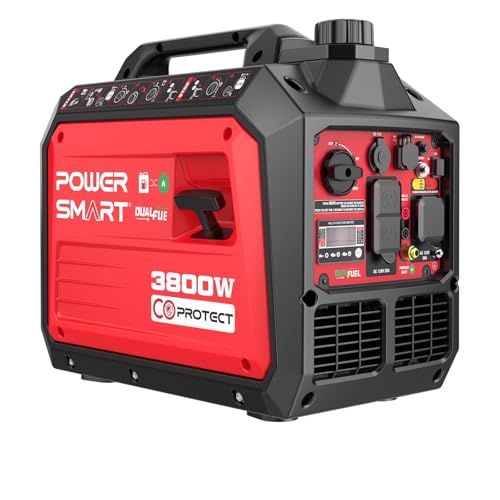
PowerSmart’s 3800-watt inverter supports gasoline (3300 running watts, up to 10 hours) and propane (3100 running watts, up to 25 hours). It emphasizes quiet operation at 65 dBA at 23 feet, suitable for quiet campgrounds or residential areas. Its inverter system provides clean, stable power (less than 3% THD) for devices like CPAP machines and laptops. Best for home backup or extended camping trips where fuel flexibility and quiet operation matter.
Why selected: Higher propane runtimes can be advantageous for longer outages. Caution: slightly heavier than ultra-portable mini-generators, which could affect portability for some users.
WEN 6800-Watt Dual Fuel RV-Ready (DF680iX)

This model provides 6800 surge watts and 5100 rated watts on gasoline, plus 6000 surge watts and 4500 rated watts on propane. It features a bonded-neutral 240V configuration suitable for low-power Level 2 charging, such as certain electric vehicle backups, and includes the CO watchdog safety. Best for users needing higher peak power for longer durations.
Who it’s best for: households or campsites with higher power demands and longer runtimes.
Why selected: Higher power makes it a strong all-around choice for more demanding loads. Caution: larger footprint and weight may reduce portability compared with smaller models.
WEN 5,600-Watt Dual Fuel Portable Generator (DF5600X)

Although not in the five primary picks, it’s worth a mention for high-demand scenarios. It offers dual fuel with electric start and CO watchdog, delivering 5600 surge watts and 4500 running watts on gasoline and 5000 surge watts and 4050 running watts on propane. Best for robust home backup or job sites with greater power needs. Caution: heavier and bulkier to transport compared to smaller portable units.
Buying Guide: How To Choose Your Dual Fuel Inverter Generator
What power level do you need? Start with your load estimate. If you plan to run essentials only, a 2000–3000-watt unit may suffice. For whole-home backup or RV air conditioners, look at 3800–6800 watts or more. Consider surge watts versus running watts to ensure startup loads are covered.
Which fuel source fits your situation? Dual fuel provides flexibility and can reduce running costs by using whichever fuel is cheaper or more available. Propane often offers longer shelf life and cleaner burns, while gasoline generally provides higher energy density and longer runtime for heavy loads.
How important is noise? Inverters are designed for quiet operation. Review dBA ratings at a practical distance (e.g., 23 feet). If you’ll use it in quiet campground zones or close to living spaces, prioritize models with the lowest noise figures.
Safety matters. Look for an automatic CO shutdown sensor (CO watchdog) and ground-neutral configuration options. For RV use, ensure the unit is RV-ready and has appropriate outlets for your setup.
Portability and maintenance. Check weight and wheel configurations if you need to move the unit regularly. Electric start is convenient, but ensure you have a reliable battery or backup crank option. Regular oil changes and fuel management extend lifespan.
Compatibility and future-proofing. If you anticipate expanding power needs or parallel operation, verify compatibility with parallel kits or other brands. Some models support parallel operation to increase total available power for longer run times.
Frequently Asked Questions
- What does “dual fuel” mean? It means the generator can run on two different fuels, typically gasoline and propane, giving you flexibility and extended runtimes when fuel supplies are limited.
- Are dual fuel inverters safe for electronics? Yes. Inverter technology provides clean, stable power with low total harmonic distortion, protecting sensitive devices like phones and laptops.
- What is CO watchdog safety? It is a sensor that automatically shuts the generator off if dangerous carbon monoxide levels are detected, enhancing safety in enclosed or semi-enclosed spaces.
- How loud are these generators? Inverter models are designed for quiet operation, often comparable to normal conversation or ambient campground noise, depending on load and distance.
- Can I run a motorcycle or RV air conditioner with these? Larger models can handle RV air conditioners and higher loads, but always verify the specific wattage requirements and consider parallel configurations if needed.
- Do these require fuel stabilizers? Using fresh fuel and stabilizers can extend storage life and reduce starting issues, especially if stored for long periods.