Answering the question “which solar panel controller should I buy?” this guide highlights five reliable options that cover common needs for 12V and 24V systems. These controllers manage battery charging, protect against faults, and support USB charging for mobile devices. They’re suitable for hobbyists, RVers, small cabins, and DIY off-grid projects. The selections emphasize safety features, ease of use, and compatibility with lead-acid and some lithium chemistries.
Summary of selected products
| Product | Brand | Voltage Type | Best For |
|---|---|---|---|
| [Upgraded] 30A Solar Charge Controller, 12V/ 24V | Depvko | 12V/24V PWM | General off-grid setups; dual USB charging |
| [Upgraded] 30A Solar Charge Controller, Black Solar Panel Battery Intelligent Regulator | Depvko | 12V/24V PWM | Lead-acid systems; compact installs |
| ACEIRMC 2pcs 30A Solar Charge Controller | ACEIRMC | 12V/24V PWM | Two-pack value; lead-acid friendly |
| Renogy Wanderer Li 30A 12V PWM | Renogy | 12V PWM | RV/Marine setups; lithium-ready with safeguards |
| MPPT Solar Charge Controller 12V 10A | SUNAPEX | 12V MPPT | Efficient charging for 12V systems |
Depvko 30A Solar Charge Controller (PWM) 12V/24V

This upgraded PWM controller automatically manages 12V or 24V systems via an internal microcontroller. It memorizes user parameters, so no resets are needed after battery depletion. Dual USB ports enable 5V/2.5A charging for devices. Best for: small off-grid cabins or RV setups relying on lead-acid batteries. Limitation: it is designed for lead-acid chemistries and should not charge lithium or nickel-based packs unless specified.
Depvko 30A Solar Charge Controller (PWM) Black Regulator
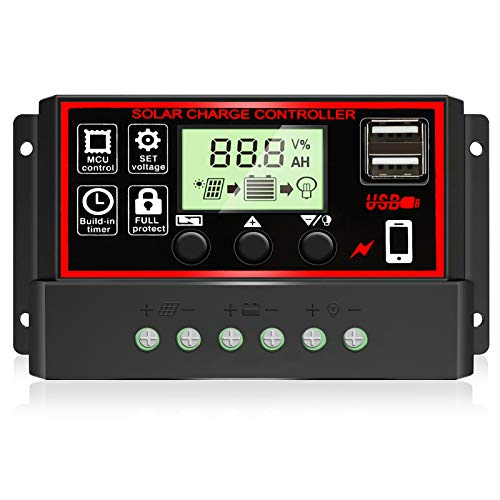
Designed for 12V/24V systems, this model stores user parameters and supports USB charging (5V/2.5A). It uses a three-stage PWM process to protect the battery and improve longevity. Best for: households with open, AGM, or gel lead-acid batteries that need a compact regulator. Caution: do not use with lithium or NiMH packs as this unit is specified for lead-acid chemistries only.
ACEIRMC 2-Pack 30A Solar Charge Controller

Two-pack ACEIRMC controllers offer 12V/24V compatibility with a 30A discharge current and dual USB outputs. The LCD provides clear status and configuration data. Best for: small installations where multiples boards are installed or when a user wants straightforward control and easy mode switching. Limitation: highlights suitability for lead-acid chemistries; the product notes emphasize compatibility with OPEN, AGM, and GEL types.
Renogy Wanderer Li 30A 12V PWM

Renogy Wanderer Li 30A supports 12V systems and is suitable for Li-ion-compatible setups, including LiFePO4 with safeguards. It offers a four-stage charging profile and robust protections (overcharge, reverse polarity, overload, short circuits). Best for: RVs, boats, or off-grid cabins seeking a compact, negative-ground PWM option. Caution: default labeling emphasizes lithium readiness, but ensure your specific lithium chemistry is supported by the controller’s settings.
SUNAPEX MPPT 12V 10A Solar Charge Controller
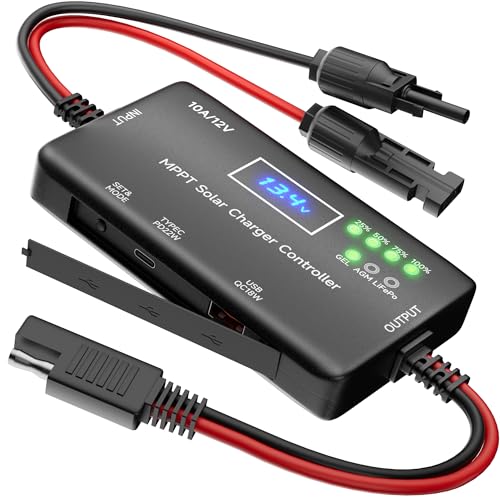
This MPPT controller is designed for 12V systems and does not support 24V configurations. It includes a zero-battery-drain mechanism and safeguards against reverse current flow. Best for: users who want higher efficiency than PWM in 12V setups with simple plug-and-play installation. Limitation: not compatible with 24V systems; polarity must be observed during connection.
ECO-WORTHY 30A Solar Charger Controller with Bluetooth

Equipped with Bluetooth for app-based monitoring, this 30A PWM regulator supports 12V/24V systems and a range of battery chemistries, including lead-acid, gel, lithium, and others. Dual USB ports provide device charging, and auto shutoff protects the battery when voltage drops below 8V. Best for: tech-savvy users who want remote monitoring. Caution: Bluetooth app reliability may vary with devices and environment.
Buying Guide: How to Choose the Right Controller
What type of charging technology do you need?
- PWM controllers are simple and affordable, suitable for lead-acid batteries and moderate solar setups.
- MPPT controllers are more efficient in converting solar power, best for higher panel counts or larger battery banks, especially in cooler climates or variable sun.
What battery chemistry will you use?
- Lead-acid (Open, AGM, GEL) devices are widely supported by PWM and MPPT controllers.
- Lithium (LiFePO4) requires careful compatibility; some PWM units advertise lithium support with caveats.
Voltage and system size matter.
- 13–15V charging windows and 12V/24V automatic adaptation are common features. Choose a regulator matched to your system voltage and panel array size.
- Consider the protection features: overcharge, over-discharge, short-circuit, and reverse polarity.
Additional features to consider.
- USB ports for charging devices in the field.
- Bluetooth or LCD display for easy status monitoring.
- Built-in timers or load control for cycling lights or pumps.
Installation and Safety Tips
- Follow manufacturer wiring diagrams exactly; incorrect polarity can damage the controller or battery.
- Ensure batteries are fully charged during first-time recognition, as some units auto-detect battery type.
- Place controllers in a ventilated, dry area to avoid heat buildup and moisture exposure.
FAQ
- What is the difference between PWM and MPPT controllers?
– PWM is simpler and cheaper, best for small systems with lead-acid batteries. MPPT is more efficient at converting solar power, suitable for larger or hotter environments and broader panel arrays. - Can I use these controllers with lithium batteries?
– Some models claim lithium support; verify the exact chemistry and settings in the manual before connecting. Many controllers are optimized for lead-acid types. - Do I need Bluetooth on a solar controller?
– Bluetooth allows remote monitoring and configuration on some models, but it is not required for operation. - Is a Dual USB port necessary?
– If you plan to charge phones, tablets, or USB-powered devices from the solar setup, dual USB ports provide convenient charging without drawing from the main load. - What safety protections should I look for?
– Look for overcurrent, short-circuit, reverse polarity, low voltage, and overcharge protections to safeguard both the battery and the controller. - Should I choose a negative-ground controller?
– Negative-ground designs are common in RV and marine installations, but ensure your system wiring matches the controller’s ground requirements.