If you’re shopping for an affordable, reliable car battery charger, focus on units that offer true 12V charging, a maintainer mode, and desulfation capabilities. These features help extend battery life and prevent common battery issues in cars, motorcycles, boats, and lawn equipment. The top picks below are suited for budget-conscious buyers who want a compact, easy-to-use charger with clear indicators and automatic shutoff.
Buyer profiles to consider:
– Budget-conscious car owners needing basic maintenance and occasional jump-start support.
– Motorcycle, boat, or ATV owners seeking a versatile 12V solution with desulfation.
– Weekend warriors who store vehicles seasonally and want reliable winter battery care.
– DIY enthusiasts who prefer a compact, simple unit with a clear display and safety protections.
Summary table of selected products
| Product | Best For | Key Feature |
|---|---|---|
| Corebox Battery Charger 6-Amp | All-around maintenance with temp compensation | 7-stage charging with desulfation, temp compensation |
| NOCO Genius1 | Small, versatile 6V/12V solution | Thermal sensor and auto-maintain |
| HECHOBO 12V 2A | Simple, budget-friendly maintainer | LED status indicators, multiple protections |
| TEMOLA Car Battery Charger | Digital display with pulse repair | 7-stage program, pulse repair |
| MOTOPOWER MP00205A | All-weather desulfator with automatic operation | Desulfation, spark-free standby |
Corebox Battery Charger 6-Amp 12V Automatic Smart Charger

Best for: Winter storage and mixed 12V lead-acid batteries. This unit acts as charger, maintainer, trickle charger, and desulfator with temperature compensation, designed to protect batteries during cold months or long vacations. It’s suitable for cars, trucks, motorcycles, lawn mowers, marine, and more.
- 7-stage charging includes desulfation, soft start, bulk charge, analysis, recondition, float, and pulse maintenance.
- Temperature compensation helps prevent overcharging in heat and undercharging in cold climates.
- Protection suite covers reverse polarity, overcurrent, short circuit, and fireproof construction.
Best for: Those who want a single unit that continuously maintains battery health while stored. Caution: Cannot repair a totally dead battery; use the repair mode with realistic expectations.
NOCO GENIUS1: 1A 6V/12V Smart Charger
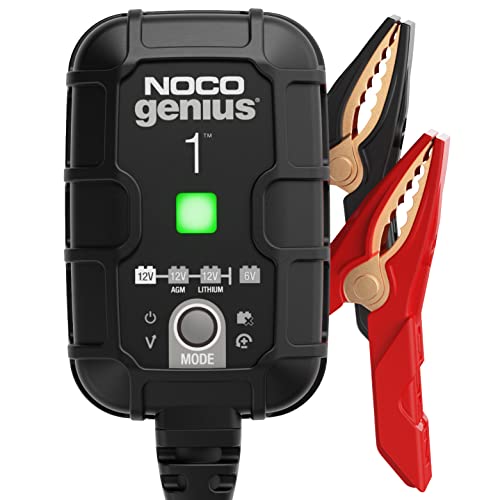
Best for: Small, space-constrained setups needing a compact all-in-one solution. The Genius1 supports multiple battery chemistries, with a thermal sensor to optimize charging automatically and prevent overcharge in hot weather.
- 6V/12V compatibility with a wide range of lead-acid and LiFePO4 batteries.
- Smart protection with temperature compensation and overcharge prevention.
Best for: Users who want a tiny, efficient charger that still provides automatic maintenance. Caution: Not all larger 12-amp or 6-amp features are available in this compact model; it is purposely small and simple.
HECHOBO 12V 2A Battery Charger and Maintainer

Best for: Budget-friendly maintenance for a range of 12V valve-controlled lead-acid batteries. It includes LED indicators to show charging status and a robust shell for safety in household or garage settings.
- Multiple safety protections against reverse polarity and overcurrent/overvoltage scenarios.
- LED indicators provide clear status without guessing.
Caution: Primarily suitable for maintenance and light charging; not designed for heavy cycle charging of deeply discharged batteries.
TEMOLA Car Battery Charger Automatic Trickle Charger

Best for: Vehicles requiring clear, real-time monitoring and a robust pulse repair feature. Suitable for cars, motorcycles, boats, and lawn equipment using 12V lead-acid or LiFePO4 batteries, with a visible display for easy status checks.
- Digital display shows voltage, current, and charging progress.
- Pulse repair function supports mildly sulfated batteries to restore performance.
Best for: Those who value a transparent charging process and a visual readout. Caution: Not recommended for lithium-based batteries unless specified by the manufacturer.
MOTOPOWER MP00205A 12V 800mA Charger

Best for: All-weather maintenance with a focus on desulfation and automatic operation. Designed for 12V lead-acid batteries across cars, boats, motorcycles, and lawn equipment, including AGM and gel cells.
- Automatic desulfation and optimization through pulse technology.
- Spark-free standby mode reduces risk during long-term connections.
Best for: Those who want a resilient, all-season charger that also desulfates. Caution: Lower current makes it slower for larger or deeply discharged batteries; suitable for maintenance rather than rapid charging.
Buying Guide
What should you look for in a cheap car battery charger?
- Voltage compatibility: Ensure the charger supports 12V batteries, and confirm if 6V compatibility is needed for smaller equipment or motorcycles.
- Charging stages: Look for multi-stage charging (at least 3-7 stages) including desulfation and float maintenance to maximize battery life.
- Desulfation capability: Pulsed or desulfation modes can help revive mildly sulfated batteries but may not recover severely damaged cells.
- Temperature compensation: A thermal sensor prevents overcharging in hot weather and undercharging in cold weather.
- Safety protections: Reverse polarity, overcurrent, overvoltage, short-circuit protection, and spark-free operation improve safety during use.
- Display and indicators: A clear digital display or LED indicators helps track progress and status without guesswork.
- Maintenance vs fast charging: Budget units often emphasize maintenance; for large or deeply discharged batteries, a charger with higher current may be preferable.
Which features matter most for different buyers?
- Occasional users who store vehicles: Prioritize maintenance modes, temperature compensation, and automatic shutoff to protect batteries during long gaps.
- Motorcycle or small craft owners: Look for compact designs with reliable desulfation and 6V/12V compatibility.
- Garage or workshop beginners: Choose units with visual displays and straightforward LED indicators for easy understanding.
- Budget-conscious families: Favor units with robust safety protections and versatile battery compatibility to cover multiple vehicles.
How to use these chargers safely and effectively
- Read the manual to confirm battery type compatibility (AGM, Gel, Flooded, etc.).
- Connect to a stable power source and attach polarity correctly before charging.
- Set the appropriate charging mode and monitor progress on the display when available.
- Unplug after charging completes or enable maintenance mode for long-term storage.
Quick FAQ
- Do cheap battery chargers work for all 12V lead-acid batteries?
Yes, most affordable units support common 12V lead-acid types including AGM, Gel, and Flooded, but always check the product’s battery compatibility list. - Can these chargers fix a completely dead battery?
Most cannot revive a totally dead battery; they are designed for maintenance and mild reconditioning of mildly sulfated or aging batteries. - Is desulfation important for battery health?
Desulfation can help restore some battery capacity for older or idle batteries but is not a guaranteed fix for severe damage. - Should I leave a charger connected all winter?
Yes, if the charger has automatic maintenance or float mode, but ensure it has protections against overcharging and temperature compensation. - Are digital displays necessary?
A display makes it easier to monitor status, but many units rely on LED indicators; choose based on your preference for visibility. - Is a higher current charger always better?
Higher current charges faster but may generate more heat; for maintenance and small batteries, a low to mid-range current is typically sufficient.