When you want reliable, fast charging on the go, these car chargers deliver. Each pick is selected for compatibility, speed, and practical use across popular devices from iPhone to Galaxy to tablets. Ideal for commuters, road trippers, and families who rely on mobile devices in transit.
Summary of selected products
| Product | Best For | Key Benefit |
|---|---|---|
| KENHAO 67W 3-Port Car Charger | Power users with multiple devices | High total wattage with 2 USB-C outputs and a USB-A port |
| LISEN Retractable Car Charger 84W | Cords management and 4-device charging | Retractable USB-C and USB-A cables, multiple ports |
| BERTHALESS Retractable 4-in-1 | Family trips and organization | Extendable cables with four ports, tidy center console |
| LISEN 69W Car Charger | Balanced power and minimal clutter | Dual-port design with smart distribution |
| JUNVANG 90W 4-Port Car Charger | High-speed loading for multiple devices | One of the higher outputs with 4 ports and fast cable |
KENHAO 67W 3-Port Car Charger USB C Fast Charge

Best for drivers who need multi-device power without sacrificing port availability. This 67W three-port charger combines USB-C PD up to 37W and USB-A QC up to 30W, enabling simultaneous fast charging for newer smartphones, tablets, and even some laptops. The all-metal housing aids heat dissipation for durability on long trips. Suitable for families with iPhones, iPads, and Android devices. Caution: Higher output can produce heat under heavy use; ensure installation in well-ventilated car outlets.
LISEN Retractable Car Charger, 84W

Best for drivers who value cable management and compact organization. The retractable design includes two cables (USB-C and older iPhone cable) plus dual USB ports, enabling up to four devices charged simultaneously. It’s compatible with most standard 12V sockets and excels for daily commutes or road trips. Limitation: It does not support CarPlay or data transfer, so it’s strictly a charging solution.
BERTHALESS Retractable 4-in-1

Best for families and shared rides, this 4-in-1 retractable charger uses two extendable lines plus USB-A and USB-C ports to support four devices at once. The retractable cables help reduce clutter and prevent tangling in the console. Caution: Check compatibility with older vehicle models if you rely on very long extensions, and note that retractable cables may require some tension to extend fully.
LISEN 69W Car Charger with USB-C

Best for users seeking a balanced, clutter-minimizing setup. This charger splits power between USB-C and USB-A ports to deliver solid performance across popular devices. It emphasizes safe charging with distributed load to reduce heat. Limitation: One port’s output may limit if both ports are utilized at maximum simultaneously; plan device power needs accordingly.
JUNVANG iPhone 17/16 Car Charger 90W
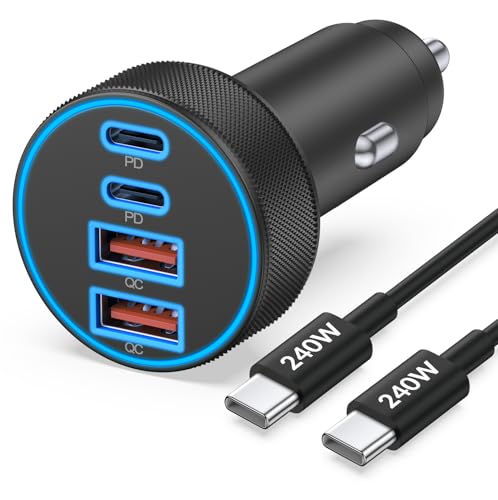
Best for high-speed loading across multiple devices in one trip. The 90W multi-port configuration supports PD and QC fast charging capabilities, including a 240W cable option in some variants. This model enables fast charging for iPhone, iPad, and many Android devices, plus a built-in coiled cable to minimize cable clutter. Caution: The higher output can generate heat; ensure proper venting and avoid covering the device while charging.
SUPERONE Retractable Car Charger 4-in-1

Best for travelers who want built-in cable management and versatile charging. This model features two extendable cables and four ports, including a real PD30W Type-C retractable cable for fast charging. A voltage display helps monitor battery health. Caution: The device is optimized for charging only; CarPlay functionality is not supported by design.
Buying Guide
Key considerations when choosing a car charger:
- Power and port mix: Decide if you need USB-C PD, USB-A QC, or both. Higher wattage allows faster charging for devices like iPhones, iPads, and newer Android phones.
- Number of devices: If multiple passengers charge at once, a multi-port charger with 4 ports can reduce the need for additional adapters.
- Cable management: Retractable cables minimize clutter and reduce dashboard hazards. Ensure cables are long enough for your seating position.
- Vehicle compatibility: Most car chargers fit standard 12V cigarette lighter sockets; check any car-specific power limitations for high-wattage loads.
- Heat management: High-output chargers can heat up; prefer models with good heat dissipation and safety protections against over-current and over-temperature.
- Safety protections: Look for over-current, over-voltage, short-circuit, and temperature protections. Automatic shutoff helps protect devices and the charger.
How to choose by use-case:
- Daily commuting: A compact dual-port or 3-port charger with USB-C PD is ideal for phones and a tablet.
- Road trips with families: A retractable 4-port solution reduces cable clutter and can charge multiple devices at once.
- High-speed charging needs: A 90W-class charger or higher with multiple USB-C ports is best for newer devices and laptops.
- Organization-focused drivers: Retractable cables and integrated cable management help keep the center console tidy.
FAQ
- Do car chargers support both USB-C and USB-A at the same time?
Yes. Many models offer USB-C and USB-A ports simultaneously to charge different devices at full speed. - What is PD, and why does it matter for car charging?
PD stands for Power Delivery, a fast-charging protocol that optimizes power transfer for compatible devices, accelerating charging on USB-C ports. - Are retractable car chargers more durable?
Retractable cables help prevent tangling and improve organization, potentially reducing wear on cables in daily use. - Can high-wattage car chargers cause overheating?
Higher wattage can generate more heat. Choose models with proper heat dissipation and protection circuitry to minimize risk. - Will these chargers charge iPads and MacBooks?
Many 67W–90W car chargers with USB-C PD can charge iPads and some MacBooks, depending on the port configuration and cable. - Is there a risk of overloading my car’s electrical system?
Car adapters are designed for vehicle electrical systems within standard ranges; however, using multiple high-wattage ports simultaneously can draw more power and should be monitored.