Looking for a reliable car battery wall charger that can maintain, trickle charge, and even desulfate toward healthier batteries? This guide highlights five top options suited for different needs—from compact, automatic maintainers to high-current charging for larger systems. Best for car enthusiasts, boat owners, and anyone who stores vehicles for long periods. Below you’ll find clear comparisons, ideal use cases, and a practical buying guide to help you choose the right charger for your batteries.
Summary table of selected products
| Product | Best For | Key Benefit | Limitations |
|---|---|---|---|
| NOCO GENIUS1 | Basic 6V/12V maintenance | Small, versatile, automatic temperature compensation | Lower amperage than others for rapid charging |
| Schumacher SC1280 | Everyday drivers with 6V/12V needs | Automatic voltage detection and smart charging | Moderate current may be slow for large batteries |
| MOTOPOWER MP00205A | All-weather, desulfation-focused care | Desulfator function and spark-free safety | Desulfation effectiveness varies by battery |
| NOCO GENIUS2 | Higher amperage needs | Force Mode and advanced charging for low-voltage batteries | Higher price point |
| NOCO GENIUS5 | Heavy-duty maintenance with more power | Significant power in a small footprint with precise control | Can be overkill for simple maintenance |
NOCO GENIUS1: 1A 6V/12V Smart Charger
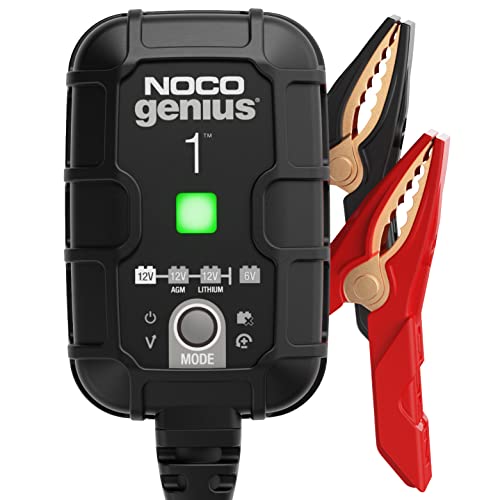
The NOCO GENIUS1 is an all-in-one charging solution ideal for 6V/12V lead-acid and LiFePO4 batteries. It acts as a charger, maintainer, trickle charger, and desulfator with overcharge protection and temperature compensation. Best for casual users who want a compact, automatic unit that prevents overcharging in hot weather and undercharging in cold weather. Suitable for maintenance on small to mid-size batteries in cars, motorcycles, boats, and power sport gear.
Why selected: Its integrated thermal sensor adjusts charge based on ambient temperature, which supports long-term battery health without constant monitoring. Cautions: It’s a 1A unit, so rapid recharging of large or deeply discharged batteries takes longer than higher-amp models.
Schumacher Electric Car Battery Charger 12V/6V — SC1280

The Schumacher SC1280 provides versatile charging for 6V/12V AGM, gel, and deep-cycle batteries. It includes automatic voltage detection and microprocessor control to apply the correct charge, with a trickle/maintain mode for stored batteries. It’s a strong choice for everyday drivers who want reliable, low-maintenance charging for automotive and marine use. Best for users who prioritize automatic performance with simple operation.
Why selected: It delivers a balance of automatic charge and maintaining functions in a compact form. Cautions: It offers a practical 12V/6V range but may be slower on larger or deeply discharged deep-cycle batteries compared with higher-amp models.
MOTOPOWER MP00205A 12V 800mA Charger

The MOTOPOWER MP00205A combines charging, maintaining, trickle charging, and desulfation in one unit. It’s ETL-listed for safety and targets 12V lead-acid batteries, including AGM and gel cells. This model is best for users seeking automatic desulfation and energy-efficient standby with zero output when not in use. It’s well-suited for all-weather maintenance and winter storage.
Why selected: Automatic desulfation helps restore battery performance without manual intervention. Cautions: The 800mA output is modest, so charging time is longer for larger batteries or batteries in poor condition.
NOCO GENIUS2: 2A 6V/12V Charger

The GENIUS2 expands to 2A, offering a more powerful option in the NOCO line. It supports both 6V/12V lead-acid and Li-ion batteries, including flooded, gel, AGM, and deep-cycle variants. A notable feature is Force Mode, which bypasses sensing for recovering very low-voltage batteries. Best for users needing faster charging and more robust maintenance without stepping up to industrial sizes.
Why selected: Higher amperage means quicker recovery and better support for larger or partially discharged batteries. Cautions: As a higher-cost option, it’s best for those who will routinely perform higher-amp maintenance or faster top-ups rather than occasional use.
NOCO GENIUS5: 5A 6V/12V Charger

The GENIUS5 packs a strong 5A output into a compact package, making it suitable for more demanding maintenance and faster charging of 6V/12V lead-acid and LiFePO4 batteries. It’s the best choice for battery systems that see regular use or sit for extended periods and still require reliable, safe charging with temperature compensation. Best for power users who need quicker top-ups and robust desulfation alongside maintenance.
Why selected: Combines power, precision charging, and all-in-one functionality in a unit that remains compact. Cautions: Higher current may be unnecessary for small, rarely used batteries; consider prior needs before choosing.
Buying Guide: Choosing The Right Car Battery Wall Charger
What amp rating do you need?
For small vehicles or storage batteries, 1A–2A units are often enough to maintain charge. For larger car batteries or frequent use, 5A or higher can provide faster top-ups without staying plugged in for hours.
Which voltage support matters?
Most batteries in consumer vehicles are 12V, with some older or specialty systems using 6V. If you own both, pick a charger that supports both 6V and 12V operation to cover all needs.
Desulfation and maintenance features—do you need them?
Desulfation helps restore old or inactive batteries; it’s beneficial for stored or rarely used batteries. If you regularly store vehicles, a desulfator feature can extend battery life, but it’s not essential for every user.
Temperature compensation: why it matters
Charger models with temperature sensing adjust charging to ambient conditions, reducing the risk of overcharging in heat and undercharging in cold. This helps prolong battery life across seasons.
Safety and ease of use
Look for spark-free connections, automatic voltage detection, and safety certifications. An LED status indicator or simple display can help you monitor the charging stage without guesswork.
What about compatibility?
Ensure the charger supports lead-acid variants (flooded, AGM, gel) and LiFePO4 if you own lithium batteries. Some models emphasize one chemistry; others are universal.
Frequently Asked Questions
- What is a car battery wall charger good for? It maintains, charges, and sometimes desulfates automotive batteries, reducing the risk of battery drain during storage and extending battery life.
- Can I use these chargers on marine or deep-cycle batteries? Yes, many models are designed for marine and deep-cycle batteries in addition to standard automotive batteries, but always check the listed battery types.
- Is desulfation safe for all batteries? Desulfation can help certain lead-acid batteries recover capacity, but results vary by battery condition. It should be used according to the manufacturer’s guidelines.
- Do I need a charger with temperature compensation? Temperature compensation helps protect batteries from environmental extremes, especially if the charger will remain connected in hot or cold spaces.
- Should I buy a charger with Force Mode? Force Mode can help recharging very low-voltage batteries that bypass the sensing circuit, but use only when needed and as directed by the device’s documentation.
- How important is the amperage rating? Higher amperage charges batteries faster but may be unnecessary for stored or seldom-used batteries. Match the amp rating to your typical charging needs and battery size.