Instantly turn your vehicle’s 12V power into usable AC and USB charging with reliable car power inverters. This guide helps buyers choose the right inverter for travel, work on the road, or camping. Best for: frequent travelers needing laptop-ready outlets, families powering small devices, and hobbyists who want quiet, compact units. The following table highlights five strong options and their core strengths.
| Product | Best For | |
|---|---|---|
| FOVAL 150W Car Power Inverter | Compact setups; quick dual USB charging | 150W continuous; 2 USB ports; 1 AC outlet; aluminum shell; portable |
| YSOLX 300W Portable Charger | Outdoor trips; multiple ports | 4 USB-C/A ports; 2x110V outlets; six total ports; cooling fan |
| PiSFAU 200W Car Power Inverter | Budget-friendly travel; compact | 2 AC outlets; 4 USB ports; quiet operation; lightweight |
| Pro Chaser 400W Power Inverter | Family travel; larger devices | 400W continuous; dual USB; 4.8A USB; long cord |
| OLTEANP 1000W Power Inverter | Heavy-duty use; camping; truck jobs | 1000W continuous; LCD display; 2 outlets; safety protections |
All products listed are designed to convert 12V DC from a vehicle into 110V AC or provide multiple USB charging options. This varies in wattage, port types, cooling systems, and portability, so choose based on your device load, travel style, and how quiet you need the inverter to be.
FOVAL 150W Car Power Inverter Review
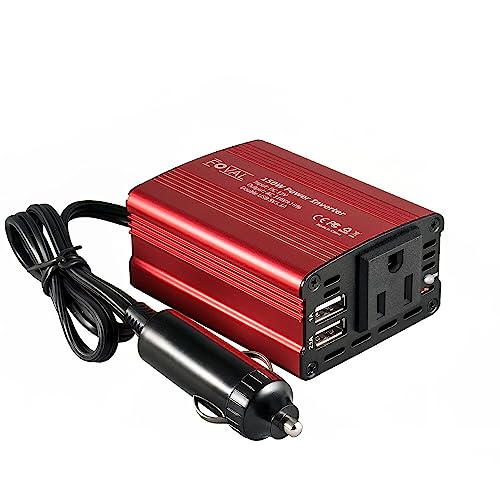
The FOVAL 150W inverter offers 150W continuous DC to AC power with a compact footprint. It includes 2 USB ports and 1 AC outlet, enabling simultaneous charging of phones, tablets, and a laptop. Its aluminum shell design aids heat dissipation and durability. This unit is best for drivers who need a lightweight, portable option for short trips or limited gadget loads. A caution: higher wattage devices may exceed its continuous rating.
YSOLX 300W Portable Charger Inverter

The YSOLX model provides 300W peak capability with four USB-C/A ports and two 110V outlets. It’s designed for campers and road trips where multiple devices require charging at once, including laptops and small appliances. It features an enhanced cooling system for longer use. Best for travelers who need many charging options and higher outlet availability. Limitation: may be larger and heavier than ultra-compact options.
PiSFAU 200W Car Power Inverter

The PiSFAU inverter offers 200W with 2 AC outlets and 4 USB ports in a compact package. It emphasizes quiet operation and efficient heat management. This option suits travelers who want a straightforward, budget-friendly unit with multiple USB charging options. Choose this if you frequently power laptops and mobile devices but don’t need ultra-high wattage.
Pro Chaser 400W Power Inverter
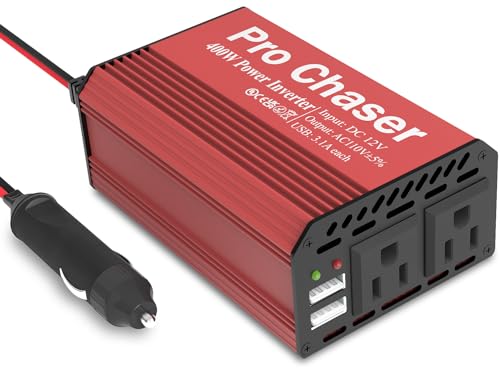
The Pro Chaser unit delivers 400W continuous power with 2x110V outlets and dual USB ports, making it suitable for larger devices and family road trips. Its 30-inch cord adds flexibility for placement in vehicles with rear seating or trunk spaces. Best for powering laptops and other mid-size appliances on the go. Caution: higher wattage may drain the vehicle battery faster when engine is off.
vansoet 400W Car Power Inverter With USB-C

The vansoet 400W inverter provides 2 AC outlets plus a PD 30W USB-C port, a 15W USB-C, and two USB-A ports. It includes an independent AC control switch and an intelligent cooling fan. This design supports fast charging for newer devices while allowing selective use of AC outlets. Choose this if you want precise control over AC power and fast USB-C charging, but be mindful of its wattage ceiling for high-draw devices.
EPANEE 800W Inverter With High Output

The EPANEE inverter lists 800W instant power with 800 peak, dual 110V sockets, a PD 65W USB-C port, and 18W USB-C/USB-A options. It also highlights built-in safety protections and a quiet cooling fan. Best for demanding workloads on the road, such as powering small appliances and work devices. Limitation: heavier and bulkier than compact models, which may affect portability.
Buying Guide: How To Choose The Right Car Inverter
- Power needs: Match continuous wattage to your devices. Laptops and small appliances typically require 100–400W, while some devices can spike higher.
- Number and type of ports: Consider the mix of USB-C, USB-A, and traditional AC outlets to cover phones, tablets, laptops, and other gear.
- Portability vs. capacity: Smaller units travel easily but may limit devices; larger units handle more devices but are heavier and harder to stash.
- Cooling and noise: Inverters with intelligent cooling fans reduce heat buildup and keep noise levels down during longer use.
- Protection features: Look for short-circuit, over-voltage, low-voltage, overload, and over-temperature protections to safeguard devices and the vehicle.
- Ease of use: Independent AC switches, clear indicators, and simple installation make a unit more user-friendly on the road.
- Vehicle compatibility: Ensure your vehicle’s electrical system and cigarette lighter circuit can support the inverter’s peak draw, especially for high-wattage models.
Frequently Asked Questions
- What is the difference between continuous wattage and peak wattage in car inverters?
– Continuous wattage is the sustained power the inverter can supply, while peak wattage is the temporary surge it can handle for brief moments. - Can I run a laptop from a car inverter?
– Yes, many inverters provide enough continuous power and a suitable outlet for laptops, but verify the wattage rating of both the laptop charger and the inverter. - Is a built-in cooling fan necessary?
– It helps prevent overheating during prolonged use, particularly for higher-wattage models and when powering multiple devices. - Should I leave an inverter plugged in when not in use?
– It’s best to unplug when not in use to prevent battery drain and reduce heat buildup. - What safety features are most important?
– Short-circuit protection, over-voltage/under-voltage protection, overload protection, and over-temperature protection are essential for safe operation. - Can a car inverter run appliances like a CPAP or breast pump?
– Some models can power small appliances, but check the wattage and manufacturer guidelines to ensure compatibility and safety.