Whether you’re upgrading a car battery setup, building a marine electrical system, or maintaining heavy-duty solar installations, choosing the right cable lug crimping tool is essential. This guide highlights five top options that cover a range of use cases—from compact handheld models to heavy-duty hydraulic crimpers—so you can pick the best tool for your needs. The picks below target common buyers: DIY enthusiasts needing versatility, professional technicians requiring high durability, and installers prioritizing ease of use and quick die changes.
| Product | Best For | Crimp Range | Note |
|---|---|---|---|
| Cable Lug Crimping Tool with 74pcs Copper Wire Lugs (Mdvora) | DIYers and light installers | AWG 10 to 1/0 | Includes lugs and heat shrink; good value |
| iCrimp Battery Cable Lug Crimping Tool (IWISS) | Professional battery work | 8 to 1/0 AWG | Rotating dies, hex-crimping |
| Brileine 10 Tons Hydraulic Crimping Tool | Heavy-duty installations | 12 AWG to 2/0 AWG | 9 dies; strong hydraulic power |
| AMZCNC Hydraulic Crimping Tool (YQK-0000) | High-current battery cables | 12 AWG to 4/0 AWG | 11 dies; power and precision |
| Growlush Hydraulic Cable Crimping Tool | Marine and RV electricals | 12 AWG to 4/0 AWG | 11 dies; 80–100 kN force |
Cable Lug Crimping Tool with 74pcs Copper Wire Lugs

The MDvora tool set targets versatility for mid-range projects. It ships with 74 copper wire lugs and 100 heat-shrink tubes, making it a compact, all-in-one kit. It features a rotary crimping mold offering six die sizes (AWG 10, 8, 6, 4, 2, and 1/0), covering common automotive and small-scale power applications. The lugs are made from electrolytic-grade copper to maximize conductivity, while the heat-shrink tubing is designed for durability under typical electrical stress.
Best for: DIYers and weekend warriors who want an all-in-one starter kit without hunting for separate components. Choose this if you need a ready-to-go bundle with compatible lugs and tubing for a variety of AWG sizes.
Caution: While the tool supports multiple die sizes, ensure you select the correct die for the lug size to avoid poor crimps or loose connections.
iCrimp Battery Cable Lug Crimping Tool for 8–1/0 AWG

The IWISS iCrimp model is designed for heavy-duty battery work with crimping across 8, 6, 4, 2, 1, and 1/0 gauge lugs. Its large die set and EDM-cut dies improve dimensional accuracy and reduce the incidence of incorrect crimps. A rotating die system simplifies die changes, helping technicians quickly adapt to different lug sizes on demanding projects. The hex-crimping approach provides a broad contact area and strong joint integrity, which helps minimize resistance and pull-out risk.
Best for: Professionals who frequently service battery banks or automotive electrical systems and need reliable, repeatable crimps with quick die changes. Choose this if you value die accuracy and a robust hex-crimp connection.
Caution: Rotating dies must be properly aligned; misalignment can compromise crimp quality. Always verify the die code corresponds to the lug size.
Brileine 10 Tons Hydraulic Crimping Tool

This 10-ton hydraulic crimping tool from Brileine is built for heavy-duty connections, with a 0.45 inch stroke and a 12 AWG to 2/0 AWG crimping range. It uses hexagonal rotary dies processed by EDM wire cutting for precise, repeatable crimps. The kit includes nine hex dies that cover the most common large-lug sizes, making it suitable for demanding battery cables and power connections in professional settings. It’s designed for frequent use in workshops or field service where durability matters.
Best for: Pros who need substantial crimping force and a broad die set for heavy gauge lugs. Choose this if you frequently crimp large copper or aluminum cables in demanding environments.
Caution: Hydraulic tools require regular maintenance and correct die selection. Avoid using on non-compatible lug profiles to prevent deformation.
AMZCNC Hydraulic Crimping Tool (YQK-0000)

The AMZCNC YQK-0000 is a 10-ton hydraulic crimper designed for demanding electrical lugs. It supports a broad crimping range from 12 AWG to 4/0 AWG and includes 11 US Hex Dies labeled for easy die selection. The tool’s hydraulic mechanism provides steady, high-pressure crimps with less manual effort, making it a strong choice for high-current battery cables and power connections. A carrying case adds portability for field work or shop use.
Best for: Installers handling large gauge battery cables and high-current runs who value precise die labeling and reliable, repeatable crimps. Choose this if you want a high-die-count tool for diverse lug sizes.
Caution: Heavy tools may require assistance for transportation or storage. Ensure the tool is used with compatible lug geometries for best results.
Growlush Hydraulic Cable Crimping Tool
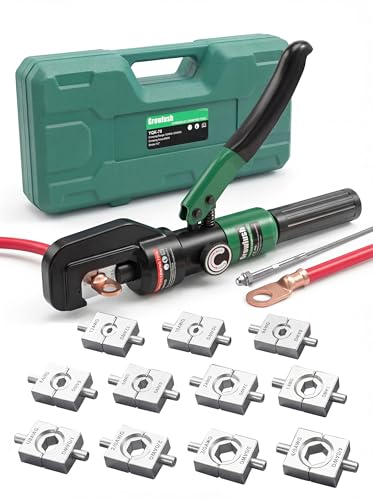
The Growlush hydraulic crimper targets versatile high-current needs with a 12 AWG to 4/0 AWG range and 11 US standard hex dies. It delivers about 80 KN (with a maximum of 100 KN) of crimping force, helping to form strong connections in battery and marine systems. The included US standard dies cover the most common lug sizes, and the tool is designed to reduce hand fatigue through a smooth hydraulic action. It is suitable for automotive, RV, marine, and solar-related electrical tasks.
Best for: Marine, RV, or heavy-duty automotive projects where a dependable hydraulic tool with a broad die selection is beneficial. Choose this if you require strong, repeatable crimps with less manual effort.
Caution: For stainless steel wire rope or unusual lug geometries, verify compatibility before crimping to avoid damage to dies or connectors.
Buying Guide: How To Choose The Right Cable Lug Crimping Tool
- Confirm the gauge sizes you work with most often (such as 8 AWG to 1/0 AWG or 12 AWG to 4/0 AWG). Hydraulic tools typically handle heavier gauges with greater ease.
- Rotating dies and hexagonal dies provide precise, consistent crimps. More dies mean broader compatibility with lug sizes, but add weight and cost.
- Manual, hammer-based, or hydraulic. Manual and hammer tools are lightweight and affordable; hydraulic tools deliver higher, steadier force with less effort for large cables.
- Look for corrosion-resistant metals, solid handles, and durable jaws. Electrolytic copper lugs and thick heat-shrink tubing improve conductivity and insulation.
- Longer handles, soft grips, and balanced weight reduce fatigue during extended use, especially for field technicians.
- Bundles with lugs, heat-shrink tubing, or carrying cases add value by reducing the need to source accessories separately.
- For fieldwork, prioritize compact, rugged models with a reliable die set. For shop work, higher-capacity hydraulic tools may be more efficient.
Frequently Asked Questions
- What does AWG range mean for a crimping tool? It indicates the smallest to largest wire gauge the tool can effectively crimp, ensuring solid electrical connections across different lug sizes.
- Are hydraulic crimpers safer than manual ones? Hydraulic crimpers reduce manual effort and restrict operator fatigue, which can improve consistency and safety during long jobs.
- Why are hex dies preferred for crimps? Hex dies create a large, uniform contact area, reducing resistance and increasing pull-out strength for high-current connections.
- What maintenance is needed for crimping tools? Regularly clean jaws, lubricate moving parts per manufacturer guidance, and verify dies are free of damage or excessive wear.
- Should I buy a kit or a single-tool crimper? Kits with lugs, heat shrink, and multiple dies offer convenience and better compatibility for varied tasks, especially for beginners or mixed-use environments.
- Can these tools crimp aluminum cables? Some models are designed to crimp copper or aluminum lugs; check the die and lug compatibility before use to avoid poor crimps.