Looking for a reliable battery powered backup generator to keep essentials running during outages or adventures off the grid? This guide selects five compact, portable options that deliver clean power for devices like CPAP machines, laptops, phones, and small appliances. Each choice is evaluated for use cases such as home backup, camping, RVing, or emergency preparedness. The table below highlights key details to help you compare quickly.
| Product | Best For | Approx. Power | Notable Benefit |
|---|---|---|---|
| EnginStar Portable Power Station 300W | Emergency backups and CPAP users | 300W / 296Wh | Two 110V AC outlets with multiple ports |
| MARBERO Portable Power Station 88Wh | Lightweight camping and short trips | 88Wh | Very compact and easy to carry |
| EF ECOFLOW Delta 2 | Home backup and RV use | 1024Wh | Expandable with additional batteries |
| Anker SOLIX C1000 Gen 2 | Power outages and remote work | 1024Wh | Ultra-fast recharge and multiple outputs |
| Jackery Explorer 1000 v2 | Longer trips and off-grid living | 1070Wh | High capacity with fast charging options |
EnginStar 300W Portable Power Station

Best for CPAP users and weekend campers who need reliable pure sine wave power. This EnginStar model weighs about 6.5 pounds and measures 9 x 5.5 x 7.5 inches, offering 296Wh and a 300W AC output. It features eight output ports to charge multiple devices at once and includes two 110V pure sine wave outlets for sensitive equipment like laptops. The built-in protection system guards against short circuits, overcharging, and overload, making it suitable for long weekend trips or emergency preparedness. A caution: charging times vary by method, and solar charging is only available with a compatible panel (panel sold separately).
What makes it stand out
- Two 110V pure sine wave outlets for safe operation of fragile electronics
- Multiple ports including DC and USB-C for versatile charging
- Advanced battery management and temperature control
Best use cases
- CPAP and small electronics during outages
- Backcountry trips where a compact power source is needed
Limitations
- Solar panel compatibility is not included; you’ll need a compatible panel to use solar charging.
MARBERO 88Wh Portable Power Station
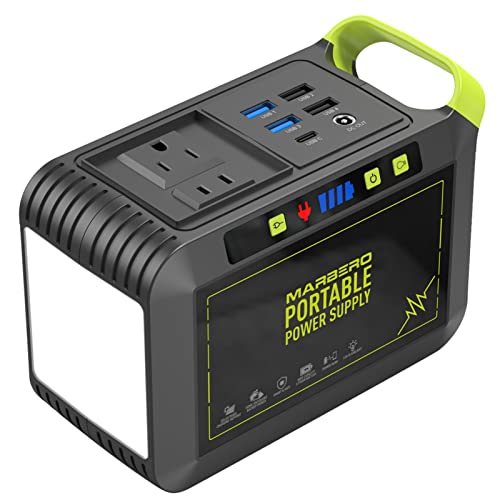
Best for light outdoor use and quick, on-the-go charging. The MARBERO unit is compact (about the size of a DSLR) and weighs around 3.2 pounds, making it suitable for backpacking, small camping setups, and emergency kits. It provides multiple outputs with a built-in Battery Management System for stability. It can be charged via wall adapter or optional solar panels and supports USB-C PD fast charging. A limitation is its smaller 88Wh capacity, which is better suited to mobile devices and small appliances rather than high-wattage gear.
Why choose this
- Extremely portable with a compact footprint
- USB-C PD and multiple outputs cover common mobile devices
Ideal buyers
- Hikers, weekend campers, students needing a portable backup
Note
- Not ideal for high-watt appliances or extended power outages without frequent recharging
EF ECOFLOW Delta 2 Portable Power Station

Best for home backup and RV use where higher capacity is needed. The Delta 2 offers 1024Wh LiFePO4 energy storage, up to 1800W AC output, and multiple outlets, including USB-C and USB-A ports. It is expandable with additional batteries to reach 3kWh, making it suitable for longer outages and off-grid living. Its key advantage is a substantial power reserve with a modular design, allowing you to scale as needed. A potential limitation is size and weight relative to ultra-portable models, which may affect portability in tight spaces.
Key reasons to consider
- Expandable capacity for extended use
- High output power suitable for cooling devices and small appliances
Who should consider it
- Homeowners seeking dependable backup or RV travelers needing extended power
Limitation
- Higher initial footprint compared to ultra-compact models
Anker SOLIX C1000 Gen 2 Portable Power Station

Best for fast recharging and reliable office or home backup. The SOLIX C1000 Gen 2 delivers 2,000W continuous output (3,000W peak) and a 1,024Wh LiFePO4 battery. It recharges rapidly—up to 1,600W in the HyperFlash recharge mode—reducing downtime during outages or travel. It supports multiple outlets and is designed for portable use with a smaller footprint than many competitors. A potential caveat is preserving battery health with frequent full cycles; proper charging practices are recommended.
Why it’s strong
- Ultra-fast charging capability for rapid readiness
- High continuous output with multiple port options
Best-for scenarios
- Emergency work setups, remote offices, and small appliances during outages
Simple caution
- Heavy use reduces the number of cycles over time; plan charging as part of routine maintenance
Jackery Explorer 1000 v2 Portable Power Station

Best for long trips, off-grid living, and emergency readiness with a balance of capacity and portability. The Explorer 1000 v2 features 1,070Wh LiFePO4 capacity, 1,500W AC output with a 3,000W surge, and a lightweight 23.8 lb frame. It supports fast charging via compatible adapters and Jackery’s app-assisted features. The rugged design makes it reliable for outdoor scenarios and home backup alike. A caveat is that higher-watt devices should be monitored to avoid exceeding the surge limit, especially during start-up of motors.
Strengths
- High energy capacity in a portable package
- Long lifecycle with LiFePO4 chemistry
For whom
- Outdoor enthusiasts, campers, and households needing dependable offline power
Potential limitation
- Higher upfront cost compared to smaller capacity units
Buying Guide
What power capacity do you need?
Estimate your essential loads (CPAP, laptop, phone, lights) and choose a unit with enough watt-hours to cover a critical outage without frequent recharges. LiFePO4 batteries offer longer lifecycles and safer chemistry for regular use.
How many ports and which outputs are important?
Consider AC outlets for small appliances, USB-C for fast device charging, and DC car ports for car accessories. A mix of 8 or more ports can reduce the need for adapters and hubs.
Is fast charging a priority?
If you anticipate short outages or irregular power, models with rapid recharge (like HyperFlash) can reduce downtime between uses.
Should you prioritize portability or expandability?
For frequent outdoor use, prioritize lighter weight and compact form. For home backups or RV use, expandability and higher capacity may be worth the extra bulk.
What about solar charging?
Check if the unit supports solar input and what solar panel compatibility is required. Panels are typically sold separately, and input wattage affects charging speed in sun.
Durability and lifecycle considerations
Longer cycle life (thousands of cycles) reduces replacement frequency. LiFePO4 chemistry generally offers longer life than standard lithium-ion options.
FAQ
- What is a battery powered backup generator? A portable power station that stores energy in a battery and provides electricity through AC and DC outputs for devices during outages or off-grid use.
- Can these units power a CPAP machine? Yes, several models provide stabilized 110V AC and suitable DC outputs that can support CPAP devices, depending on power draw and duration.
- Is LiFePO4 better than standard lithium for these products? LiFePO4 batteries offer longer cycle life and improved safety, making them common in higher-end backup units.
- Do these units come with solar panels? Panels are typically sold separately; many models support solar charging when paired with a compatible panel.
- How do I choose between 1,000Wh and 2,000Wh capacity? Choose 1,000Wh for light, short-term needs and portability. Choose 2,000Wh for longer outages or higher-load devices, accepting greater size and weight.
- Can I run high-watt appliances from these? Most models are designed for low to moderate loads (up to about 1,000–1,800W continuous). Check surge ratings for devices with high startup power.