Answering the search for a reliable battery generator with a solar panel, this guide compares top portable and home backup options. These devices offer solar charging, multiple outputs, and durable batteries suited for camping, RVing, or power outages. Best for campers and outdoor lovers who need lightweight, versatile power; best for homeowners seeking robust backup capacity; best for travelers needing fast recharging on the go. The following summaries highlight who each product is best for and why it stands out, along with practical cautions.
Summary Table
| Product | Best For | Key Benefit | Limitations |
|---|---|---|---|
| EF ECOFLOW Delta 3 Max | Home backup and RV camping | Ultra-fast charging and high sustained output | Higher price point |
| Jackery Solar Generator 1000 V2 | Balanced power on the go | High capacity with light footprint | Solar panel efficiency varies by sun |
| Jackery HomePower 3000 | Essential home backup | Large capacity with UPS features | Heavy for portable use |
| Anker SOLIX C1000 | Compact reliability | Ultra-fast recharge and many ports | Moderate capacity relative to bigger units |
| BLAVOR Portable Power Station 1600W | Value with built-in solar | Integrated solar panel and LiFePO4 | Limited solar input compared to larger kits |
Jackery Solar Generator 1000 V2 with 200W Solar Panel

The Jackery Solar Generator 1000 V2 pairs a 1,070Wh LiFePO4 battery with a 1,500W continuous AC output (3,000W surge). It is designed for outdoor use, RV trips, and emergency power. It emphasizes portability with a relatively light build for its capacity and offers an efficient recharge path through solar and AC sources.
Best for: Outdoor enthusiasts and remote workers who need reliable, scalable power without frequent recharging. Why selected: strong balance of capacity, weight, and charging speed makes it widely usable for camping and emergencies. Caution: solar charging depends on sun exposure; large appliances should be avoided during peak heat to preserve battery health.
Jackery HomePower 3000 Portable Power Station

The HomePower 3000 delivers a durable 3,072Wh capacity and multiple outputs for home backup and outdoor use. It features robust power delivery and two 200W solar panels as part of the package, designed to support refrigerators, routers, and other essentials during outages. This unit is a strong choice for long-duration outages and RV adventures.
Best for: Homeowners seeking a dependable, expandable backup with ample runtime. Why selected: high capacity and reliable output make it suitable for critical devices. Caution: heavier and less portable than smaller units, which may affect via-transport scenarios.
Anker SOLIX C1000 Portable Power Station

The Anker SOLIX C1000 offers 1,056Wh of LiFePO4 capacity with 2,400W surge capability and 11 ports for versatile device charging. It emphasizes fast recharging (UltraFast) and longevity, with a 10-year lifespan and thousands of cycles. This model suits busy camps, remote work setups, and situations needing many devices powered simultaneously.
Best for: Users who need multiple ports and quick top-ups on the go. Why selected: the port variety and fast recharge make it a flexible daily carrier. Caution: higher price tier and mid-range capacity compared with larger home-focused units.
BLAVOR Portable Power Station 1600W

The BLAVOR unit includes a built-in 40W solar panel and a 1024Wh LiFePO4 battery, delivering 1,600W continuous output and 3,200W surge. It is designed for home backup, camping, and RVs, with eight outlets and strong battery chemistry for longer cycles. This option is attractive for those who want a ready-to-go solar generator without separate panels.
Best for: Budget-conscious buyers who want a solar-included kit. Why selected: built-in solar panel simplifies setup and reduces extra components. Caution: solar input efficiency and total runtime depend on panel area and sun conditions, which may vary by location.
EF ECOFLOW Delta 3 Max with 220W Solar Panel
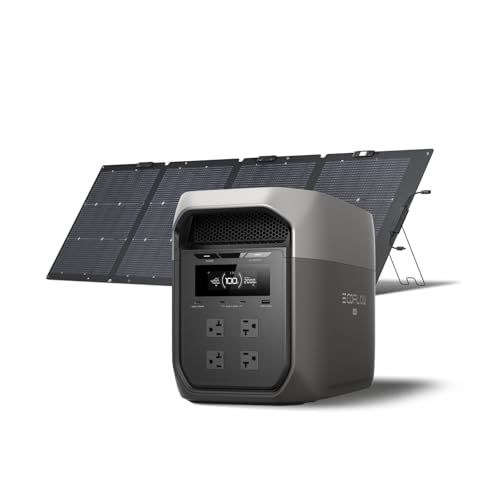
The Delta 3 Max provides up to 3,400W continuous X-Boost output and rapid charging capabilities, with a 3,400W maximum AC output and 3,400W surge. It supports fast recharge and quiet operation, suitable for home backup, RV trips, and heavy-duty outdoor use. Its reliable transfer time helps protect sensitive electronics during outages.
Best for: Users needing high output for appliances and quick replenishment. Why selected: strong performance envelope and rapid charging enhance reliability. Caution: larger footprint and higher price compared with mid-range models.
Buying Guide
What to consider when choosing a battery generator with a solar panel:
- Power needs: Assess wattage of appliances you plan to run simultaneously. Choose a unit with higher continuous wattage than your peak load.
- Battery chemistry and lifespan: Lithium-based LiFePO4 offers longer life and safety. Consider units with 2,000–4,000+ charge cycles for longevity.
- Port selection: Look for diverse outputs (AC, USB-C, USB-A, DC) to cover phones, laptops, and small appliances.
- Solar compatibility: Verify panel wattage, MPPT charging, and whether solar input matches your region’s sun exposure and use-case needs.
- Weight and portability: Balance capacity with portability if you intend to carry the unit on trips.
- UPS and safety features: For home backup, a unit with seamless transfer and protective features helps maintain safety and device integrity.
Frequently Asked Questions
- What is the difference between a portable power station and a solar generator? A portable power station stores energy in a battery and can be charged via AC or solar; a solar generator emphasizes solar charging as a primary feature, often with integrated panels.
- How many devices can I run at once? That depends on the unit’s continuous wattage rating. Check total watts of devices you plan to run concurrently to avoid overloading.
- Can I use these at home during a power outage? Yes, most models support home backup, with UPS features and stable transfer to essential devices.
- Do solar panels work in cloudy weather? Solar efficiency decreases with shade and clouds; larger panel areas and higher wattage help maintain charging in variable conditions.
- How long does it take to recharge fully? Recharging time depends on input power. Some units offer 0–80% in about an hour with high input, but charging from solar varies with sunlight.
- Are LiFePO4 batteries safer? Yes, LiFePO4 generally offers enhanced thermal stability, longer life, and better resilience in extended use.