When protecting network gear, choose a robust UPS that can reliably power modems, switches, routers, and small servers during outages. The best options balance runtime, surge protection, and ease of integration with office or home networks. This guide highlights five top picks suitable for different buyer needs, from compact home offices to small data closets. Each product is evaluated for who it’s best for, along with clear pros and limitations to help you compare.
Overview of top picks
| Product | Best For | Key Benefit | Limitation |
|---|---|---|---|
| GOLDENMATE 2000VA LiFePO4 UPS | Power users needing long life and many outlets | Long-lasting LiFePO4 battery and AVR | Higher initial cost |
| CyberPower BRG1000AVRLCD | Compact workstations and small networks | Intelligent LCD, multiple outlets | Lower VA than larger models |
| CyberPower BRG1500AVRLCD2 | Mid-sized networks needing more outlets | More outlets and USB ports | Bulkier than BRG1000 |
| CyberPower PR750LCD3C | Small offices with cloud monitoring | Cloud monitoring and sinewave output | Smaller capacity |
| OPTI-UPS TS2000E | Systems requiring 20A outlet support | Line-interactive with AVR and user-replaceable power | Outlet outlet compatibility varies by setup |
GOLDENMATE 2000VA LiFePO4 UPS Review

The GOLDENMATE model uses a LiFePO4 battery pack (51.2V, 9Ah) for extended endurance and a life expectancy surpassing 10 years with over 3,000 charge cycles. This translates to lower replacement costs and reduced maintenance compared with lead-acid systems. It’s a line-interactive UPS with a pure sine wave output and AVR to handle voltage fluctuations. Ideal for protecting critical network components and workstations that require stable power and longer runtime.
Best for: Users who want long battery life and higher outlet capacity for dense network setups. It’s well-suited for home labs, small offices, or home offices with multiple devices in need of surge protection and backup power.
Why selected: This model’s LiFePO4 battery technology reduces total cost of ownership and avoids frequent replacements, making it a practical long-term choice for network gear. The eight outlets with generous spacing support multiple cords and adapters.
Limitation: Higher upfront cost and heavier build may require careful placement and handling. The note on maintenance is minimal due to LiFePO4 chemistry, but ensure compatibility with your device load.
CyberPower BRG1000AVRLCD Review
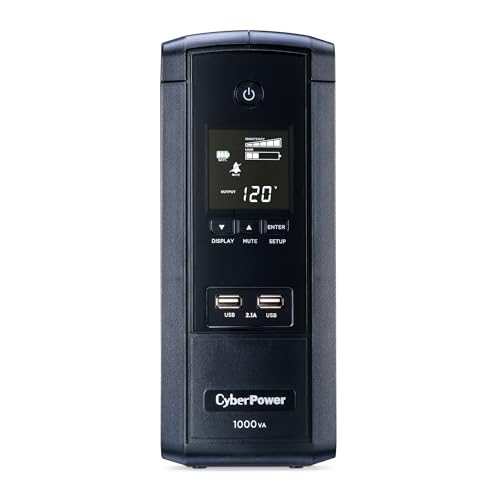
The BRG1000AVRLCD is a compact, 1000VA/600W unit with an intelligent LCD panel that shows runtime, load, and battery capacity. It provides 10 outlets divided between battery-backed and surge-protected, along with two USB charging ports. The unit uses simulated sine wave output, which is generally sufficient for most modern PCs, routers, switches, and media devices. This makes it a practical choice for small networks or a home office with moderate power needs.
Best for: Small workstations, home network gear, and offices needing clear runtime visibility in a compact format.
Why selected: The Multifunction LCD panel and balanced outlet distribution help you plan device placement while maintaining protection. It’s easy to deploy with a six-foot cord, simplifying setup under desks or in small racks.
Limitation: The unit supplies simulated sine wave power, which may be less ideal for high-end, sensitive power supplies or some UPS-aware peripherals. Consider higher-end sinewave models if you rely on critical equipment requiring strict waveform quality.
CyberPower BRG1500AVRLCD2 Deep Dive

The BRG1500AVRLCD2 ups the ante with 1500VA/900W capacity and 12 outlets. It includes six battery-backed outlets and six surge-protected outlets, with USB ports (Type-A and Type-C) to charge mobile devices. The color LCD panel provides real-time battery and power data with intuitive alerts. This model suits networks with multiple PoE devices, small servers, and a need for more outlets than the BRG1000 offers.
Best for: Mid-sized networks and offices with multiple devices that require consistent backup power and easy charge options for phones and tablets.
Why selected: The expanded outlet count and added USB ports deliver practical expansion for growing workspaces. The color display helps monitor risk of downtime before it happens.
Limitation: It’s bulkier and heavier than BRG1000, which may affect placement options in compact rooms or under-desk setups.
CyberPower PR750LCD3C Cloud Monitor UPS

The PR750LCD3C is a 750VA/750W UPS with sinewave output and a built-in cloud monitoring feature via optional components. It offers six NEMA 5-15R outlets, a multifunction LCD panel, and a compact mini-tower design. This option is ideal for small to medium setups where cloud visibility helps IT staff monitor uptime and receive alerts remotely.
Best for: Small offices or home networks needing remote monitoring and dependable backup for essential devices like routers, switches, and small servers.
Why selected: Cloud monitoring adds a proactive layer for uptime management in distributed environments. The built-in sinewave output helps maintain compatibility with Active PFC devices.
Limitation: The smaller 750W rating may limit runtimes if you connect multiple high-draw devices at once. Plan for targeted devices to maximize runtime efficiency.
OPTI-UPS TS2000E Line-Interactive UPS

The OPTI-UPS TS2000E delivers 2000VA/1200W with line-interactive AVR, designed for homes and small offices. It requires a 20-amp wall outlet or an adaptor if 15-amp outlets are used. This model emphasizes voltage boosting and bucking to maintain safe voltages during fluctuations, making it a practical choice for networks sensitive to power quality, including basic routers and switches.
Best for: Environments where a higher VA unit is needed but a full sinewave is not mandatory for all devices. It’s well-suited for outlets that support 20A, or where an adaptor is used for compatibility.
Why selected: The AVR feature helps manage voltage irregularities without depleting battery power immediately, preserving runtime for critical devices.
Limitation: Outlet compatibility can require careful planning, especially if your space lacks a 20A circuit or you rely on multiple high-draw devices concurrently.
Buying Guide: Key Purchase Considerations
What size UPS do I need for my network gear? Start with your total connected load (in watts) and add a buffer for surge power. Aim for a unit with at least 20-30% more capacity than your current draw to accommodate growth and peak loads.
Why is waveform quality important? For most network equipment, a sinewave or near-sinewave output protects sensitive power supplies better than a basic simulated waveform. If you have high-end servers or sensitive telecom gear, prioritize true sinewave models.
How many outlets should I have? Count the devices that require backup power. Include routers, modems, switches, NAS devices, and small servers. Larger networks benefit from models with a balanced split between battery-backed and surge-only outlets.
Is energy efficiency a factor? Lithium-based UPS batteries (like LiFePO4) extend service life and reduce maintenance. However, they can cost more upfront. Consider long-term cost of ownership and replacement needs when choosing.
What about remote monitoring? Cloud or remote monitoring helps IT teams respond quickly to outages. This is valuable for small offices that don’t have dedicated on-site IT staff or for distributed networks.
What maintenance considerations exist? If a unit uses user-replaceable batteries or modules, check the ease of replacement and availability of spares. For line-interactive models, AVR performance can reduce battery wear by stabilizing input voltage without drawing from the battery unnecessarily.
Frequently Asked Questions
- What should I pair with a network UPS? Pair it with routers, switches, and small servers to ensure critical components stay online during outages.
- Are lithium-based UPS batteries better than lead-acid? Yes for longevity and lower total cost of ownership, though initial price may be higher.
- How do I calculate required UPS runtime? Estimate device runtime by multiplying each device’s wattage by expected uptime and sum for the total. Choose a model that meets or exceeds this value.
- Is cloud monitoring essential? It’s beneficial for remote management and proactive outage alerts, especially in multi-site environments.
- What is AVR and why is it useful? Automatic Voltage Regulation maintains safe voltage levels, reducing unnecessary battery drain during voltage fluctuations.
- Can I use a UPS with non-UPS devices? Most devices tolerate UPS power, but ensure the power draw stays within the unit’s rating to avoid overload.
Summary of top picks for quick comparison
| Model | VA / W | Outlets | Best For | ||
|---|---|---|---|---|---|
| GOLDENMATE 2000VA | 2000VA / 1600W | 8 | Long runtime, many devices | Pure sine wave | LiFePO4 battery |
| CyberPower BRG1000AVRLCD | 1000VA / 600W | 10 | Compact, budget-friendly | Simulated sine | Clear LCD |
| CyberPower BRG1500AVRLCD2 | 1500VA / 900W | 12 | More outlets, USB ports | Simulated sine | Higher capacity |
| CyberPower PR750LCD3C | 750VA / 750W | 6 | Cloud monitoring | Sinewave | Remote cloud |
| OPTI-UPS TS2000E | 2000VA / 1200W | — | 20A outlet compatibility | Line-interactive AVR | Adaptor may be needed |