When the power goes out, a reliable sump pump backup prevents basement flooding and water damage. This guide highlights five dependable battery backup systems designed for sump pumps, explaining who each is best for, why it was selected, and practical considerations for choosing the right model.
Summary of chosen products:
| Product | Key Benefit | Best For |
|---|---|---|
| VIOPUMPO 2500W Sump Pump Backup Battery System | High output with pure sine wave and LCD remote | Homes needing strong, clean power for multiple loads |
| Cantonape 2000W Sump Pump Backup Battery System | LED display with quick auto-switch | Users prioritizing clear status info |
| OLTEANP 2500W Sump Pump Battery Backup System | Smart 25A charging and versatile battery compatibility | Flood-prone areas requiring flexible battery options |
| Jlouneo 2500W Sump Pump Battery Backup System | Real-time LCD display and fast auto-switch | Those who want precise monitoring during outages |
| VEVOR 2000W Sump Pump Battery Backup System | 3-stage charging and plug-in setup | Easy installation with broader battery compatibility |
VIOPUMPO 2500W Battery Backup System

- Continuous power with pure sine wave output, suitable for different load types and high efficiency.
- Built-in 25A charger supports fast charging and trickle charging for deep-cycle lithium and AGM batteries.
- LCD remote shows voltage, power, and battery status; multiple protections improve safety and longevity.
Best for: Homeowners needing robust 2500W backup capacity with clean power for both sump pumps and auxiliary loads. Choose this if you expect frequent outages and want a clear status readout.
Caution: Battery types must be deep-cycle; non-deep-cycle batteries are not supported by the charger design.
Cantonape 2000W Sump Pump Backup Battery System

- Output power of 2000W with pure sine wave; LED display provides real-time monitoring of battery and AC voltage.
- Automatic switching to battery inverter during outages for continuous sump pump operation.
- 3 AC outputs offer flexible pump wiring options; high conversion efficiency reduces losses.
Best for: Users who value straightforward status information and seamless auto-switching. Opt for this if you want a compact system with clear LED readouts.
Caution: Requires compatible deep-cycle batteries; performance depends on the chosen battery type.
OLTEANP 2500W Sump Pump Battery Backup System

- Designed for basement flood protection with automatic grid-to-battery transfer.
- Supports LiFePO4, AGM, GEL, and flooded deep-cycle batteries; battery not included.
- Built-in 25A smart charger with multi-stage protection (overcharge, short circuit, etc.).
Best for: Homeowners in flood-prone areas who want flexible battery chemistry options. Choose this if you plan to mix battery types or upgrade later.
Caution: Battery not included; ensure the chosen battery has suitable capacity for your sump pump load.
Jlouneo 2500W Sump Pump Battery Backup System

- 2500W pure sine wave output supports multiple sump pumps; 16.6A combined draw limit.
- 25A fast charging and 12ms auto-switch for rapid transfer to battery power.
- 15ft wired LCD remote with real-time monitoring of voltage, power, and battery level.
Best for: Users who want precise, long-range monitoring and rapid switching during outages. Choose this for large-basement setups needing reliable visibility.
Caution: Ensure your pumps’ combined load remains within the 16.6A limit to avoid overload.
VEVOR 2000W Sump Pump Backup System
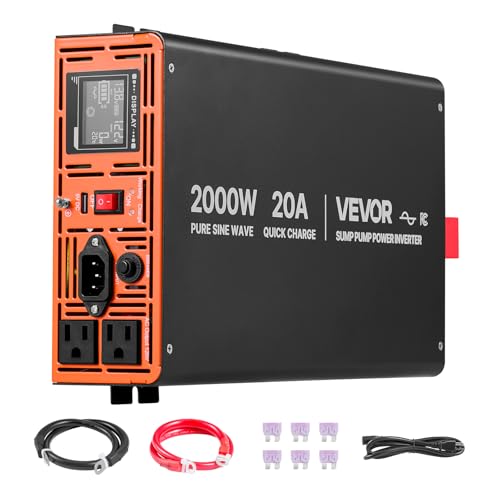
- 2000W pure sine wave output with an AC outlet and USB port for versatile use.
- Three-stage charging (Bulk, Absorption, Float) to protect and extend battery life.
- Plug-in design for simple setup; compatible with 12V lead-acid, AGM, Gel, and LiFePO4 batteries.
Best for: People who want an easy-to-install backup that works with several battery chemistries. Choose this if you value plug-and-play convenience.
Caution: The battery is not included; verify your battery choice and capacity to sustain your sump pump during outages.
Buying Guide
Key questions to help you choose a sump pump backup system that matches your home and risk tolerance:
- What is my sump pump’s total wattage draw, and how many pumps will run simultaneously?
- Do I prefer a higher wattage for broader compatibility or a smaller, budget-friendly setup?
- Which battery chemistry options are acceptable for my climate and maintenance preferences?
- Do I need a built-in display and remote monitoring, or is a simple plug-and-play unit enough?
- Is automatic transfer time important to me (faster transfer reduces flood risk during outages)?
- What are the safety protections I require (overcharge, short circuit, heat, low voltage)?
Solving these questions helps compare models on a like-for-like basis. For example, higher-wattage systems like 2500W units are better for multi-pump configurations or larger basements, while 2000W units suit single-pump setups in smaller spaces. Consider charger speed and battery compatibility to ensure your chosen model can be paired with your preferred deep-cycle batteries. A clear LCD or remote readout supports proactive maintenance by showing battery health and voltage levels before a storm hits.
Frequently Asked Questions
- Do these backup systems power a sump pump during a full outage? Yes. They switch automatically to battery power when grid power fails, maintaining sump pump operation.
- Can I use any battery type with these systems? Most models are compatible with several deep-cycle options (life cycles vary by brand). Always verify the compatible battery types listed by the manufacturer.
- Will these protect multiple sump pumps at once? Some units support more than one pump or higher current needs; check the combined wattage limit (often around 16.6A max per system) before pairing multiple pumps.
- Is professional installation required? In most cases, these are designed for homeowner installation, but if you are unsure about wiring or transfer switches, professional help is recommended.
- Do these include the battery? Most packages do not include batteries; you must purchase compatible deep-cycle batteries separately.
- What is the typical transfer time? Transfer times vary; some units offer rapid auto-switch in milliseconds to seconds depending on design.