If you’re preparing for outages or off-grid moments, a home backup generator that’s portable and easy to run can be a smart choice. This guide focuses on five dependable options suited for different home sizes and power needs. The best fit depends on your home’s load, fuel preferences, and whether you need transfer-switch compatibility. The selections below target common buyer intents: full-house power, essential circuits, or RV-ready setups. A quick comparison table is included to help you choose at a glance.
Buying quick-reference table
| Product | Best For | Fuel & Power | Transfer Switch Ready |
|---|---|---|---|
| Westinghouse 12500 Dual Fuel | Medium-to-large homes, 100% core loads | Gas / Propane | Yes |
| Westinghouse 14500 Peak Tri-Fuel | Larger homes, prolonged outages | Gas / Propane / Natural Gas | Yes |
| WEN 4,750-Watt Dual Fuel | Smaller homes, essential circuits | Gas / Propane | Yes |
| DuroMax XP13000EH | Whole-home backup, RV and emergencies | Gas / Propane | Yes |
| Oxseryn 4400 Watt Inverter | Quiet backup, limited loads | Gas | No |
Westinghouse 12500 Watt Dual Fuel Backup Generator

Best for medium-sized homes needing reliable dual-fuel support. Running watts: 9500 (gas) / 8500 (propane); peak watts: 12500 (gas) / 11200 (propane). Features remote start, transfer-switch readiness, and a 457cc Westinghouse engine with automatic low-oil shutdown. VFT display shows voltage, frequency, and hours. Pros: flexible fuel choice and long runtime on gas. Cons: propane efficiency is lower than gasoline at full load. Best for: households seeking flexible fuel options and a robust transfer-ready unit.
Westinghouse 14500 Peak Watt Tri-Fuel Backup Generator

Best for larger homes or frequent outage scenarios. It provides 11,500 running watts on gasoline, 13,500 peak on propane, and 12,000 peak/9,500 running on natural gas. Powered by a 550cc Westinghouse engine with a durable cast-iron sleeve. Runs up to 19 hours on a 9.5-gallon tank, or up to 7 hours on a 20-lb propane tank. Pros: tri-fuel versatility; Cons: heavier and louder than smaller units. Best for: households needing extended runtime across multiple fuel options.
WEN 4,750-Watt Dual Fuel Portable Generator

Best for essential circuits and smaller homes. Switchable between gasoline (4,750 surge / 3,800 running) and propane (4,350 surge / 3,500 running). 120V and 240V output support transfer switches and emergency backup. Electric start with a 224cc engine makes quick startup practical. Pros: lighter and more maneuverable; Cons: lower total wattage than larger units. Choose this if you need a compact, fuel-flexible backup with transfer switch support.
DuroMax XP13000EH 13,000-Watt Dual Fuel

Best for whole-home backup and RV-ready scenarios. Delivers 13,000 watts (gas) or equivalent on propane with strong Dual Fuel performance. Marketed as a leader in Dual Fuel portability, with a robust engine designed for power and longevity. Pros: strong overall capacity and transfer-switch readiness. Cons: weight and fuel consumption can be substantial. Choose this for whole-home scenarios where maximum wattage is essential and dual-fuel flexibility is valued.
Oxseryn 4400 Watt Inverter Generator
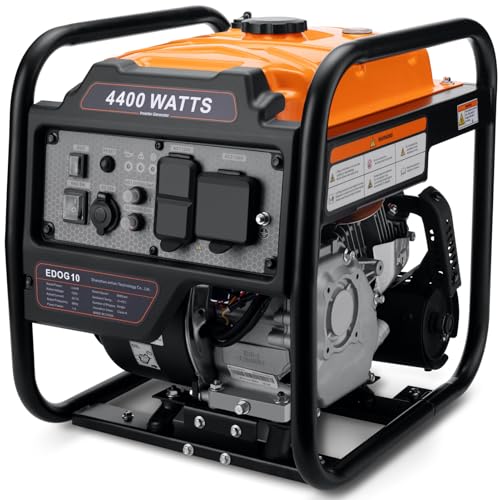
Best for quiet, lightweight backup with RV-ready features. Provides 4400 peak watts and 3400 running watts, with multiple outputs including RV and USB ports. Runs up to 14 hours at 25% load with ECO mode. Pros: quieter operation and portability; Cons: lower wattage not suitable for whole-home loads. Use when you need a compact, low-noise option for essential devices or small RV setups.
Buying Guide
What size is right for your home?
- Essential vs. whole-home load: If you only need critical circuits, a smaller dual-fuel unit can suffice. For whole-home back-up, seek 9,000+ running watts or higher with transfer-switch readiness.
- Fuel preferences: Gas engines deliver maximum runtime but propane offers longer shelf life and safer storage. Tri-fuel units add natural gas compatibility for even more options.
- Transfer switch compatibility: If you plan to use a house electrical transfer switch, ensure the generator model is listed as transfer-switch ready and matches your home’s service rating.
- Portability and weight: Heavier units deliver more power but are harder to move. Consider wheeled models or those with lift handles for easier handling during setup.
- Runtime and fuel tank size: Larger tanks extend runtime, especially on gasoline. Factor fuel availability, noise, and emission regulations in your decision.
- Maintenance and durability: Look for engines with automatic low oil shutdown, durable sleeves, and clear digital hour meters to track usage and service needs.
FAQ
What is the difference between running watts and peak watts?
Running watts indicate continuous power output, while peak watts represent the maximum surge the generator can deliver for short periods to start motors.
Do these generators work with home transfer switches?
Yes, all listed models that state transfer-switch readiness can work with standard home transfer switches designed for portable generators.
Is a dual-fuel generator better than single fuel?
Dual-fuel offers flexibility and can be advantageous when one fuel source is scarce or expensive, but overall efficiency varies by model and fuel type.
How long can these units run on a full tank?
Runtime depends on tank size and load. Larger tanks and lighter loads extend runtime; heavy loads shorten it quickly.
Are inverter generators quieter?
Typically yes. Inverter models are designed for lower noise and stable power, ideal for sensitive electronics.
What is a good rule of thumb for selecting wattage?
List essential household loads and sum their wattage. Add a safety margin (20–25%) to cover startup surges and future needs.