Discover top devices designed to mask conversations, generate precise test signals, and support relaxation. This guide highlights five high‑quality options, detailing how each can improve privacy, reduce distractions, or aid in research and learning. The selections cover professional noise masking, versatile signal generation, and educational wave kits to explore sound physics and resonance.
| Product | Brand | Key Use |
|---|---|---|
| Pure Resonance Audio SMG1 Sound Masking Generator | Resonance Audio | Speech privacy and productivity |
| 1Hz-500kHz DDS Signal Generator with Schumann Resonator | Seesii Store | Oscilloscope calibration and testing |
| 7.83Hz Schumann Resonance Generator | – | Relaxation and sleep support |
| WVGEN-DLX Mechanical Wave Kit | GSC International Store | STEM physics learning and demonstrations |
| ECUTEE Low Frequency Signal Generator 10Hz-1MHz | ECUTEE Store | Audio signal generation and experimentation |
Pure Resonance Audio SMG1 Sound Masking Generator

The Pure Resonance Audio SMG1 is designed to protect privacy and reduce distractions by masking speech and ambient noise. It creates a controlled acoustic environment that helps maintain confidentiality in offices, medical facilities, and call centers while boosting focus and productivity. Users can customize sound masking through adjustable white, brown, and pink noise levels, enabling a tailored solution for any professional space.
1Hz-500kHz DDS Signal Generator With Schumann Resonator

This device combines a high-frequency DDS signal generator with a 7.83Hz Schumann resonator, offering unique capabilities for electronic circuit testing and stress relief. It supports sine, square, triangle, and sawtooth waveforms, with a switchable filter for precise sine and pulse outputs. Dual power options make it portable for classrooms, labs, or field work, and it’s suitable for oscilloscope calibration and audio amplifier testing.
7.83Hz Schumann Resonance Generator

This adjustable sine-wave generator focuses on the Earth’s natural Schumann resonance at 7.83Hz, offering a tool for deep relaxation and improved sleep. The acrylic case provides a clear and durable enclosure, while the broad frequency range from 0.01Hz to 299,999Hz enables exploration of relaxation, therapy, and experimental sound healing approaches. The device emphasizes stable output and long-lasting construction for repeated use.
WVGEN-DLX: Mechanical Wave Kit
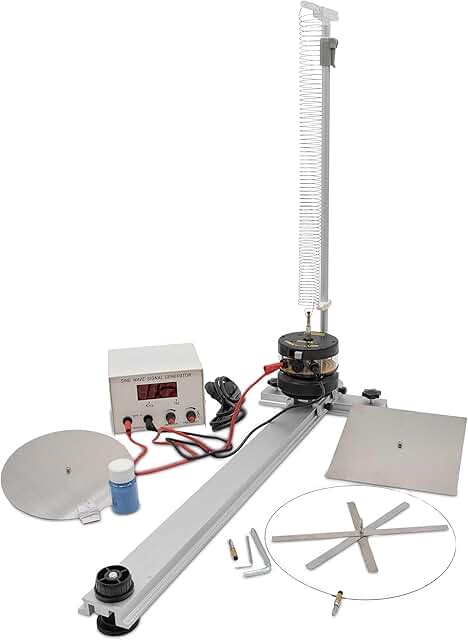
This mechanical wave kit offers hands-on exploration of waves, sound, and interference. It includes a sine wave generator, driver, Chladni plates, springs, string, sand, and more, designed to make abstract physics concepts tangible. Suited for middle school through college-level learners, the kit supports interactive demonstrations and experiments focused on wave dynamics and resonance.
ECUTEE Low Frequency Signal Generator 10Hz-1MHz

The ECUTEE low-frequency signal generator provides stable sine and square wave outputs with a wide 10Hz to 1MHz range. A 6-step attenuator with 10dB steps and a level regulator allows precise output control. The device is calibrated with a single graduated scale and can reach greater than 5Vrms no-load, offering strong performance for audio experiments and signal testing.
Buying Guide: Key Purchase Considerations
- Use case and goals: Distinguish between privacy-focused noise masking, professional signal testing, relaxation, or educational exploration to pick the right type of device.
- Noise masking versus signal generation: Noise generators mask speech and improve focus, while signal generators produce defined waveforms for calibration, experiments, or therapy.
- Frequency range and waveform options: Consider whether you need broad ranges (0.01 Hz to hundreds of kHz) and multiple waveforms (sine, square, triangle, sawtooth) for versatility.
- Output stability and accuracy: Look for precision components, stable frequency output, and low drift to ensure reliable results in testing or therapy settings.
- Power and portability: Dual power options (AC/DC or battery) increase field usability for lab work, classrooms, or remote environments.
- Build quality and durability: Durable enclosures, clear interfaces, and components like acrylic housings or protective cases extend instrument life in classroom or lab contexts.
- Safety and privacy considerations: When masking conversations, ensure device use complies with local regulations and workplace policies to protect privacy and avoid inadvertent interference with others.
- Educational value: For STEM learning, select kits with comprehensive components (drivers, plates, experimental guides) to maximize hands-on understanding of wave behavior and interference.
- Connectivity and compatibility: Check input/output connectors, compatibility with oscilloscopes, audio interfaces, or other measurement tools used in your setup.
- Budget and support: Compare feature sets against price, and consider vendors that provide documentation, firmware updates, and customer support.