Find the right 9-inch circular saw blade for common woodworking tasks, including ripping, crosscutting, and fine finishing. This guide highlights five reliable options, each suited to different project needs such as fast cutting, clean finishes, or versatile all-purpose use. Buyers who work with softwood, hardwood, plywood, or laminate can compare teeth counts, kerf, and arbors to choose the blade that best fits their saw and workload. The table below summarizes core specs to aid quick comparisons.
| Product | Teeth | Arbor | Best For | |
|---|---|---|---|---|
| KuangBBBTools 9″ 40T Carbide Tip | 40 | 5/8″ | General wood cutting | ATB grind for fast, smooth cuts |
| Wadoy 9″ Table Saw Blade 40T | 40 | 5/8″ | Plywood finishing and versatile woodcutting | ATB carbide for clean cuts |
| ATIE 9″ 40T General Purpose | 40 | 5/8″ | Ripping and crosscutting | High-quality carbide tips |
| Freud LU84R009 9″ 40T Combination | 40 | 5/8″ | All-purpose cutting | Combination grind for versatility |
| Freud LU87R009 9″ Thin Kerf Rip | 22 | 5/8″ | Thin kerf ripping | Thin kerf for fast feed and less waste |
Below are five product features and practical notes to help you decide which blade best fits your saw and projects. Each entry notes the intended user and provides a concise rationale for the choice, along with a potential limitation to consider when selecting blades.
KuangBBBTools 9″ 40 Teeth Carbide Tip Wood Cutting Circular Saw Blade

Best for general wood cutting. This 9″ blade features a 40-tooth carbide-tipped design with an ATB tooth configuration, intended to deliver fast, smooth cuts in softwoods and hardwoods alike. Kerf is 0.1″ and the blade rides on a 5/8″ arbor, suitable for standard mid-sized saws. The blade’s ATB geometry helps reduce tear-out on plywood and laminates, making it a reliable all-purpose option for hobbyists and small shops. A notable limitation is that it’s not recommended for metal cutting, so keep it to wood and wood alternatives.
Wadoy 9″ Table Saw Blades, 40T Carbide Tipped for Workshop Wood Cutting Tasks
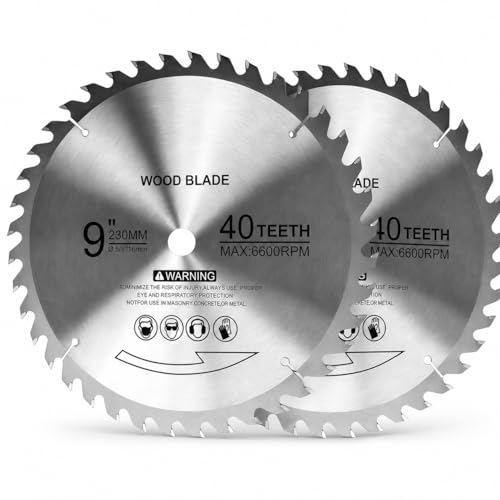
Best for versatile wood cutting and clean finishes. The blade uses 40 carbide-tipped teeth with an ATB design to minimize tear-out while delivering clean crosscuts and smooth rip cuts. It fits most table saws and miter saws with a 5/8″ arbor, making it a practical replacement blade for many workshops. The trade-off is that at 40T, finer finishing may still be desirable with higher-end blades for some materials. It’s a solid mid-range option for mixed woodworking tasks.
ATIE 9″ 40 Tooth Carbide Tip General Purpose Blade (2 Pack)

Best for all-purpose ripping and crosscutting. This 2-pack offers flexibility for projects requiring more blades or quick blade swaps on busy job sites. The 40T ATB design and 5/8″ arbor suit a wide range of softwood, hardwood, and plywood applications, with a kerf of 0.1″ for accurate cuts. A potential limitation is that it’s not a specialized finish blade, so for high-precision veneering or light laminates, consider pairing with a dedicated finish blade.
Freud LU84R009: 9″ x 40T Combination Blade

Best for flexible cutting tasks requiring both ripping and crosscutting. The LU84R009 features a 5/8″ arbor and a .126″ kerf, with 40 teeth and a combination grind designed to manage multiple materials efficiently. Large front gullets aid in chip removal, supporting quicker feeds in typical woodworking. If your work emphasizes fine finishing, this blade offers broad versatility but may not excel in high-precision finishing compared to dedicated finish blades.
Freud LU87R009: 9″ Thin Kerf Rip Blade

Best for high-efficiency ripping. The LU87R009 provides a thin kerf (.094″) with 22 teeth, designed to minimize material waste and maximize feed speed. The 5/8″ arbor fits standard 9″ saws, and the ATB grind supports clean rip cuts with reduced resistance. This blade is particularly suitable for solid wood ripping. A limitation is the reduced number of teeth, which may yield rougher edge quality on highly crosscut-heavy tasks or intricate joinery.
Buying Guide: Key Considerations For 9″ Blades
Choosing the right 9″ blade involves aligning blade geometry with your saw and project needs. Here are practical questions to guide your decision.
- What material will you cut most often? For softwood and plywood, blades with 40T ATB designs offer balance between speed and finish. For metal or ferrous materials, a steel-cutting blade is needed instead of a wood blade.
- Are you prioritizing finish quality or speed? High-tooth counts (like 40T) generally provide smoother cuts, while thinner kerfs improve feed rate and reduce waste on large rip projects.
- What arbor compatibility do you need? Most 9″ blades use a 5/8″ arbor; ensure your saw accepts this size or consider adapters if necessary.
- Is blade longevity important? Carbide-tipped blades last longer than steel blades on durable woods and laminates, but you’ll still want the right tooth geometry for your material.
- Will you combine ripping and crosscutting tasks? A combination blade covers a wide range of tasks, though single-purpose finish blades may outperform in specific finishes.
Frequently Asked Questions
- What is the difference between a 40T and a 22T blade for wood cutting? A 40T blade provides smoother cuts with less tear-out, while a 22T rake is better for fast ripping and reducing waste in thick stock.
- Can I use a 9″ blade on any table saw? Most 9″ blades require a 5/8″ arbor and standard mounting. Check your saw’s manual for arbor size and max RPM compatibility.
- Is a thin-kerf blade worth it? Yes, for faster cuts and reduced material consumption, especially on large rip projects, but it may be slightly less forgiving on rough stock.
- Are combination blades better than dedicated finish blades? Combination blades are versatile for varied tasks, but finish blades designed for a specific material often yield higher-quality edges.
- What safety considerations are important? Ensure proper blade installation, use sharp carbide teeth, and wear eye and hand protection during cutting tasks.
This guide presents five 9″ blades optimized for woodworkers seeking reliable performance across common tasks. Consider your typical materials, desired finish quality, and tool compatibility when choosing among these options.