Looking for reliable backup power around 7000 watts and want options that fit different fuel types and setups? This guide highlights five strong alternatives that are well-suited for home backup, RV use, and job sites. Each option is evaluated for who benefits most, why it’s selected, and practical limitations to consider. Buyers seeking long runtimes, portability, or dual/fuel flexibility will find clear comparisons to aid decision-making.
| Product | Best For | Power Range | Fuel Type |
|---|---|---|---|
| Generac XD5000E | Emergency home backup; job sites | 5000W run / 6,000W peak | Diesel |
| PowerSmart 7000-Watt Open Frame | Clean power for electronics; RV and home | 6,000W running / 7,000W surge | Gasoline |
| DuroMax XP13000HX | Whole-home backup; RV and heavy-duty use | 13,000W | Gasoline/Propane |
| DuroStar DS13000MX | Dual-fuel flexibility; large outages | 13,000W | Gasoline/Propane |
| Westinghouse 8200 Peak Watt Tri-Fuel | Versatile fuels; quiet operation | 6,600W running / 8,200W peak | Gas/Propane/Natural Gas |
PowerSmart 7000-Watt Open Frame Inverter Generator

Best for electronics safety and versatile usage. This unit delivers 6000W running and 7000W surge with clean sine wave power (<3% THD), protecting sensitive devices like laptops and cameras. It offers an electric push-start plus recoil backup, a 322cc engine, and a 6-hour runtime at 50% load on a 3.2-gallon tank. The 120/240V dual-voltage selector makes it suitable for home transfer switch setups or heavy-duty RV service. A potential limitation is needing a warm-up period to reach full wattage when loading high-wattage equipment.
Who it’s best for: home backup users needing clean power for electronics, small workshops, and RV camping. Why selected: strong inverter performance and dual-voltage versatility at a competitive wattage range.
Westinghouse 12500 Peak Watt Dual Fuel Home Backup

Best for long outages and fuel flexibility. This model offers 9500 running watts and 12500 peak watts when running on gasoline, with propane support and a long runtime on a 6.6-gallon tank. It includes a remote start key fob, transfer switch readiness, and CO shutdown for safety. Users should be aware of its larger footprint and heavier weight, which reduces portablity for frequent moves.
Who it’s best for: homeowners needing substantial backup power and transfer switch readiness. Why selected: robust peak power and dual-fuel capability for extended outages.
Limitation: heavier and bulkier than smaller portable units; not ideal for tight spaces or frequent transport.
WEN 11,000-Watt Dual Fuel Portable Generator (DF1100T)
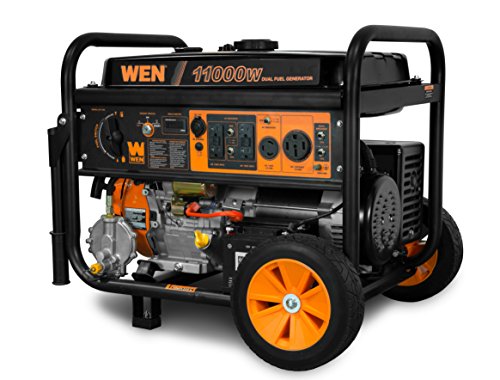
Best for flexible backup power with wheeled portability. The DF1100T switches between gasoline and propane, delivering 8,300 running watts on gasoline and 7,500 on propane. It supports 120V/240V output, facilitating transfer switches and multi-appliance support. The unit is electric start with a 457cc engine. A consideration is the heavier load at higher wattage, which can affect fuel efficiency and noise levels compared with lighter-duty models.
Who it’s best for: users needing a dual-fuel option with strong 120/240V capability and wheels for mobility. Why selected: clear fuel flexibility and reliable electric start for emergencies.
DuroMax XP13000HX Dual Fuel Generator

Best for whole-home backup with dual fuel flexibility. The XP13000HX outputs 13,000 watts and supports both gasoline and propane, offering high power for storms or extended outages. It incorporates copper windings and a CO alert for safety. A limitation is its high power draw and large size, which reduces portability and storage options for compact spaces.
Who it’s best for: households or small businesses needing substantial simultaneous appliance support. Why selected: high wattage with dual-fuel options for resilience.
WEN 6800-Watt Dual Fuel RV-Ready Inverter (DF680iX)

Best for RV enthusiasts and light home backup needing lower footprint. The DF680iX runs on gasoline or propane, delivering 6800 surge and 5100 running watts on gas, with 4500 running on propane. It features a bonded-neutral 240V option for Level 2 EV charging. A caution is that at peak load it may approach its maximum capacity more quickly than larger units.
Who it’s best for: RV users and small homes needing reliable 120/240V capacity with CO watchdog safety. Why selected: compact, inverter-based, multi-fuel capability with safety features.
Buying Guide: Key Purchase Considerations
- Fuel type and availability: Diesel offers longer life and higher durability on heavy-duty sites, but gasoline, propane, or natural gas can be more accessible in urban settings. Consider dual-fuel models for flexibility during outages.
- Power needs: Translate surge and running watts to your essential appliances. For home backup, prioritize models with higher running watts and robust surge capacity.
- Portability vs. capacity: Small, portable units are easier to move but provide less total power. Larger units deliver more power but require greater storage and transportation effort.
- Safety features: Look for CO shutdown, low-oil shutoff, and proper outlet coverage. Inverter technology can reduce THD for electronics.
- Transfer switch readiness: If you plan whole-home backup, choose models with transfer switch compatibility or readiness to simplify installation.
- Run time and fuel efficiency: Longer runtimes minimize refueling during outages. Check fuel tank size and consumption at typical loads.
- Noise and footprint: Inverter-based units are usually quieter and produce cleaner power, which matters for residential use and RV camping.
Frequently Asked Questions
- What is the difference between running watts and surge watts? Answer: Running watts indicate continuous power output, while surge watts represent the extra power available for starting motors and high-load equipment.
- Are diesel generators more durable than gasoline? Answer: Diesel engines are typically built for longevity and heavy use, making them common for job sites and extended outages, but they can be heavier and noisier.
- Is inverter technology important for home backup? Answer: Yes, inverter generators produce cleaner power (lower THD), safer for electronics and sensitive devices.
- Do I need a transfer switch for whole-home backup? Answer: A transfer switch simplifies safe switching between utility power and generator, and several listed models are transfer switch ready or compatible.
- Can I run a coffee maker or fridge at the same time as an AC unit? Answer: This depends on the unit’s running and surge watts. Check the peak and running watt ratings for simultaneous loads.
- How important is CO monitoring? Answer: CO shutdown features help protect occupants by automatically stopping the engine if dangerous carbon monoxide is detected.