Answering the question, these 7-1/4 inch masonry blades are designed to cut through concrete, brick, block, and fiber cement with a diamond or polycrystalline diamond (PCD) edge. They’re best for contractors and serious DIYers who need fast, clean cuts with minimal wear. The top picks below target different needs: durability for frequent use, compatibility with common saw brands, and versatility for wet or dry cutting. The following table highlights five strong options to help you choose quickly.
| Product | Best For | Why It Stands Out |
|---|---|---|
| DEWALT Diamond Blade for Masonry, DW4712B | General masonry work | Solid all-around performance with a standard 5/8″ arbor and easy operation. |
| FEWELL 7” Diamond Blade | Wet or dry cutting | Segmented design and versatile material compatibility for concrete and stone. |
| Janchi 7-1/4 Inch 4T PCD Tip Blade | Fiber cement and hard materials | Long life with diamond-tipped teeth and ultra-thin kerf for precise cuts. |
| EDiamondTools 7″ Segmented Diamond Saw Blade | Concrete, brick, block | Multipurpose with good performance-to-price balance. |
| WEN BL0704 7-1/4-Inch Blade | Fiber cement and laminate | PCD blade with thin kerf for clean, fast cuts. |
DEWALT Diamond Blade for Masonry, High Performance, 7-Inch

The DEWALT DW4712B is a 7″ masonry blade with a 5/8″ diamond knock-out arbor. It’s designed for reliable performance in standard masonry tasks and is easy to use for both pros and serious DIYers. Best for: general masonry cutting in everyday projects where a dependable blade matters. Limitation: data notes the China-made origin, which may matter to buyers prioritizing local manufacturing.
FEWELL 7” Diamond Blade for Concrete

FEWELL’s 7″ blade features a segmented design with a 7/8″–5/8″ adapter, suitable for wet or dry cutting concrete, brick, block, and stone. Its 14 segments and 10 mm segment height aim to balance aggressive cutting with extended life. Best for: projects requiring versatile cutting across masonry materials. Caution: adapter compatibility may require double-checking your saw’s arbor diameter before purchase.
Janchi 7-1/4 Inch 4T PCD Tip Hardie Blade

Janchi’s PCD-tipped blade is designed for cutting Hardie cement boards, laminate flooring, and other ultra-hard materials. It promises up to 60x longer life versus standard carbide blades, with an ultra-thin kerf for fast, precise cuts. Best for: professionals working with fiber cement and similar composites. Limitation: designed primarily for harder materials; may not be ideal for soft wood framing cuts.
EDiamondTools 7″ Segmented Diamond Saw Blade

EDiamondTools offers a versatile 7″ blade with segmented teeth for cutting concrete, brick, and block. It emphasizes a balanced performance-to-price ratio and a DM 7/8″ arbor. Best for: users seeking a cost-conscious option without sacrificing basic performance. Caution: not every variant supports heavy-duty, repeated use in professional settings.
WEN BL0704 7-1/4-Inch Diamond-Tipped Blade
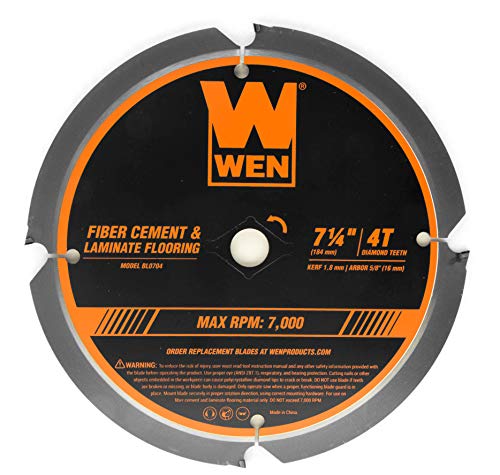
The WEN blade is a 7-1/4″ option with a 5/8″ arbor, rated up to 7,000 RPM. It’s tailored for fiber cement board and laminate cuts, with a very thin kerf (about 1.8 mm) for efficient, clean finishes. Best for: users prioritizing dust control and smooth cuts on fiber cement and laminate. Limitation: may be less aggressive on very hard masonry without sufficient feed pressure.
Buying Guide: 7-1/4 Inch Masonry Blades For Your Saw
- Material compatibility: Choose blades designed for concrete, brick, block, or fiber cement. Diamond-tipped edges perform best on hard materials, while standard carbide blades are better for wood or soft plastics.
- Arbor size and compatibility: Most blades use a 5/8″ arbor, but some include adapters. Confirm your saw’s arbor diameter and whether you need a DMK adapter or a retrofit accessory.
- Wet vs dry cutting: Wet-cut blades reduce dust and heat, extending blade life in concrete. Dry-cut blades are convenient but may wear faster in dense materials.
- Kerf thickness: Ultra-thin kerfs (1.8 mm or less) cut faster and with less saw load but require steady hand control to prevent deflection.
- Segment design: Segmented blades excel in fast, rough cuts and aggressive materials; continuous or laser-cut blades provide smoother finishes on softer materials.
- Durability and life: Polycrystalline diamond (PCD) tips last longer on hard composites like fiber cement. Diamond-coated segments resist wear better under repeated dry-cut use.
- RPM rating: Ensure the blade’s maximum RPM matches or exceeds your saw’s speed to prevent overheating or blade stress.
- Safety considerations: Always use appropriate PPE, secure workpieces, and follow saw manufacturer guidance for feed rate and cutting direction.
Choosing By Use Case
- For general masonry tasks with frequent dry cuts, consider DEWALT DW4712B for reliability and ease of use.
- For versatility across concrete and stone with wet/dry options, FEWELL offers practical performance.
- For hard fiber cement and long life, Janchi’s PCD-tipped blade is a strong pick.
- For budget-conscious buyers needing solid all-around cutting, EDiamondTools provides value without sacrificing core capability.
- For fiber cement and laminate emphasis, WEN BL0704 balances clean cuts with a thin kerf.
FAQ
- What’s the difference between segmented and continuous blades? Segmented blades cut quickly through hard materials and generate more debris; continuous blades offer smoother cuts on softer materials with less chipping.
- Can I cut fiber cement with any 7-1/4″ blade? Not all blades are designed for fiber cement. Look for PCD-tipped or specialized fiber cement blades to maximize life and reduce dust.
- Is it safe to cut dry or wet? Wet cutting reduces dust and heat; dry cutting is faster for quick jobs but can wear blades faster in tough materials.
- Do all blades fit standard 7-1/4″ saws? Most blades use a 5/8″ arbor; verify your saw’s arbor and any adapters needed before purchasing.
- How do I extend blade life? Use the correct blade type for the material, maintain steady feed pressure, and avoid overheating by backing off occasionally on long cuts.
- Should I buy twice-the-price for longer life? If you frequently cut hard materials, investing in a PCD-tipped or high-quality diamond blade can reduce replacement frequency and deliver consistent cuts.