Searching for a 5000 watt propane generator? This guide compares top dual‑fuel and inverter models to help you pick the right unit for home backup, RV living, or outdoor work. The best picks balance peak power, fuel flexibility, and quiet operation. This overview targets buyers who need dependable power without excessive noise or weight. The featured models suit travel trailers, small homes, and job sites where clean power matters.
| Product | Type | Best For | Key Benefit |
|---|---|---|---|
| Westinghouse 5000 Peak Watt Dual Fuel (Remote Start) | Dual‑fuel inverter | RV users and home backup | Remote start and versatile fuel options |
| MUTAOMAY 5000W Portable Inverter | Inverter | Quiet camping and sensitive electronics | Ultra‑quiet operation with Eco Mode |
| Oxseryn 5000W Inverter Generator | Inverter | Emergency home backup | EPA compliant, robust fuel efficiency |
| PowerSmart 5000W Portable Inverter | Inverter | Home backup and RVs | Electric start with CO alarm |
| WEN 6800‑Watt DF Inverter (EV/CO) | Dual‑fuel inverter | Electric vehicle backup | Higher surge on gasoline, CO watchdog |
Westinghouse 5000 Peak Watt Dual Fuel with Remote Start

This Westinghouse model delivers 5000 peak watts and 3900 rated watts with less than 3% total harmonic distortion. It runs on gas or propane and features a remote start via key fob, along with both a 120V duplex outlet and a 30A RV outlet. It’s a strong choice for travel trailers or light home backup, especially when quiet operation matters. The digital display provides fuel level, power output, remaining runtime, voltage, and lifetime hours for easy monitoring.
Best for: RV owners and homeowners who value convenience and dual‑fuel flexibility. Limitations: Parallel capability is noted, but always verify compatibility with your existing generator pairings and ensure proper grounding when connected to heavy loads.
Westinghouse 5000 Peak Watt Dual Fuel with CO Sensor
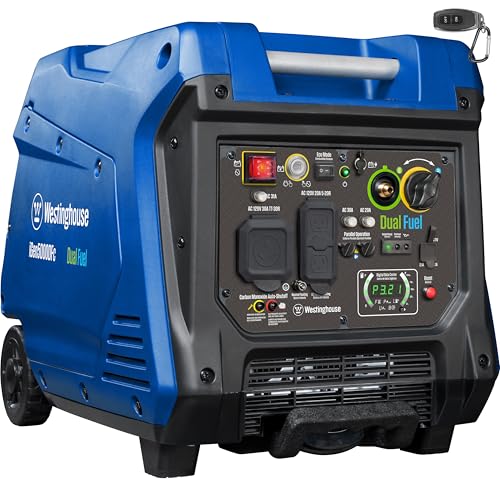
This variant adds automatic carbon monoxide shutdown for enhanced safety, alongside the same dual‑fuel capability and digital LED data center readout. It includes a ground‑floating neutral grounding system and two USB outlets in addition to 120V and 30A RV outlets. Best for users prioritizing automatic safety features in residential or campground settings.
Best for: Buyers who want built‑in safety shutoff. Limitations: Higher feature set can increase cost; verify CO shutdown behavior under elevated ambient temperatures.
MUTAOMAY 5000W Portable Inverter Generator

Powered by 5000W peak and 4000W running watts, this inverter emphasizes clean power suitable for laptops, CPAP machines, and electronics thanks to low THD. It is designed for quiet operation with Eco Mode that aligns engine speed to load, and it claims up to 9.8 hours on a full tank at light load. It includes a 1*12V port and 30A RV outlet.
Best for: Campers and remote hobbyists who need dependable, clean power with extended runtime. Limitations: Quiet performance varies with load; confirm fuel capacity and local noise regulations in camping areas.
PowerSmart 5000W Portable Inverter with Electric Start
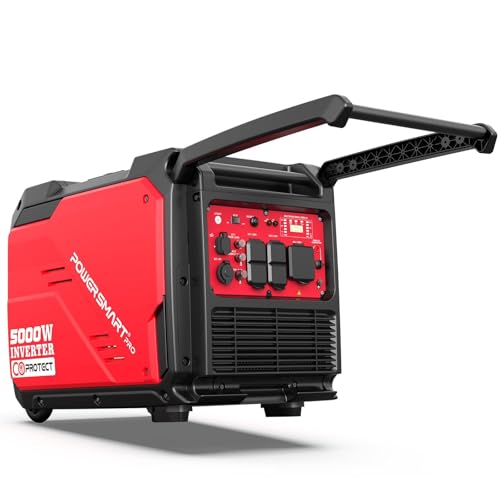
PowerSmart’s unit emphasizes a high surge rating with 5000W peak and 4000W running power. It includes an electric start with a CO alarm for safety and offers up to 10 hours of runtime with a 3.43‑gallon tank at 50% load. Eco‑Mode optimizes fuel use while maintaining a reasonable noise level. Best for: Home backup and RV enthusiasts who want a balance of power, safety, and efficiency. Limitations: CO alarm requires regular testing to avoid nuisance shutdowns during light loads.
WEN 6800‑Watt DF Inverter (Electric Start)

This WEN model provides a higher gasoline surge (6800 watts) and 5100 rated watts, with a dual‑fuel capability (gas and propane). It includes a CO watchdog sensor to automatically shut down on dangerous CO levels and supports 240V bonded-neutral configuration for low‑power Level 2 charging. It’s well suited for EV backup and scenarios where additional surge power is beneficial.
Best for: Users needing higher gasoline surge and vehicle charging readiness. Limitations: Dual‑fuel operation can complicate maintenance; ensure proper refueling safety and storage procedures.
Buying Guide
Fuel flexibility and power output
Consider whether you need dual‑fuel capability for propane and gasoline, or if a single fuel source suffices. Higher peak wattage helps start heavy appliances like air conditioners, while continuous running watts determine everyday usage. Look for units with at least 4000–4500 running watts for comfortable RV and home backup performance.
Noise, runtime, and portability
Noise level matters in campgrounds and neighborhoods. Inverter generators generally run quieter than traditional open‑frame models. Check runtime figures at a practical load (often 25–50%). Tank size and fuel efficiency when paired with Eco Mode affect total operating time between fills.
Safety features
CO sensors and automatic shutoffs reduce risk in enclosed spaces. A floating neutral or bonded 120/240V configurations may matter if charging electric vehicles or connecting to home transfer systems. Inspect grounding requirements and CO testing practices before first use.
Ease of starting and maintenance
Electric start improves convenience, especially for frequent use. Recoil backup is common, but test reliability. Parallel capability allows pairing with another generator for more power, but confirm compatibility with your existing equipment and outlets.
Outlets and compatibility
Look for a mix of 120V outlets, USB ports, and a 30A RV outlet for flexible hookup. Check the outlet configuration and wire gauge to prevent overloads during peak demand. Ensure the model supports your RV or home wiring setup.
Usage scenarios
- Home backup: prioritize running watts, CO safety, and fuel availability.
- RV travel: emphasize quiet operation, gas/propane flexibility, and RV outlets.
- Camping or job sites: consider portability, Eco Mode, and run time per tank.
FAQ
- What does ‘5000 peak watts’ mean? Peak watts indicate the maximum power the generator can deliver briefly to start high‑draw appliances; running watts show the continuous power it can sustain.
- Is propane as reliable as gasoline? Propane stores longer and is cleaner burning, but availability can vary. Dual‑fuel options provide flexibility for outages.
- Are these generators safe to run indoors? No. Always operate outdoors in a well‑ventilated area and install CO and carbon monoxide detectors if used near living spaces.
- Can I parallel these generators with another unit? Some models support parallel operation; verify compatibility and follow manufacturer instructions for safe connections.
- What maintenance steps are essential? Regular oil checks, spark plug inspection, air filter cleaning, and battery/remote start testing keep performance stable.
- Which generator is best for sensitive electronics? Inverter generators with low THD (typically under 3–5%) provide cleaner power suitable for laptops, TVs, and CPAP machines.