The buyer’s search is for a reliable 500 watt solar panel kit that includes a battery and inverter for off-grid setups. This guide highlights five practical kits suited for camping, RVs, boats, and remote cabins. Each option is evaluated for best use case, durability, and ease of installation. The following selections emphasize flexible panels, integrated charging, and user-friendly setups to help you choose the right kit for your needs.
| Product | Brand | Best For | Notes |
|---|---|---|---|
| 1000 Watt Flexible Solar Panel Kit (2 × 500W) | GCUSSZ | RVs, boats, and irregular surfaces | Flexible up to 30°; high efficiency; 40A controller included |
| 500 Watt Solar Panel Kit (2 × 250W) | GCUSSZ | Off-grid camping and small boats | Flexible; great for curved surfaces; includes inverter & controller |
| ECO-WORTHY 200W Starter Kit | ECO-WORTHY | First off-grid setup for RVs | Battery and inverter included; simple 4-step install |
| ECO-WORTHY 12V 200W Kit | ECO-WORTHY | Remote RV or cabin power | Bluetooth/Wi‑Fi monitoring; MPPT option; 2×100W panels |
| ECO-WORTHY 200W Complete Kit | ECO-WORTHY | Beginner-friendly off-grid power | Includes 50Ah LiFePO4 battery; 600W inverter |
1000 Watt Flexible Solar Panel Kit with 2×500W Panels
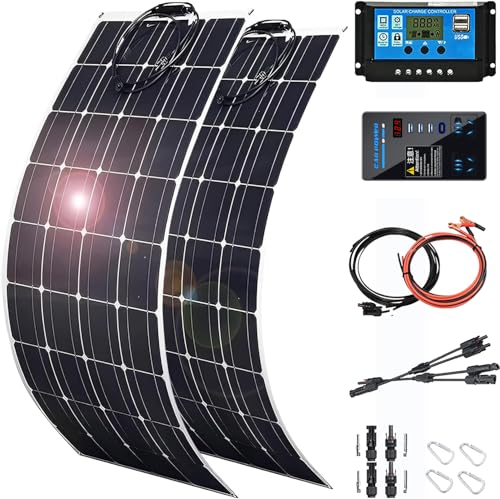
Best for: RVs, boats, and other curved surfaces. This kit uses monocrystalline cells with an ETFE cover for high light reflectivity and efficiency. The flexible panel design allows bending up to 30 degrees, enabling installation on irregular surfaces. This kit includes a 40A charge controller and an inverter, simplifying off-grid power in sun-rich environments. Caution: Flexible panels may be less durable under continuous heavy abrasion or sharp edge impact compared with rigid panels.
500 Watt Solar Panel Kit with 2×250W Flexible Panels

Best for: Small off-grid setups on curved surfaces such as RVs and boats. The kit offers two 250W flexible panels with a 40A controller and inverter. Panels are designed for low-light performance and contoured installations. Limitation: The total wattage is 500W, so power output depends on sun exposure and may require longer daylight hours to reach peak. Choose this if you value flexibility on irregular surfaces.
ECO-WORTHY 200W Starter Kit for RV Off Grid
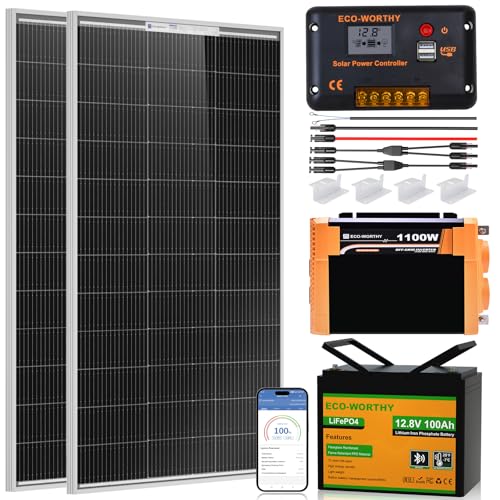
Best for: Beginners building a complete off-grid system. This 200W starter kit includes two 100W panels, a 100Ah lithium battery, an 1100W inverter, and a 30A PWM controller. It is designed to be easy to install and provides a turnkey power solution for RV trips or small cabins. Caution: The capacity is 200W, so larger loads may require battery capacity expansion or additional panels.
ECO-WORTHY 12V 200W Kit with Bluetooth Monitoring
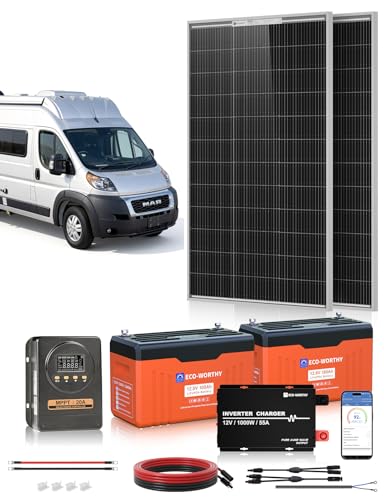
Best for: RVs and remote cabins needing smart monitoring. This kit includes two 100W panels, two 12V 100Ah LiBattery with SOC display, a 1000W inverter, and a Bluetooth/Wi‑Fi module for app control. It offers up-to-date monitoring features and an all-in-one solution for off-grid living. Limitation: Bluetooth/Wi‑Fi connectivity depends on device compatibility and smartphone reception.
ECO-WORTHY 200W Complete Starter Kit

Best for: Newcomers seeking a full, beginner-friendly off-grid solar system. The kit includes 200W of solar panels, a 50Ah LiFePO4 battery, and a 600W inverter. It emphasizes a straightforward setup and reliable daily output. Caution: Battery size may limit high-power equipment operation concurrently; plan loads accordingly.
Buying Guide
Power needs and system size: Determine your daily energy requirement in watt-hours to pick a kit with adequate battery capacity and inverter size. If you plan to run heavy appliances, prefer higher wattage panels and larger storage.
Panel flexibility versus durability: Flexible panels offer easy installation on curved surfaces but can be less durable than rigid panels in harsh environments. Consider your mounting surface and exposure risk.
Battery type and capacity: Lithium batteries generally offer longer life and deeper discharge than lead-acid. Ensure the kit provides safe charging, proper voltage, and compatible connectors for your intended load.
Controller and inverter compatibility: Check if the included charge controller supports your panel configuration and whether the inverter’s continuous wattage matches your typical loads.
Monitoring and ease of setup: Bluetooth or Wi‑Fi monitoring helps track performance. Beginner-friendly kits with step-by-step installation guides reduce DIY effort.
Mounting and space: Some kits are designed for RVs, boats, or cabins; verify mounting options, weight, and space requirements before purchase.
Future expandability: If you may scale up later, select kits that allow adding more panels or higher-capacity batteries without reconfiguring the entire system.
FAQ
- Q: Do these kits require professional installation? A: Some kits are designed for DIY installation, but consult local regulations or a professional for electrical safety and warranty considerations.
- Q: Can I expand a 200W kit to 500W later? A: Expansion is possible with compatible panels, controllers, and wiring; verify the kit’s compatibility before buying extra components.
- Q: Is lithium battery essential? A: Lithium batteries offer longer life and deeper discharge, but lead-acid options may be cheaper upfront. Choose based on budget and power needs.
- Q: Will these kits run my RV appliances at night? A: The included battery stores energy for use when solar input is low or unavailable; ensure battery capacity matches your load profile.
- Q: How many hours of sun are needed? A: Output depends on location, weather, and panel efficiency; typical installations aim for several hours of peak sun daily for reliable power.
- Q: Are these all-in-one kits best for beginners? A: All-in-one kits offer simplicity and faster setup, which is beneficial for beginners and first-time off-grid users.