Looking for a 50 amp propane generator that can power a whole home or RV setup during outages? This guide highlights five top options with strong 50A outlets, dual-fuel capability, and safety features. Each pick is explained for typical buyers: homeowners needing full-house backup, RV enthusiasts, and frequent campers. Compare run time, fuel flexibility, and safety features to choose the right model for your needs. A quick summary table follows to help you scan at a glance.
| Product | Fuel Options | Best For | Key Benefit |
|---|---|---|---|
| Westinghouse 12500 Peak Watt Dual Fuel | Gas, Propane | Home backup, transfer-ready power | 50A RV outlet and long runtime |
| Westinghouse 13500 Peak Watt Dual Fuel | Gas, Propane | Large homes, emergency power | High peak watts with 50A output |
| Westinghouse 14500 Peak Watt Tri-Fuel | Gas, Propane, Natural Gas | Largest homes, multi-fuel flexibility | Three-fuel versatility with 50A |
| AIVOLT 7500 Watt Dual Fuel | Gasoline, Propane | RV and smaller homes | Strong 50A RV-ready outlet |
| Gidrox 11000W Tri-Fuel | Gas, Propane, Natural Gas | Electronics-friendly, backup power | 50A outlet and CO safety features |
Westinghouse 12500 Peak Watt Dual Fuel — 50A Ready

This Westinghouse model delivers 9500 running watts (gas) and 12500 peak watts, or 8500 running watts and 11200 peak watts on propane. It includes remote electric start, a digital hour meter, and a CO sensor option on some variants. It features a heavy 457cc Westinghouse engine with a 6.6-gallon tank and fuel gauge, supporting up to about 12 hours of runtime at a generous load. The 50A RV outlet (14-50R) and 30A transfer switch-ready outlet enable substantial home or RV power transfer. Best for large homes or long outages where a robust 50A circuit is needed.
Who it’s best for: homeowners needing substantial whole-house backup or RVers relying on a 50A service. Why selected: high peak power, dual-fuel flexibility, and transfer-switch readiness. Caution: weight and size require a solid setup area and proper handling for transport and storage.
Westinghouse 13500 Peak Watt Dual Fuel — 50A RV Ready

With 10500 running watts on gasoline and 12500 peak watts on propane, this model suits larger homes or job sites needing reliable backup. It includes remote start, a 9.5-gallon fuel tank, and multiple outlets including a 50A RV-ready plug. The CO shutdown and long-hour meter provide practical safety and monitoring. Best for homeowners seeking a balance of high running wattage and a strong propane option. Choose this if you want extra peak power while still maintaining a flexible gas/propane setup. Limitation: propane performance can vary with weather and altitude.
Westinghouse 14500 Peak Watt Tri-Fuel — 50A Outlet
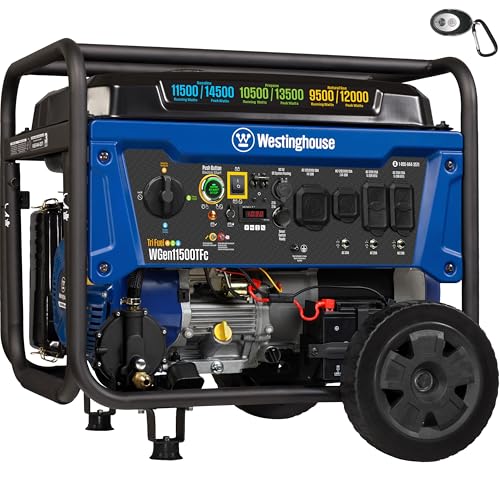
This tri-fuel generator provides 11,500 running watts (gas), 13,500 peak watts ( propane), and 12,000 peak watts on natural gas, all via a heavy-duty 550cc Westinghouse engine. It runs up to 19 hours on a 9.5-gallon tank and includes a 50A outlet plus transfer switch readiness. Best for larger homes or centers that require natural gas compatibility. Choose this if you want fuel flexibility across three sources. Caution: natural gas hookup requires an available gas line and proper installation.
AIVOLT 7500 Watt Dual Fuel — 50A RV Ready

Powered by a 322cc OHV engine, this dual-fuel generator handles 6300 watts on gasoline and 5800 watts on propane. It includes a full 50A RV outlet, a 120V 30A twist-lock, and standard 120V outlets. A CO Watch-Guard system adds carbon monoxide safety with visual alerts and automatic shutdown. Best for RVs or mid-sized homes that need a robust 50A capability with clear safety features. Limitation: lower running watts compared to larger Westinghouse models, so plan load accordingly.
Gidrox 11000W Tri-Fuel — 50A Outlet

Gidrox delivers 11,000W peak and 8,000–11,000W running watts depending on fuel, with tri-fuel capability and a 50A outlet. It features an advanced CO sensor, low THD for sensitive electronics, and a remote start option. Best for users who want three-fuel flexibility and electronics-friendly power. Choose this if you require safe operation for sensitive devices and plan to connect to a larger ATS. Limitation: higher fuel consumption on high loads due to the large power output.
Buying Guide
What to consider when selecting a 50A propane generator:
- Power needs: Match running watts to your essential circuits or whole-house load. Higher peak watts handle startup surges for appliances and AC units.
- Fuel versatility: Dual- or tri-fuel models offer flexibility if one fuel runs low during an outage.
- Outlets and transfer readiness: Ensure there is a 50A RV outlet and a transfer switch-compatible configuration or a ready transfer switch kit.
- Run time and tank size: Larger tanks extend runtime; consider fuel gauge availability for planning outages.
- Safety features: CO sensors, automatic shutdown, and sturdy enclosures reduce risks during operation.
- Noise and footprint: Inverter-based or modern designs often run quieter with better fuel economy; check space requirements for installation.
FAQ
- What does 50A outlet mean on a generator?
– A 50A outlet, typically a 14-50R receptacle, supports higher-load circuits and is designed for RVs and large transfer-switch setups. - Can these generators run on propane only?
– Yes, most listed models are dual- or tri-fuel and can operate on propane, gasoline, and sometimes natural gas, depending on the unit. - Is a transfer switch required for backup power?
– For safe, code-compliant whole-house power, a transfer switch is recommended; some units are transfer switch ready for easy installation. - Are these generators safe for sensitive electronics?
– Many models provide clean power or low THD via inverter technology, but always verify THD specifications for sensitive devices. - Which model offers the longest run time on propane?
– Propane run time depends on tank size and load; tri-fuel units with larger tanks tend to maximize endurance under propane use.