When you need fast, reliable charging in the car, a high-amp USB car charger is essential. This guide highlights top 5-amp car chargers suited for everyday drivers, travelers, and tech-heavy road trips. Each pick supports multiple devices, including iPhone, Android, tablets, and laptops, with varying port configurations. The best options balance fast charging, safety, and ease of use. Below is a quick buying table to compare key details at a glance.
| Product | Ports / Output | Best For |
|---|---|---|
| JUNVANG 90W 4-Port Car Charger | 2 USB-C, 2 USB-A; 90W max (PD/QC) + 240W cable | Power-hungry devices, families, multi-device charging |
| Meagoes 2-Pack 90W USB C Car Chargers | 2 USB-C; 45W each port | Two high-speed charges in the same car |
| NOCO GENIUS5 5A Battery Charger | 6V/12V, battery maintainer and desulfator | Lead-acid and Li-ion batteries in vehicles |
| Anker 323 USB-C Car Charger | One USB-C 30W, one USB-A 22.5W | Fast charging for phones and tablets, compact |
| KENHAO 3-Port 67W Car Charger | USB-C PD 37W, USB-A QC 30W | USB-C and USB-A devices in one hub |
JUNVANG 90W 4-Port USB C Car Charger
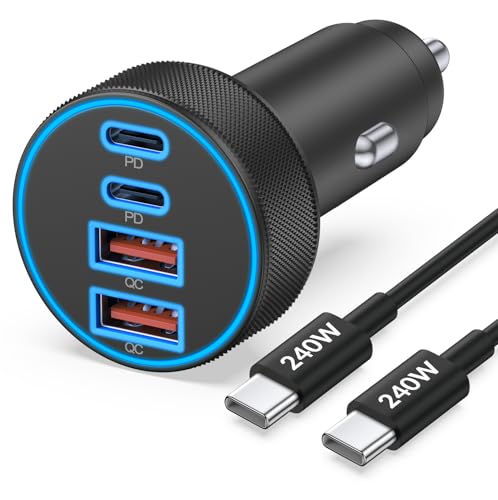
The JUNVANG charger offers a robust 90W PD/QC fast-charging platform across four ports, including two USB-C and two USB-A outputs. It supports PPS/PD fast charge for devices like iPhone 17 series and latest Androids, and a 240W USB-C cable for high-output devices. Best for households with multiple devices or for road trips where several gadgets need power at once. Choose this if you need strong power delivery to many devices in one car. Caution: Heat management is important with high output; avoid blocking the venting area of the car’s lighter socket.
Meagoes 2-Pack 90W USB C Car Chargers

This bundle includes two PD-capable car chargers with dual 45W USB-C outputs each, enabling rapid charging for two devices simultaneously. Best for families or carpooling where multiple devices need fast charging without compromising speed. It also features a soft blue LED to locate ports in the dark, while keeping brightness to a minimum. Limitation: No USB-A ports, so if you rely on older devices, you’ll need a separate charger for those.
NOCO GENIUS5 5A Battery Charger

The NOCO GENIUS5 is a smart battery charger and maintainer for 6V and 12V lead-acid and lithium batteries, including marine and powersport batteries. It features an integrated thermal sensor that adjusts charging based on ambient temperature to prevent overcharge or undercharge. Best for vehicle owners who want a versatile, all-in-one charging solution beyond quick charging. Caution: Not a standard USB car charger for phones—intended for battery maintenance and charging of automotive and similar batteries.
Anker 323 USB-C Car Charger

The Anker 323 provides a compact solution with a 30W USB-C port and a 22.5W USB-A port, enabling fast charging for phones and tablets while staying small enough for tight vehicle consoles. Best for drivers who want high-speed charging without adding bulk to the dashboard. Limitation: Only two ports, so simultaneous high-demand charging may require prioritizing devices.
KENHAO 3-Port 67W Car Charger

The KENHAO 67W car charger features PD 37W on USB-C and QC 30W on USB-A for fast charging across a mix of devices, including iPhones, Android phones, and tablets. Best for users who need a mix of USB-C and USB-A outputs in one compact device. Caution: Total output is shared; charging speeds may drop if multiple ports are used intensively at the same time.
Buying Guide
- Output Power and Port Configuration: Look for PD (Power Delivery) and QC (Quick Charge) support for the fastest device charging. Multi-port designs are ideal for households or multiple travelers.
- Device Compatibility: Ensure the charger supports your main devices (iPhone, Android, tablets, laptops). USB-C PD is typically the fastest option for newer devices.
- Cable Quality and Length: A high-quality, high-amp USB-C cable can dramatically affect charging speed. Longer cables may introduce some voltage drop; shorter, thicker cables often perform better at high wattages.
- Heat and Safety: Chargers with built-in temperature sensing and overcurrent/overvoltage protections reduce the risk of overheating or damage to devices.
- Form Factor and Durability: Wall-to-car adaptors vary in size and build. All-metal housings tend to dissipate heat more efficiently and resist wear in car environments.
- Bundle Value: Multi-car-charger packs can offer better value for families or multiple vehicles, especially when paired with extra cables.
- Road-Trip Scenarios: For long trips, consider chargers with multiple ports and higher total wattage to support several devices at once without sacrificing speed.
Frequently Asked Questions
- What does 90W charging mean in a car charger? It indicates the maximum power the charger can deliver across its ports, enabling faster charging for compatible devices.
- Can a car charger damage my device? When used with certified chargers and cables, charging is controlled by safety features to prevent overcharging or overheating.
- Is PD fast charging better than QC? PD is widely adopted for USB-C devices and generally provides faster, more versatile charging for higher-wattage devices.
- Do USB-C car chargers cause compatibility issues? Most modern chargers support a broad range of devices; check device compatibility with USB-C PD or QC standards.
- Should I buy a 2-pack or 3-pack charger? Multi-pack options are cost-efficient for households with multiple cars or for sharing with family and friends.
- Are there safety concerns with high-wattage car chargers? Look for chargers with thermal sensors and overload protection to minimize risks in hot or crowded electrical networks.