Whether you’re expanding an off-grid system, upgrading a rooftop setup, or equipping a portable power station, the right solar panel can dramatically boost energy production. This guide highlights five solid options that align with a 490-watt target by combining high-efficiency single panels and practical multi-panel configurations. Each choice is evaluated for best use cases, durability, and installation practicality to help you select the right fit for homes, RVs, farms, and remote cabins.
| Product | Channel | Estimated Output | Best For |
|---|---|---|---|
| JJN Bifacial 425W Panel | Single, Bifacial | 425W (front) + up to ~25% more from backsheet | Rooftop and off-grid homes needing higher daily yield with bifacial tech |
| STAR 430W Bifacial Panel | Single, Bifacial | 430W | Spaces with space-saving layouts; best for limited-area installations |
| Renogy N-Type 400W Panels (2Pcs) | Pair of 200W panels | 400W total | Compact 12V/24V systems; flexible in mobile setups and vans |
| DOKIO 400W Mono Panel | Single 400W panel | 400W | Ground mounts and accessory-ready off-grid arrays |
| ECO-WORTHY 200W Portable Panel Kit | Foldable portable panel | 200W | Portable power stations, camping, and temporary off-grid needs |
JJN Bifacial 425W Panel

The JJN 425W Bifacial panel uses a transparent backsheet to generate electricity from both sides, offering up to 25% higher energy output under suitable conditions. It employs 16BB N-type cells for improved efficiency and shading resilience. Its rugged aluminum frame and IP65/IP68-rated components support outdoor use in wind and snow events.
Best for: Off-grid homes, rooftops, and farms where extra daily yield justifies bifacial gains. Choose this if you expect strong sun from multiple angles and want a single-panel solution with front-and-back generation.
Caution: Bifacial gains depend on albedo and mounting conditions; performance may vary with shading or reflective surfaces.
STAR 430W Bifacial Panel

This 430W panel emphasizes high power density with an advanced half-cell design, enabling stronger output in limited space. It’s UL61730 certified and designed to perform with minimal light-induced degradation over a long lifespan. The architecture reduces installation complexity by simplifying mounting and wiring for compact off-grid setups.
Best for: Small residences, RVs, tiny houses, and other constrained spaces where space efficiency matters. Use this when you need high wattage per square foot and straightforward installation.
Caution: While space-efficient, real-world output still depends on sun exposure and mounting quality; strong shading can impact gains.
Renogy N-Type 400W Panels (2-Pack)

Renogy’s 400W panels use 16BB N-type cells for enhanced efficiency and better performance in warm conditions. The kit’s two-panel arrangement is designed for easy 24V or 12V system compatibility and can be deployed in tight spaces such as vans and cabins. The 7.5% smaller, lighter form compared to prior models helps with mobility.
Best for: RVs, cabins, and boats where a compact footprint and scalable power are priorities. Choose this set if you plan a modular array with potential future expansion.
Caution: Requires compatible mounting hardware and a suitable charge controller to maximize efficiency in your specific system voltage.
DOKIO 400W Mono Panel

The DOKIO 400W panel targets off-grid charging with robust power output and longer built-in MC4 leads (3 m). It offers practical wiring flexibility, especially important for setups where controller sizing and cable routing are critical. It emphasizes 12V parallel priority for smoother charging in 12V systems.
Best for: Gardens, greenhouses, and sheds where a reliable single-panel solution is preferred for battery charging and small scale power needs. Choose this if you value longer lead lengths and flexible wiring arrangements.
Caution: Real-world output depends on sun, temperature, and system configuration; ensure the MC4 leads and wiring meet your installation standards.
ECO-WORTHY 200W Portable Panel Kit
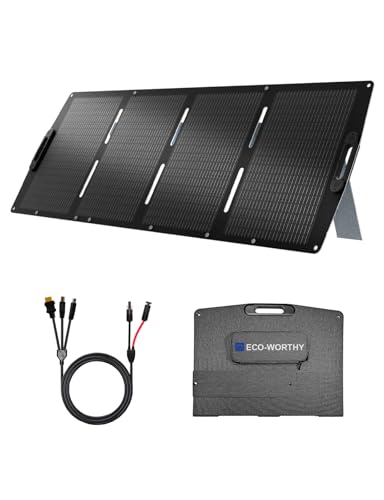
This foldable 200W panel kit uses high-efficiency monocrystalline cells with PERC technology to maximize light capture. The portable design includes a kickstand setup for quick positioning and compatibility with popular power stations via standard 19.4V MC4 outputs and adapters. It is well-suited for temporary off-grid needs and mobile installations.
Best for: Campers, RV travelers, and emergency power setups where portability and fast deployment matter. Choose this if you need a compact, easy-to-carry option to complement larger systems.
Caution: The 200W rating means it’s best paired with additional panels or supplemental storage to meet higher daily energy demands.
Buying Guide: Key Considerations For 490W Panel Options
- System architecture: Decide between single high-wattage panels (like 425–430W bifacial units) and multi-panel arrays (such as 2×200W Renogy packs) to match your roof space and electrical goals.
- Cell technology: N-type and bifacial designs offer better shading resilience and efficiency. Weigh upfront cost against potential output gains in your location.
- Durability and ratings: Look for IP ratings, wind and snow load specs, and frame materials that suit your climate.
- Installation footprint: Consider space constraints on rooftops, RVs, or ground mounts. Half-cell or compact designs can save space without sacrificing output.
- Wiring and compatibility: Ensure charge controllers, inverters, and battery banks match panel voltage (12V/24V/48V systems) and connector types (MC4, XT60, etc.).
- Portability vs. permanence: Foldable portable panels offer rapid deployment for temporary needs, while rigid panels suit permanent installations.
Frequently Asked Questions
- What defines a good 490W solar setup?
- Are bifacial panels worth installing on a home roof?
- Can I mix different brands in a single solar array?
- What is the best panel for small spaces like vans?
- How do I choose between a single high-watt panel and a multi-panel kit?
- Do higher efficiency cells guarantee better daily energy production?