For buyers seeking reliable 36-volt solar solutions, these panels and kits are tailored to charge 36V systems efficiently, whether you’re powering a golf cart, a small off-grid setup, or a portable power station. These options emphasize compatibility with 36V or higher battery systems and MPPT charging for better efficiency. This guide highlights five products that balance portability, durability, and practical use for 36V configurations. The quick-buying table summarizes key compatibility and use cases to help you compare at a glance.
| Product | Best For | Key Benefit |
|---|---|---|
| TXL 280W Flexible Solar Panel Kit | Golf carts and irregular surfaces | Ultra-thin flexible design with MPPT for 36V–72V systems |
| DOKIO 400W Monocrystalline Panel (31V) | Off-grid power stations and 12/24V systems | High real-world power with longer MC4 cable |
| DOKIO 200W Foldable Solar Panel Kit | Portable charging for 24V/36V setups | Compact, standalone controller, long cable |
| ECO-WORTHY 260W Flexible Kit | Golf carts needing more range | 1040Wh/day estimate with MPPT boost |
| CTOLITY 400W Portable Foldable Panel | Portable power needs for 36V systems | Foldable, high efficiency, universal kit |
TXL 280W Flexible Solar Panel Kit for Golf Carts

Best for: Golf cart owners who want continuous solar charging on irregular surfaces. This kit pairs two 140W flexible panels with an MPPT controller designed for 36V–72V packs, delivering up to 1120Wh per day under favorable sun. The panels are ULTRA-thin and significantly lighter than rigid panels, which helps with mounting on curved surfaces common to golf carts. The MPPT controller stabilizes charging and supports parallel or series connections. Caution: flexible panels can be more susceptible to micro-cracks if bent beyond recommended radii; check installation guidelines before mounting on uneven frames.
DOKIO Monocrystalline 400W Solar Panel (31V)

Best for: Off-grid setups requiring robust power and longer cable runs. This panel delivers real-world power around 400W, with an extended 3 m MC4 cable to simplify routing and reduce connectors. MPPT charging helps maintain steadier input into 12V systems, and parallel wiring is recommended for most 12V configurations. Limitations: performance varies with sun angle and temperature; higher voltage connections should align with a controller that supports the intended array configuration.
DOKIO 200W 36V Portable Foldable Kit
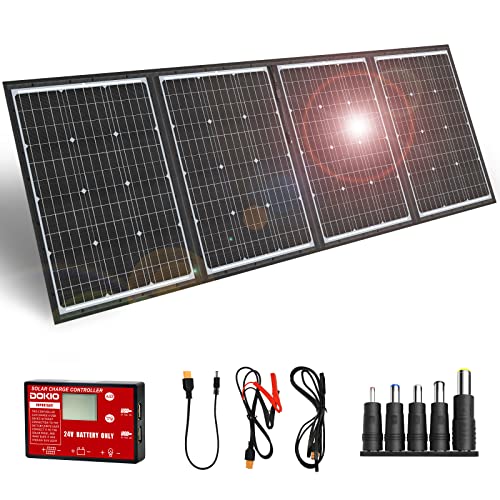
Best for: Travelers and campers needing a compact 36V-ready solution. This 200W foldable kit includes a standalone PWM controller, a long 9.8 ft cable, and a light 9.7 lb build. It is ideal for easy transport and quick setup near a shaded controller or power station. Caution: PWM controllers may be less efficient than MPPT in rapidly changing conditions; ensure you have 24V or compatible battery wiring and safety protections in place.
DOKIO 300W Portable Foldable Kit for 36V Use

Best for: Outdoor enthusiasts seeking higher-power portability for 36V systems. The kit folds compactly and includes a standalone controller with USB output for supplementary devices. The long cable helps place panels in sun while controllers stay shaded. Caution: The product description notes a foldable design; ensure the hinges and latches are kept clean and intact to avoid wear over time.
Buying Guide: Key Considerations For 36V Solar Setups
What should you look for when choosing 36V solar panels?
- Voltage compatibility: Verify whether the panels are designed for 36V, 48V, or higher systems and ensure your charger or controller supports 36V input or higher.
- Controller type: MPPT controllers generally offer higher efficiency than PWM, especially in variable sun. If your kit includes MPPT, your 36V system will charge more consistently.
- Panel flexibility vs. rigidity: Flexible panels excel on curved surfaces like golf carts, but rigid panels generally deliver robust long-term performance. Choose based on mounting surface and climate.
- Weight and portability: If you travel often, lighter portable kits with carry handles and compact folds are advantageous for quick setup.
- Cable length and routing: Longer MC4 or DC cables simplify placement, but excessive length can introduce voltage drop. Plan routing to keep panels in sun and controllers shaded when possible.
- Environment and durability: Look for waterproof or weather-resistant builds and sturdy frames for outdoor use. IP ratings and frame materials influence longevity in harsh conditions.
- System integration: Check whether the kit supports parallel or series connections and confirm compatibility with your battery bank (lead-acid, lithium, GEL, etc.).
Frequently Asked Questions
- What is the advantage of 36V solar panels?
36V panels are commonly used for golf carts and mid-range battery systems; they convert sunlight to an appropriate charging voltage for higher-capacity packs, improving charging efficiency when paired with proper MPPT controllers. - Do I need MPPT for 36V systems?
MPPT controllers typically offer better efficiency in fluctuating sunlight and temperatures, particularly for higher voltage arrays; consider MPPT when your budget allows. - Can I upgrade a 36V golf cart to flexible panels?
Yes, flexible panels are suitable for curved surfaces on many golf carts, provided mounting methods and weather protection meet the manufacturer’s guidelines. - What should I check before buying a kit?
Confirm voltage compatibility, controller type, cable length, and whether the kit includes mounting hardware or requires additional components for your setup. - Are portable kits suitable for off-grid cabins?
Portable foldable kits can serve as supplemental power, but for a stable off-grid cabin system you may need larger arrays, proper mounting, and robust charge controllers. - How does sun exposure affect output?
Real-world output varies with sun angle, temperature, shading, and cable runs; MPPT helps compensate for some of these factors, but ideal conditions maximize generation.