Choosing the right 3500-watt generator for an RV ensures you can power essentials—air conditioning, cooking, lighting, and charging—without interruption. This guide compares five RV-ready inverter generators, highlighting who each model is best for, plus practical buying tips. The list focuses on models with peak or running watts around 3500, suitable for typical RV loads and outdoor use.
| Product | Peak / Running Watts | Fuel Type | Best For |
|---|---|---|---|
| LIFAN 3500W Portable Inverter Generator | 3500W peak, 3000W rated | Gas | Quiet, sensitive electronics, RV use |
| ERAYAK 4500W Dual-Fuel Inverter | 4500W peak / 3500W rated (gas), 4050W peak / 3150W rated (propane) | Gas / Propane | Flexible power for RVs and emergencies |
| Champion Power Equipment 4500-Watt RV Ready | 4500W peak / 3500W running | Gas | Quiet operation and long run time for RVs |
| Oxseryn 4400W Inverter Generator | 4400W peak / 3400W running | Gas | RV backup and portable power with multiple outputs |
| Pulsar PGD40ISCO Ultra Light 4000W | 4000W peak / 3200W running | Gas | Lightweight, quiet operation for camping |
ERAYAK 4500W Dual-Fuel Inverter Generator

Best for: RV users who value fuel flexibility and longer runtimes. This dual-fuel inverter provides gasoline or propane power, with a gas-priority switch to avoid sudden outages. Its large power output supports RV essentials and tools during outdoor trips.
- Dual-fuel capability (gasoline and propane) for flexibility
- Gas priority auto-switch minimizes downtime
- Portable design with compact dimensions
Limitation: Heavier than some lighter options, which can affect transport in tight spaces. Consider storage and handling if you frequently move the unit by hand.
Champion Power Equipment 4500-Watt RV Ready

Best for: RV owners seeking quiet operation and a robust runtime. This generator is engineered for low noise plus extended run time, making it suitable for overnight camping and tailgating.
- 61 dBA quiet technology for RV parks and campsites
- Parallel-ready option to double output with another unit
- CO Shield protects against carbon monoxide exposure
Limitation: Parallel kit sold separately, which means additional investment is needed to reach higher output.
Oxseryn 4400W Inverter Generator
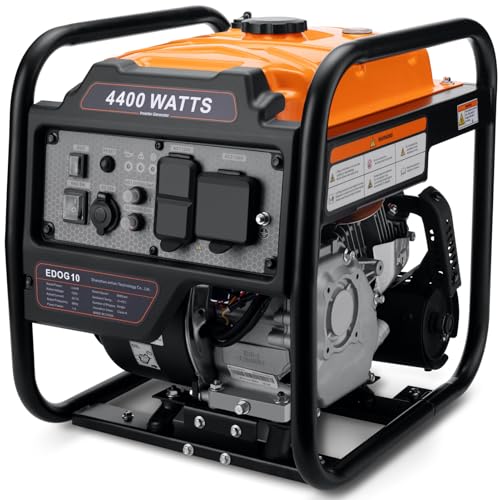
Best for: RVers who need versatile outputs and long runtime. It delivers multiple outlets including RV power, and its ECO mode reduces fuel consumption while extending runtime.
- Multiple output options (RV, 120V, DC)
- Long runtime up to 14 hours at low load
- Built-in fuel gauge for easy monitoring
Limitation: Higher fuel consumption under heavy loads; plan for sustained power needs accordingly.
Pulsar PGD40ISCO Ultra Light 4000W

Best for: Campers seeking a lightweight, reasonably quiet generator with solid power for RV loads. Its compact size makes it easy to store in smaller RV compartments.
- 4,000 peak watts and 3,200 running watts
- Lightweight design with relatively quiet operation
- One-gallon fuel capacity provides around 4 hours at half load
Limitation: Smaller fuel tank means more frequent refueling on longer trips.
Buying Guide: Key Considerations For 3500 Watt RV Generators
Power needs vary by RV size, climate, and appliances. Consider the following to pick the right unit.
- Power requirements: Determine peak and running watts of your RV loads (air conditioner, fridge, microwave, heater, outlets).
- Fuel type and availability: Gasoline units are common; dual-fuel options add flexibility during outages or travel.
- Inverter technology: Look for pure sine wave output (<3% THD) to protect sensitive electronics.
- Noise level: If you park in camps or parks, choose models around 58–62 dB for neighbor-friendly operation.
- Run time and tank size: Larger tanks extend runtime, reducing refueling needs during trips.
- Portability and dimensions: Weight and footprint matter for storage in RV compartments or trunks.
- Outlets and versatility: Ensure the generator provides RV-ready outlets and extra USB or 12V ports if needed.
- Safety features: CO sensors, automatic shutoffs, and proper ventilation are important for safe operation.
- Parallel capability: If you anticipate higher loads, check whether a parallel kit is available and compatible.
Frequently Asked Questions
- What is the difference between peak and running watts?
Peak watts represent the maximum momentary power, while running watts indicate sustained power. For RVs, running watts matter for ongoing loads; peak watts handle startup surges. - Is pure sine wave power necessary for RV appliances?
Yes. Pure sine wave general inverter generators provide clean, stable power, safer for electronics like laptops and CPAP machines. - Can I run an RV air conditioner on a 3500W inverter?
Some 3500W inverters can support smaller RV AC units with efficient power management, but high-btu models may require higher capacity or parallel setups. - What is the benefit of a dual-fuel generator for camping?
Dual-fuel units offer flexibility if gasoline becomes scarce; propane can be a convenient backup fuel source. - How important is run time for RV trips?
Long runtimes reduce refueling breaks and provide reliable power during extended campsites or outages. - Do I need a parallel kit to increase output?
Parallel kits enable you to pair two inverter generators for more power; ensure compatibility with your model.