When choosing a 3500-watt dual fuel generator, the goal is reliable power that’s flexible in fuel options and easy to use in everyday scenarios. This guide highlights five top models suited for home backup, camping, and RV use. It covers fuel versatility, run times, noise levels, and safety features to help you pick the right unit. The selections favor models with solid portability, decent run times on both gas and propane, and practical safety features for sensitive electronics.
| Product | Best For | Fuel Options | Key Benefit |
|---|---|---|---|
| PowerSmart 3800W Dual Fuel Inverter | Home backup & quiet camping | Gas/Propane | Best balance of surge/wattage and quiet operation |
| MaXpeedingrods 3500W Dual Fuel | Small homes & RVs | Gas/Propane | Easy start options and long runtime with Eco mode |
| WEN Quiet 3600W Dual Fuel | Noise-sensitive locations | Gas/Propane | Very quiet operation and clean power |
| LIFAN 3500W Portable Inverter | RV parks & camping | Gas/Propane | Extremely quiet and compact |
| Pulsar GX400BN 4000W Dual Fuel | Higher peak needs & portability | Gas/Propane | High peak output with RV-ready features |
PowerSmart 3800W Dual Fuel Inverter Generator
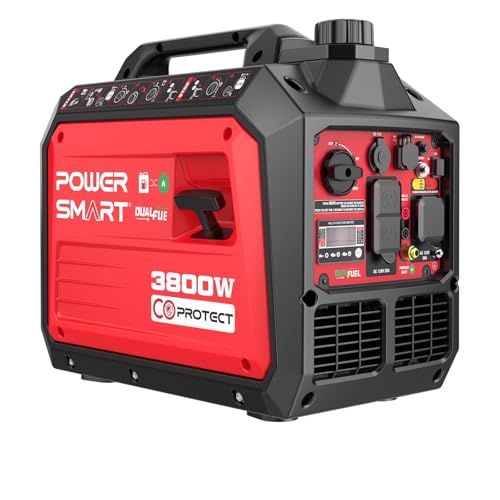
Best for home backup and quiet camping needs a dual-fuel unit that smoothly alternates between gasoline and propane. PowerSmart delivers 3800 surge watts on gas and 3500 surge watts on propane, with rated watts at 3300 gas and 3100 propane. The inverter system produces clean power with less than 3% THD, making it safe for laptops, CPAP machines, and phones. A quiet operation of about 59 dB at 23 feet makes it suitable for neighborhoods and campgrounds. Best for users prioritizing fuel flexibility and low noise.
- Dual fuel versatility: switch between gasoline and propane with ease for long outages or remote camping.
- Quiet output: 59 dB at 23 feet keeps noise to a minimum in campgrounds and backyards.
- Clean power: Pure Sine Wave with <3% THD supports sensitive electronics.
Who it’s best for: Homeowners needing an adaptable generator for outages and campers who value quiet operation. Caution: Dual-fuel units may require more frequent maintenance than single-fuel units.
MaXpeedingrods 3500W Dual Fuel Inverter Generator
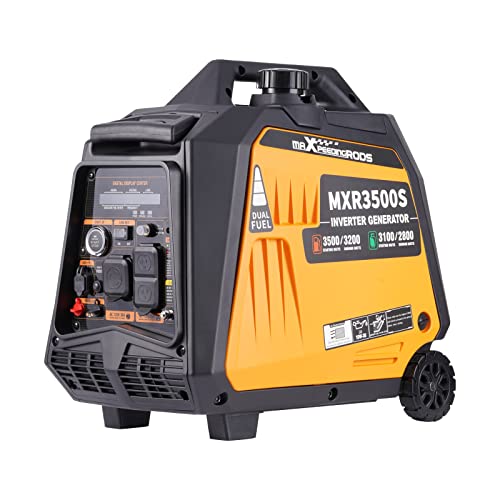
The MaXpeedingrods model targets reliable home backup and RV use with dual fuel capability. It offers 3500 surge watts and 3200 rated watts on gas, and 3100 surge watts with 2800 rated watts on propane. Features include three starting options: remote, electric, and recoil, providing quick starts in varying conditions. In Eco mode, run times extend, with approximate operation of 11 hours on gas and up to 24 hours on LPG at lower loads. Best for users who want flexible fueling and easy starting.
- Multiple start methods: remote, electric, and recoil for quick readiness.
- Eco mode prolongs runtime to maximize fuel efficiency.
- Extended LPG operation suitable for longer outages with external LPG tanks.
Who it’s best for: Users seeking versatile starting options and longer run times on propane. Caution: Propane performance may be reduced in very cold conditions.
WEN 3600W Quiet Dual Fuel Generator

The WEN DF360iX emphasizes quiet operation and clean power suitable for sensitive electronics. It runs on gasoline with 3600 surge and 2900 rated watts, or propane with 3500 surge and 2600 rated watts. It’s designed to be very quiet, providing a favorable option for campgrounds or household use where minimal noise is important. Best for users who prioritize conserving fuel while maintaining steady power for devices and small appliances.
- Low noise: designed to be extremely quiet in typical usage scenarios.
- Dual fuel flexibility with respectable surge and running watts.
- Clean power output suitable for electronics and laptops.
Who it’s best for: People who want quiet operation in shared spaces and a balance of power for standard home backup. Caution: Lower running watts on propane may limit larger loads on propane fuel.
LIFAN 3500W Portable Inverter Generator

The LIFAN 3500W generator focuses on ultra-quiet operation and compact design. It provides 3000W rated and 3500W peak power with THD under 3%. This model is ideal for RV camping, backyard power, and small appliances requiring stable voltage. It weighs about 46 pounds and has a compact footprint for easy storage. Best for campers and RV travelers who need a quiet, space-saving unit.
- Very quiet operation: suitable for noise-sensitive areas like campgrounds.
- Compact and portable with built-in handle for easy transport.
- Safe for electronics due to low THD and clean power.
Who it’s best for: RV travelers and campers prioritizing portability and quiet performance. Caution: Lower gas-only wattage limits heavy loads on gasoline alone.
Pulsar GX400BN 4000W Dual Fuel

The Pulsar GX400BN provides 4000 peak watts and 3200 running watts on gas, with 3600 peak and 2800 running watts on propane. It features a high-speed 5.5HP 149cc engine and is designed with RV readiness in mind. It’s a strong option when you anticipate higher peak loads or need parallel capability with other units. Best for users needing extra surge capacity and the option to pair units for more power.
- Strong peak output suitable for appliances with high startup load.
- RV-ready and convenient for camping and emergencies.
- Parallel capability enables longer runtimes with additional units.
Who it’s best for: Those who require higher peak power and the flexibility to scale power via parallel setups. Caution: Heavier than some compact models; consider storage and transport needs.
Buying Guide: 3500-Watt Dual Fuel Generators
Fuel Flexibility And Run Time
Dual-fuel models let you switch between gasoline and propane. Gasoline offers longer run times per fill, while propane can be stored longer and is useful during extended outages. Look for run-time specs at a typical load (25-50%) to compare across models.
Power Output And Suitability
Peak watts indicate startup capacity; running watts determine sustained loads. For home backup, 3000–3500 running watts covers most home essentials. For RVs or small shops, ensure the running watts meet your critical devices’ needs.
Noise And Portability
Lower decibel ratings enhance usability in neighborhoods and campsites. Weight and handle design influence portability, especially if you need to move the generator frequently or store it in tight spaces.
Safety And Electronics Compatibility
Inverter technology and a low THD (total harmonic distortion) help protect sensitive electronics. Features like CO sensors and auto shutoff systems improve safety where exhaust or gas leaks could be concerns.
Starting Methods And Convenience
Remote, electric, and recoil starts improve reliability in adverse conditions. Consider models with multiple starting options if you often power up in difficult locations or when you want quick access in emergencies.
Maintenance And Accessories
Check for included essentials such as oil, funnels, tool kits, and user manuals. Some models offer parallel kit compatibility, which can extend total power by pairing units.
Summary At A Glance
- Best all-round balance: PowerSmart 3800W Dual Fuel Inverter — quiet, versatile, safe for electronics.
- Best for multiple starts: MaXpeedingrods — remote/electric/recoil starts, long propane run times.
- Quiet operation: WEN 3600W — ideal for noise-sensitive locations with clean power.
- Ultra-portable: LIFAN 3500W — light, compact, extremely quiet for camping.
- Higher peak option: Pulsar GX400BN — strongest peak output with parallel capability.
Frequently Asked Questions
- What is the difference between peak watts and running watts? Answer: Peak watts indicate startup surge capacity; running watts show steady, continuous power.
- Are dual-fuel generators safer for home use? Answer: They offer flexibility, but always follow local safety guidelines and use proper ventilation.
- Is an inverter generator better for electronics? Answer: Yes, inverter generators provide cleaner power with stable voltage and low THD.
- Can I parallel two generators? Answer: Some models support parallel operation; check manufacturer guidance and necessary kits.
- Which fuel is cheaper? Answer: Propane can be cheaper in some areas and is easier to store long-term, but gasoline often provides longer run times per volume.