The 3400 watt class of inverter generators blends portability with reliable power for camping, emergencies, and off-grid adventures. This guide highlights five popular models, focusing on running watts, fuel type, noise levels, portablility, and add-on features like multiple outlets and CO protection. Each entry includes a quick overview and how it fits typical use cases—from RV nights to backyard power outages. Use the Buyer’s Guide to compare sizing, fuel type, and accessories to choose the right model for your needs.
| Product | Power (Running / Peak) | Fuel | Weight | Notable Feature |
|---|---|---|---|---|
| maXpeedingrods 3400 Watt Portable Inverter Generator | 3000W / 3400W | Gasoline | 46 lbs | RV ready, multiple outlets |
| PowerSmart 3800-Watt Portable Inverter Generator | 3300W / 3800W | Gasoline/Propane | Not stated | Dual fuel, RV 30A outlet |
| A-iPower 4600W RV-Ready Quiet Generator | 3600W / 4600W | Gasoline | 56 lbs | CO sensor, open frame |
| WEN 3600-Watt Dual Fuel Inverter Generator | 2900W / 3600W | Gasoline/Propane | Not stated | CO watchdog, quiet operation |
| Aceup Energy 4000 Watt Inverter Generator | 3200W / 4000W | Gasoline | Not stated | EPA compliant, parallel ready |
maXpeedingrods 3400 Watt Portable Inverter Generator

The maXpeedingrods model is a compact, gas-powered inverter designed for outdoor use and emergency power. It delivers up to 3400 watts peak and 3000 watts running power, with a runtime expectancy of up to 8 hours under certain loads. Its 4-stroke 144cc engine is paired with two 120V 20A outlets, a 120V 30A outlet, and two USB ports, expanding compatibility for camping gear, lighting, and small appliances. Weighing about 46 pounds, it emphasizes portability for RV trips or backyard gatherings.
PowerSmart 3800-Watt Portable Inverter Generator

The PowerSmart unit offers dual-fuel versatility, supporting gasoline (3800 starting watts, 3300 running watts) and propane (3500 starting watts, 3100 running watts). It provides roughly 4.5 hours of runtime at 50% load and includes a 30A outlet suitable for RV and home backup setups. Noise levels are around 59 dBA at 23 feet at 25% load, making it a considerate option for quiet camping and neighborhood outages while maintaining robust power for essentials.
A-iPower 4600W RV-Ready Quiet Portable Inverter Generator
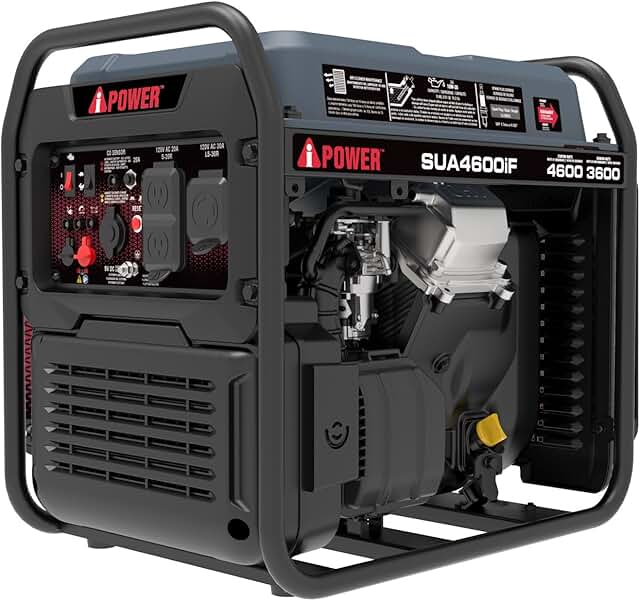
The A-iPower model targets higher power needs with 4600 starting watts and 3600 running watts from a 149cc engine. Weighing about 56 pounds, it remains portable for camping and home backup. It features inverter technology for clean power (low total harmonic distortion) and is well-suited for sensitive devices such as laptops and TVs. It is described as RV-ready, supporting typical 120V AC loads with a focus on stable performance in outdoor settings.
WEN Quiet and Lightweight 3600-Watt Dual Fuel Inverter Generator

The WEN DF360iX delivers dual-fuel capability with 3600 surge watts and 2900 rated watts on gasoline, plus propane options of 3500 surge watts and 2600 rated watts. It emphasizes quiet operation and clean power suitable for charging devices and running electronics. The unit’s CO watchdog and inverter technology align with safety-conscious camping and home backup uses, particularly where low noise is valued in campsites or quiet neighborhoods.
Aceup Energy 4000 Watt Inverter Generator

The Aceup Energy unit uses a 149cc 4-stroke OHV engine to produce 4000 peak watts and 3200 rated watts, with a runtime of up to about 5 hours at half-load on a 1.32 gallon tank. It includes an intelligent gauge to monitor voltage, runtime, gasoline level, hertz, and output, plus features like a low oil indicator and economy mode. Its outlets include 120V AC and an RV receptacle, with a 12V DC car charger; it is parallel-ready for doubling power when needed.
Buying Guide: Key Purchase Considerations
Power requirements: Estimate total wattage for essential devices and appliances. If you expect higher starting loads, consider units with surge watts well above running watts to handle on-demand power.
Fuel options: Gasoline units are common, but dual-fuel models enable propane use when gasoline is scarce or during longer outages. Propane can be cleaner and easier to store for some users.
Noise and comfort: Measured in decibels, quieter units are preferable for campsites, RV parks, and residential areas. Inverter technology typically reduces noise while delivering clean power suitable for electronics.
Portability and weight: For frequent road trips, look for lighter models with compact profiles and handles. If your uses include remote camping spots, a lighter unit simplifies transport and storage.
Outlets and compatibility: Ensure the generator provides the right mix of outlets (120V, 20A, 30A, USB) and RV connectors if you intend to power an RV or specific appliances. Parallel-ready options expand future capability.
Safety features: CO sensors, shutoff features, and proper overload protection help minimize risk when used in enclosed spaces or tents. Always operate outdoors in well-ventilated areas.
Reliability and maintenance: Look for reputable brands with accessible parts and good support networks. Regular oil changes and fuel stabilization can extend run time and performance.
Warranty and support: Check warranty length and coverage on both generator components and accessories. A strong service network reduces downtime during repairs or maintenance.
Budget alignment: While higher power and dual-fuel features add flexibility, balance price with expected use. If you only need occasional power for camping, a lighter, simpler unit may be more cost-effective.
Environmental considerations: Fuel efficiency, emissions, and noise levels vary by model. If eco-friendliness is a priority, review THD (Total Harmonic Distortion) and inverter technology specifics to protect electronics and reduce fuel use.
Usage scenarios: RV work, home backup, camping, and events all have distinct requirements. Choose a model that aligns with your most frequent use case, and consider a second unit or a parallel kit for extended power needs.