The following selection highlights 3 phase power generator options and accessories that help convert or manage three-phase power for American homes and workshops. This guide covers rotary phase converters, micro generators for educational use, permanent magnet generators, phase transformers, and automatic transfer switches. Each entry includes a quick reference, practical uses, and key features to consider when choosing a system.
| Product | Brand | Type | Key Use |
|---|---|---|---|
| PL-5 Pro-Line 5HP Rotary Phase Converter | NAPCco Pro-Line | Rotary phase converter | Single to three-phase conversion |
| CrocSee Micro 3 Phase AC Mini Brushless Generator | CrocSee | Micro 3-phase generator kit | Educational and small-scope experiments |
| 3-Phase Permanent Magnet Generator | Generic | Low RPM PM generator | Wind/water turbine or standalone 3-phase supply |
| 10KW Transformer 3-Phase AC 220V to 380V | WTTTOOLS | Voltage transformer | Step-up three-phase conversion |
| Automatic Generator Transfer Switch, 125A | MARSTEK | Transfer switch | Backup power with automatic switching |
PL-5 Pro-Line 5HP Rotary Phase Converter

The PL-5 Pro-Line rotary phase converter is designed to start and run a 2.5 HP motor or load types such as CNC machines, resistive or inductive devices up to 7 amps at 208–240 volts. For heavier 5HP motor loads, the PL-10 Pro-Line is recommended. The converter comprises two main parts: an electrical control panel and an idler motor, simplifying installation and use for workshop environments where true 3-phase power is needed from single-phase supply.
CrocSee Micro 3 Phase AC Mini Brushless Generator
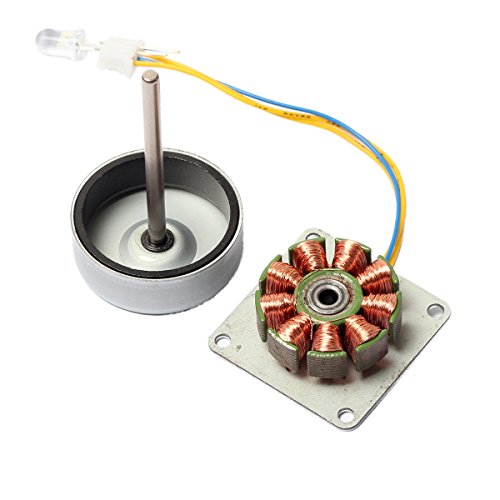
This micro 3-phase brushless generator is suitable for educational purposes and small-scale experiments in electricity generation. It teaches the basics of three-phase generation and can serve as a starting point for larger projects. Output ranges from 3V to 24V with current capabilities around 0.1A to 1A, offering a safe, hands-on learning tool for students and hobbyists exploring electrical concepts.
3-Phase Permanent Magnet Generator

This low-speed permanent magnet generator uses NdFeB magnets and copper windings to deliver stable 3-phase output with good efficiency. Constructed with a die-cast aluminum housing, it is durable against wind, rain, and environmental exposure. It is designed to be easy to operate, with direct-drive capability and minimal maintenance needs, making it a practical option for wind or water turbine projects and other low-speed 3-phase applications.
10KW Transformer 3-Phase AC 220V to 380V

This transformer device provides 3-phase AC 220V input to 380V output, with a power rating of 10 kW. It is designed for safe, stable three-phase voltage transformation in industrial or large workshop settings. The unit’s dimensions and weight (approximately 470mm x 370mm x 360mm and around 50 kg) reflect a robust, install-ready solution with a user-friendly electronic display and straightforward controls for operation.
Automatic Generator Transfer Switch, 125A 120V 3 Pole

This 3-pole automatic transfer switch ensures seamless power transfers between a primary source and backups. It includes over/under voltage protection and overcurrent safeguards to protect connected appliances. The switch supports flexible phase priority settings and programmable timing (1–999 seconds) for automatic shutdown during low-demand periods, making it suitable for home backup systems and RV installations where reliable automatic switching is essential.
Buying Guide
- Purpose and compatibility: Determine whether you need a rotary phase converter to create a true three-phase supply from single-phase input, a dedicated generator for three-phase output, or a transformer/transfer switch for backup and distribution needs.
- Voltage and phase: Ensure the device supports your target voltage (common North American values include 120/240V single-phase or 208–240V three-phase, depending on the setup) and the required phase stability.
- Load characteristics: Consider motor starting currents, inductive vs resistive loads, and peak demand. Rotary converters may handle mixed loads differently than PM generators or transformers.
- Efficiency and heat: Review efficiency ratings and heat dissipation, especially for larger systems or continuous operation. Poor efficiency can lead to energy waste and extra cooling needs.
- Durability and protection: Look for rugged enclosures, corrosion resistance, and protective features such as overvoltage, undervoltage, and overcurrent protections to safeguard appliances.
- Ease of installation: Some solutions require professional installation (especially higher-wattage transformers and transfer switches), while others are more plug-and-play with clearer wiring diagrams.
- Maintenance and lifecycle: Consider maintenance requirements, warranty coverage, and expected lifespan of motors, magnets, or electronics.
- Noise and footprint: Rotary converters can produce audible noise and vibrations; assess enclosure design and space requirements to fit your workshop or site.
- Future expansion: If you anticipate higher loads later, plan for scalable options (e.g., an upsized rotary converter or a higher-capacity transfer switch) to avoid retrofits.
- Regulatory considerations: Verify compliance with local electrical codes and safety standards, especially for fixed installations in homes or RV setups.