Answering the search intent for 280 watt solar panels, this guide highlights top options aligned with high efficiency, portability, and off-grid reliability. The list targets buyers seeking mobile or stationary setups, including campers, RV owners, and emergency backup planners. Each entry includes who it’s best for, why it stands out, and any notable limitations. A compact buying table at the end of the introduction helps compare core specs at a glance.
| Product | Type | Key Benefit | Best For |
|---|---|---|---|
| TWELSEAVAN 280W Panel | Portable | 25.8% efficiency, wide MC4 compatibility | Outdoors, camping, RVs |
| CTOLITY 400W Panel | Portable Foldable | 23% efficiency, IP65 waterproof | Outdoor adventures, emergencies |
| Callsun 400W Bifacial | Bifacial | Rear-side energy capture, anti-shade | Rooftop or open areas with sun exposure |
| Renogy 250W Bifacial | Bifacial | 25% efficiency, high bifaciality | Off-grid cabins, RVs |
| VEVOR 200W Foldable | Foldable | 24% efficiency, multi-port charging | Traveling power needs |
TWELSEAVAN 280W Portable Solar Panel

The TWELSEAVAN 280W panel uses 25.8% high-efficiency HPBC solar cells to deliver up to 280W under optimal sun. Its ETFE-laminated surface provides high light transmission, helping maximize energy capture. This panel is best for outdoor enthusiasts who need a lightweight, portable solution for camping, RV trips, or off-grid campsites. The 14 lb weight and foldable design with four adjustable kickstands enable quick setup and stable positioning.
Best for: campers, RV travelers, and emergency prep where portability and fast tilt setup matter. Caution: more sunlight exposure yields higher output; performance may drop under heavy shading or overcast conditions.
CTOLITY 400W Portable Solar Panel

The CTOLITY 400W panel delivers 23% efficiency for reliable power generation. It’s designed for outdoor adventures and home backups, with IP65 waterproofing and an auto-reboot feature to adapt to changing light. Aimed at users with larger power needs, this panel pairs well with Jackery, EcoFlow, and similar power stations. Its foldable, lighter build enhances portability, but its higher wattage may require more storage space when folded.
Best for: outdoor explorers and emergency planners needing substantial portable solar capacity. Caution: heavier than ultra-compact models; ensure sufficient storage space in vehicles or packs.
Callsun N-Type 400W Bifacial Panel

Callsun’s 400W bifacial panels use N-Type 16BB cells for up to 25% efficiency and a rear-side energy capture that can boost total output by up to 30%. The dual-module anti-shade design keeps power flowing when part of the panel is shaded. These panels are well-suited for rooftop installations or open-field setups where shade is a concern. Limitation: bifacial performance depends on rear reflections and mounting conditions.
Best for: users seeking higher overall daily energy with shade resilience. Choose this if your installation has ample sun and you can optimize rear-side exposure. Caution: performance gains depend on installer and mounting orientation.
Renogy 250W Bifacial N-Type Panel

Renogy’s 250W bifacial N-Type panel uses 16BB cell technology and achieves about 25% efficiency with an 80% bifaciality factor. The rear-side energy contributes roughly 14% more power, providing better summer performance and high-temperature resilience with a low temperature coefficient of -0.29%/°C. This panel is ideal for RVs or rooftops in hot climates. Limitation: higher initial cost, and performance relies on proper rear-side exposure.
Best for: off-grid installations needing higher daily output in hot conditions. Choose this if rear-side gains are feasible in your setup. Caution: installation quality affects bifacial gains.
TXL 280W Flexible Solar Panel Kit

This kit provides two 140W flexible panels totaling 280W, with MPPT controller and 36V/48V/60V/72V compatibility. Its ULTRA-THIN flexible design is 0.1 inches thick and light, suiting irregular surfaces and golf carts. It includes an MPPT controller with protections and a real-time charge readout. Limitation: flexible panels can be more susceptible to wear over time and may require careful mounting.
Best for: golf carts, irregular surfaces, and portable setups where flexibility and weight are critical. Choose this if you need a light, adaptable system. Caution: ensure proper mounting to tolerate flexing and movement.
Renogy 200W Portable Solar Panel

Renogy’s 200W portable panel uses N-Type 16BB cells with 25% efficiency, offering a compact foldable solution with MC4 outputs for power stations and 12V systems. It weighs about 13.9 lbs and folds to backpack size, making it ideal for limited spaces. The panel supports charging multiple devices via USB-C PD and USB-A ports on compatible setups. Limitation: lower wattage than 280W models, which may require more panels for high-demand loads.
Best for: those prioritizing compact size and quick setup in tight spaces. Choose this if you need a portable, space-saving option. Caution: may require additional panels to meet higher power needs.
VEVOR 200W Foldable Solar Panel
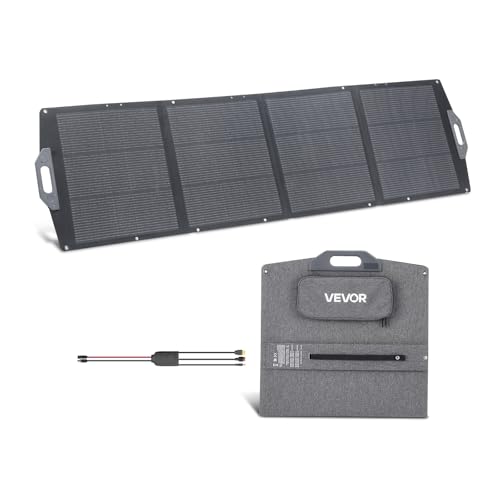
VEVOR offers a 200W foldable panel with 24% efficiency and MC4 output, plus USB-A, Type-C, and DC ports for multi-device charging. Its IP67 rating supports rugged outdoor use, making it a solid choice for camping and hikes, and it includes a versatile 3-in-1 MC4 connector cable for broader compatibility. Limitation: at 200W, it falls short of the 280W target, potentially requiring more panels for high-demand loads.
Best for: multi-device charging on outdoor trips where rugged, all-weather performance matters. Choose this if you need a robust, portable solution with broad compatibility. Caution: may require a larger array to meet higher energy needs.
Buying Guide: Key Considerations for 280W Panels
- Portability vs. power: Balance the need for lightweight, compact panels with the target wattage to meet daily energy demands.
- Cell technology: N-Type and bifacial designs offer higher efficiency and rear-side gains; consider climate and mounting when choosing.
- Durability: Look for IP65/IP67 ratings or better, weatherproof laminates and rugged frames for outdoor use.
- Compatibility: Ensure MC4, USB-C PD, and vehicle/VPS compatibility with your power stations or inverters.
- Mounting and space: Foldable designs fit tight spaces; bifacial setups require optimal rear exposure for best results.
- Maintenance: ETFE surfaces resist yellowing and allow longer efficiency; plan for cleaning and inspection.
FAQ
- What is the practical wattage of a 280W solar panel in real-world conditions? In bright sun, it can approach the rated 280W; in partial shade or lower sun, expect proportionally lower output.
- Do bifacial panels require special mounting? Yes, they perform best with rear-side exposure and reflective surroundings to maximize rear energy capture.
- Can portable panels charge a power station effectively? Yes, most portable panels include MC4 outputs and USB ports that connect to power stations for charging.
- Is a higher wattage always better for camping? Not always; higher wattage means more energy, but also more space and weight. Match to your energy needs and available storage.
- Which panel is best for hot climates? Panels with lower temperature coefficients perform better in high temperatures, reducing energy loss as heat rises.
- Are flexible panels suitable for all surfaces? Flexible panels work well on curved surfaces but may be less durable over long periods compared to rigid panels.