Answer: 25 watt solar panels offer compact, portable solar charging and battery maintenance for small off-grid setups. They’re ideal for RVs, boats, camps, cars, and emergency power.” Best suited buyers include outdoor enthusiasts, RV owners, boaters, homeowners seeking portable charging, and anyone needing a lightweight, weather-ready solar solution.
The following selection highlights five 25W panels that balance portability, durability, and practical charging features. Use this guide to compare how each model fits your charging needs, weather conditions, and maintenance goals. A quick summary table follows to help you pick at a glance.
| Product | Best For | Key Benefit |
|---|---|---|
| ECO-WORTHY Solar Panel 25W | Small vehicles and light loads | 100Wh daily output in good sun; waterproof and wind/ snow resistant |
| ECO-WORTHY 25W 12V Kit | Battery upkeep and backup | Includes controller and mount; durable 25W panel with waterproofing |
| FlexSolar 25W Ultra-Portable | Hiking, camping, emergencies | Ultra-light, foldable, USB-A/C ports, MPPT |
| LEPITERY 25W 12V Kit | Versatile off-grid setups | 10A PWM controller; broad battery compatibility |
| SOLPERK 25W 12V Kit | Rugged weather use | 8A waterproof controller; high-efficiency cells |
ECO-WORTHY Solar Panel 25W 18V Monocrystalline

This 25W monocrystalline panel delivers about 100Wh per day in four peak sun hours, suitable for charging or maintaining 12V batteries in RVs, boats, or trailers. Its compact size (16.5×12.6×0.7 inches) and a 39.3-inch extension cable make it easy to place and connect to a charge controller or 12V load. The waterproof junction box and corrosion-resistant aluminum frame support long outdoor use, with wind and snow loads rated for harsh environments.
Best for: users needing a compact, durable panel for 12V battery charging on vehicles or off-grid setups. Choose this if you prioritize outdoor resilience and space efficiency. Caution: for higher daily energy, heavier loads may require larger panels.
ECO-WORTHY 25W 12V Solar Battery Charger Trickle Maintainer

This kit emphasizes battery upkeep with a 25W panel and adjustable mount, plus upgradeable controller. It’s designed to charge and maintain 12V batteries (LiFePO4, AGM, SLA, GEL, etc.) for trailers, RVs, boats, and small vehicles. The system is described as waterproof and robust, using premium monocrystalline cells for up to 23% efficiency and corrosion-resistant hardware for longevity.
Best for: those who want a ready-to-use maintenance solution with mounting hardware and a more robust controller. Better for: steady, periodic charging and long-term battery health. Limitation: performance may vary under heavy daily loads or partial shade.
LEPITERY Solar Panel Kit 25W 12V

This kit uses an 18V 25W monocrystalline panel with a 10A PWM controller. It targets compatibility with a wide range of 12V rechargeable batteries (LiFePO4, Lithium Ion, AGM, GEL, etc.). The unit emphasizes weather-resistant framing and tempered glass, plus protective corner casings to guard the glass during transport. The PWM controller helps prevent overcharging and extends battery life through safe charging routines.
Best for: users who want broad battery compatibility and a cost-effective control solution. Choose this if you value protective hardware and a straightforward charging profile. Caution: PWM controllers are typically less efficient than MPPT when solar input is variable.
SOLPERK 25W 12V Solar Battery Charger

This 25W panel pairs with an IP-rated 8A waterproof controller and is built to withstand outdoor weather. It claims high-efficiency monocrystalline cells and a robust aluminum frame with tempered glass. The included waterproof controller offers six protections and zero power draw at night, helping conserve energy and protect the battery bank in rough conditions.
Best for: users needing a rugged, weatherproof charging solution for boats, RVs, or long-term off-grid stations. Better for: challenging outdoor environments. Limitation: PWM-based systems may require more attention to shade and sun exposure for optimal performance.
SOLPERK Solar Panel Kit 20W 12V
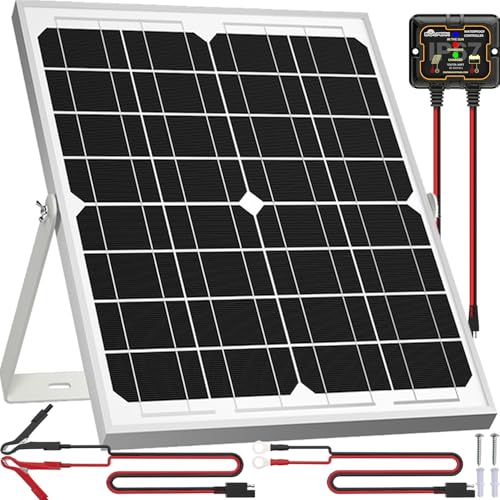
Although listed as 20W, this SOLPERK kit is often selected for its durability and smart controller features suitable for smaller off-grid needs. The 12V system supports various battery types and includes a smart MPPT controller that improves charging efficiency, with weatherproofing designed to endure outdoor use.
Best for: buyers who want a compact, weatherproof system with a modern controller approach. Choose this if you prioritize efficient charging management in fluctuating sun. Note: it is a smaller wattage option compared to other 25W kits.
Horleisol 25W Solar Panel Kit

Horleisol combines a 25W monocrystalline panel with a smart MPPT-style controller. The panel is described as rugged with IP67 waterproofing and a sturdy aluminum frame. It’s positioned as suitable for RVs, boats, cars, motorcycles, ATVs, and phones via USB, helping extend battery life and support small devices during travel.
Best for: travelers needing a versatile, all-weather kit with intelligent charging. Avoid this if you require extremely high daily energy or a larger panel for faster charging in sunny locales.
Buying Guide
What to consider when choosing a 25W panel
Energy needs: Match panel output to your typical daily energy consumption. If you regularly run key devices or charge larger batteries, consider a kit with higher efficiency and a capable controller.
Controller type and compatibility
MPPT controllers maximize energy harvest, especially in variable sun. PWM controllers are simpler and often cheaper but may be less efficient in shaded or fluctuating conditions. Verify battery chemistry compatibility (LifePO4, AGM, GEL, etc.).
Durability and weather resistance
Weatherproofing, tempered glass, and corrosion-resistant frames extend lifespan. Panels should withstand wind loads and snow loads in your climate. Consider IP ratings for water exposure and the robustness of mounting hardware.
Portability vs. permanence
Foldable and compact panels excel for hiking and camping. Rigid panels with mounting kits suit RVs and boats. Think about storage space, weight, and ease of setup when planning an installation.
Installation and maintenance
Look for included mounting brackets, cables, and connectors. Some kits include extension cables and battery clips, which can simplify setup. Regular inspection of cables and seals helps prevent corrosion and energy loss.
Safety and compatibility
Check protection features (over-charge, over-discharge, reverse polarity, short circuit). Ensure mounting and wiring comply with your vehicle or vessel’s electrical system and local regulations.
Cost vs. value
Higher efficiency and better weatherproofing can justify a higher upfront cost if you rely on consistent off-grid charging. Compare total system components, not just panel wattage, to gauge true value.
FAQ
- Q: Can a 25W panel fully charge a typical 12V battery?
- A: It can maintain or slowly recharge a small battery, especially with a proper charge controller and favorable sun. Real-world performance depends on sun exposure and load.
- Q: Is MPPT worth it over PWM for a 25W panel?
- A: MPPT generally yields more energy, particularly in partial shade or cooler conditions, though PWM may suffice for simple maintenance tasks.
- Q: Are these panels weatherproof for marine use?
- A: Many panels are advertised with waterproofing and corrosion resistance, but verify IP ratings and mounting suitability for marine environments.
- Q: Can I mix panels of different brands in one system?
- A: Mixing is possible but not optimal. Mismatched voltages and controllers can reduce efficiency and battery health; use matched components when possible.
- Q: Do these kits include everything I need to install?
- A: Some kits include mounting brackets and cables; others may require additional hardware or a compatible charge controller for full setup.
These selections provide a practical overview of 25W solar panels for lightweight off-grid charging and battery maintenance. Use the buying guide to compare energy management needs and environmental conditions, then choose the kit that best aligns with your typical usage scenario.