Find the right 240-watt solar panel for portable power, RVs, or home backup. This guide compares five high-efficiency options, highlighting who they’re best for, how they perform, and where to watch for potential limitations. Ideal buyers include campers, van dwellers, tiny home owners, and emergency-prep enthusiasts seeking reliable, scalable solar charging.
Summary table of selected products:
| Product | Brand | Key Benefit | Best Use |
|---|---|---|---|
| Aonxi 240W Portable Solar Panel | Aonxi | High efficiency up to 23.5%, versatile USB and DC outputs | Portable power stations, camping, emergencies |
| GRECELL 240W Portable Solar Panel | GRECELL | Ultra-light foldable design, 25%+ efficiency | Outdoor adventures, RVs, off-grid setups |
| Callsun 240W Bifacial Solar Panel | Callsun | Dual-module, bifacial design for extra output | RVs, boats, rooftop systems in reflective environments |
| LensunSolar 240W Flexible Panel | LENSUNSOLAR | Flexible, high efficiency with BC back-contact cells | Non-traditional roofings, curved surfaces, vans |
| OUPES Portable 240W Panel | OUPES | Lightweight, easy setup with kickstands | Portable generators, camping, small off-grid rigs |
Aonxi 240W Portable Solar Panel

This 240W panel uses high-efficiency monocrystalline cells with up to 23.5% conversion. It outputs through a DC 20V port and three USB ports, broadening compatibility with solar generators and USB-powered devices. Best for campers who need a compact, all-in-one charging option that works with most portable power stations. Caution: verify compatibility with your specific power station model in the detailed page to ensure the DC and USB outputs meet your device requirements.
GRECELL 240W Portable Solar Panel

GRECELL combines a foldable design with 25%+ efficiency, offering a lighter weight at around 16.3 lbs. It includes multiple connectors (XT60/Anderson/DC7909/DC8020), suitable for Jackery, EcoFlow, Paxcess, and similar brands. Best for hikers and RV users who need a compact setup that can be easily carried and mounted on uneven surfaces. Limitation: ensure your power station supports the included connectors and check the included stand for stability on soft ground.
Callsun 240W Bifacial Solar Panel
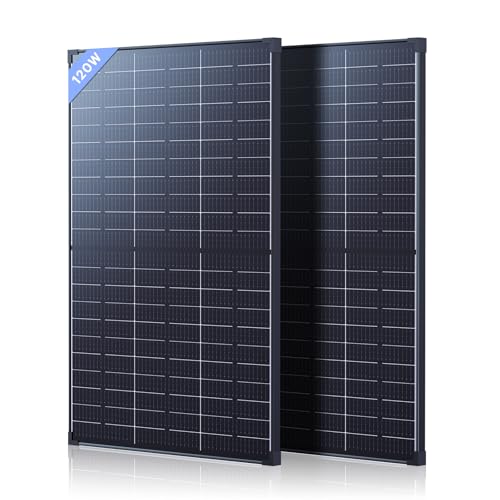
This twin-panel system uses N-type 16BB technology for up to 25% efficiency and adds bifacial capabilities to harvest reflected light for up to 30% more power. Best for rooftop installations on reflective surfaces or elevated setups where shade is variable. Choose this if you want maximizing daily output in diverse sun conditions. Caution: bifacial gains depend on surface reflectivity and installation angle; performance may vary with terrain.
LensunSolar Flexible 240W Panel

LensunSolar offers a semi-flexible ETFE panel with BC back-contact cells, achieving up to 25.8% efficiency. Front-grid-free design reduces heat buildup and may better withstand bending on curved surfaces. Best for curved roofs or portable setups where rigidity is a constraint. Limitation: flexible panels can be more delicate than rigid panels; handle with care during transport and mounting.
OUPES Portable 240W Panel

OUPES emphasizes easy setup, with a foldable form and kickstands for angled sun exposure. It weighs about 18.48 lbs and ships with a long cable. Best for weekend campers and small off-grid setups seeking straightforward assembly and reliable low-profile transport. Caution: ensure the kickstands are securely deployed to prevent tipping on soft ground.
Buying Guide: Key Purchase Considerations
- Output and efficiency: Higher efficiency panels deliver more power in limited space, important for vans, rooftops, or backpack-friendly setups.
- Weight and portability: Lighter panels are easier to carry for camping or travel, but may trade durability or rigidity.
- Portability options: Foldable vs. flexible designs affect storage, mounting options, and surface compatibility.
- Connectors and compatibility: Check included connectors (XT60, Anderson, DC outputs) and whether your power station accepts these inputs.
- Durability and weather resistance: Look for IP ratings, ETFE coating, and robust frames for outdoor use.
- Shade tolerance: Bifacial and TwinCell designs help mitigate partial shading and improve daily output in real-world conditions.
- Size and mounting: Consider surface area on your vehicle, tent, or rooftop and the availability of stands or grommets for mounting.
Frequently Asked Questions
- What makes a 240W solar panel suitable for off-grid use?
Answer: It provides substantial charging power for portable power stations and small systems while remaining reasonably portable for camping or RV setups. - Are bifacial panels always worth the extra cost?
Answer: They can increase output, especially on reflective surfaces, but gains vary with installation and environment. - How do I choose between foldable and flexible 240W panels?
Answer: Foldable panels are typically more rugged and easier to set up, while flexible panels suit curved roofs and lightweight applications. - Can these panels charge multiple devices at once?
Answer: Yes, many models provide USB ports and 20V DC outputs to charge power stations and USB devices concurrently. - What should I verify before buying regarding compatibility?
Answer: Confirm output voltage, connector types, and whether the panel’s output matches your power station’s input specifications. - Are there limitations with portable panels in bad weather?
Answer: Panels perform best in sunlight; prolonged shade or heavy rain reduces charging efficiency and requires protective handling.