Answering the demand for dependable 220V solar inverters, this guide highlights five top options designed for on/off-grid setups, battery independence, and scalable power. Suitable buyers include homeowners seeking backup power, RV and off-grid users, and small workshops needing consistent 230V output. Each product is evaluated for best use case, benefits, and a practical caveat.
| Product | Type / Best Use | Why It Stands Out |
|---|---|---|
| Y&H 6.2KW Hybrid Inverter 48V | Off-Grid / Battery-Optional | High continuous output with MPPT, pure sine wave, and dual load outputs for essential/post-disruption power. |
| Aninerel 12000W Solar Hybrid Inverter | Large Home/Workshop | Two MPPTs, high charging current, scalable in parallel up to 6 units for big power needs. |
| Y&H 3200W Solar Hybrid Inverter (24V) | Compact 24V Systems | Stable 3.2kW output with multiple charging modes and compatibility with various battery chemistries. |
| Y&H 6.2KW Hybrid Inverter DC48V (8000W PV) | Battery-Free Optional / Home Backup | Strong 6.2kW inverter with extended PV input, battery-free operation, and advanced battery management. |
| VoolexGo 10000W Hybrid Solar Inverter | High-Load Home/RV | Split-phase 110/220V output, robust MPPT, and wide PV input for demanding loads. |
Y&H 6.2KW Hybrid Inverter 48V — Battery-Optional 230VAC

Best for: Off-grid homes or workshops needing a reliable 230VAC supply with a 6.2kW continuous capacity. This model combines an inverter, MPPT solar charger, and battery charging into a single unit with pure sine wave output.
- Pure Sine Wave Inverter: 6.2kW, 230VAC single-phase output; built-in 120A MPPT charger; supports battery-free operation.
- Technical Range: Max PV power 6500W, PV voltage 60–450Vdc, cold start at 46V.
- Two Load Outputs: Main and Second Output; settings adjust to battery voltage and outages.
Best for: Users who value uninterrupted power during outages and want a single-box solution. Caution: Main Output may stop if battery voltage falls below the set threshold; plan for backup management accordingly.
Aninerel 12000W Solar Hybrid Inverter

Best for: Large off-grid or mixed off-grid/on-grid installations where high continuous output is needed and parallel expansion is planned. It supports up to 6 units for up to 72kW total output.
- Dual MPPT & High Efficiency: Two MPPT controllers with up to 220A charging; compatible with up to 500VDC PV arrays.
- Output: 120V single-phase or 240V split-phase; no-battery operation possible for solar-to-load use.
- Parallel Capability: Up to six units, enabling scalable power growth.
Caution: Parallel configuration requires proper balance and wiring; verify local codes for multi-unit setups.
Y&H 3200W Solar Hybrid Inverter (24V)

Best for: 24V battery systems in residential or small off-grid setups where compact size and reliable 3.2kW output are sufficient.
- Pure Sine Wave Inverter: 3200W output; 24V DC to 230V AC; supports lead-acid and lithium batteries.
- Charging Modes: Off-grid with four charging modes; grid-tied compatibility with different prioritization strategies.
- PV Range: 55–450Vdc; max PV input 3000W; 80A MPPT charger.
Best for: Situations prioritizing flexible charging order (Solar First or Mains First). Caution: Output is limited to 3.2kW; larger loads require higher-capacity models.
Y&H 6.2KW Hybrid Inverter (DC48V to AC220V)
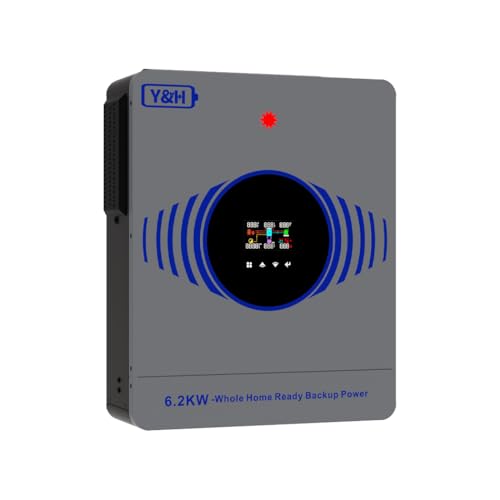
Best for: Home energy storage systems that require reliable 48V battery operation, high PV tolerance, and dual-output flexibility for critical and non-critical circuits.
- Battery-Free Operation: 6.2kW output with a wide PV input range (up to 8000W PV); MPPT with 27A input current.
- Battery Management: Real-time SOC, voltage, current, temperature; optional Wi-Fi app for monitoring.
- Charging Modes: Four modes including Solar First and Solar & Utility, optimized for fluctuating solar conditions.
Caution: Advanced battery management features rely on accurate sensor data; ensure proper installation for maximum benefit.
VoolexGo 10000W Hybrid Solar Inverter (48VAC)
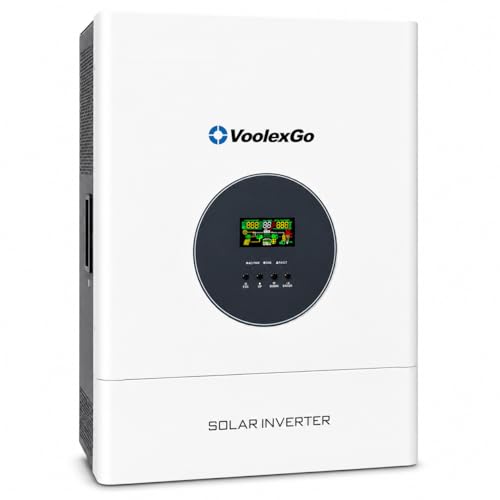
Best for: Heavy-duty home or RV use where 110V/220V split-phase output is needed along with robust MPPT charging and high PV input.
- Split-Phase Output: 110V/220VAC ±10%; upgraded hybrid design with 6.4kW PV input capability.
- PV Input: Up to 6400W, 150VDC; MPPT range 60–150VDC; supports charging from solar, utility, or generator.
- Communication: BMS/RS485, RS232, and dry contact options for integration with smart systems.
Best for: Users needing flexible voltage options and strong load handling. Caution: Higher power models may require more robust grounding and electrical safety setup.
Buying Guide
What should I consider when choosing a 220V solar inverter?
Power needs: Match continuous output to your typical daily loads, adding headroom for peaks. For heavy appliances or workshops, 6kW+ units or parallel-capable inverters are preferable.
Battery strategy: Decide between battery-free operation or battery-based setups. Battery-free models depend more on solar input and grid/generator availability, while battery-enabled units offer backup during outages.
How many MPPTs do I need?
More MPPTs can harvest energy more efficiently under varying sun conditions. Dual MPPT units improve charging stability with high-voltage PV arrays and mixed shading scenarios.
Is parallel operation important for me?
Parallel capable inverters are essential for scaling output to meet growing power demands, reducing individual unit load, and increasing surge capacity for large loads.
What about safety and compatibility?
Look for built-in protections (overload, short circuit, temperature). Ensure the unit supports your battery chemistry and voltage (12V, 24V, 48V) and is compatible with local electrical codes.
How do I monitor performance?
Some models offer LCD readouts and optional Wi‑Fi apps to monitor SOC, voltage, current, and temperature. This helps optimize charging strategies and prevent waste or outages.
What are common limitations to expect?
Battery voltage thresholds can affect main output during discharge; some models require precise configuration to prevent unexpected shutdowns. In multi-unit setups, proper balancing and wiring are essential for safe operation.
FAQ
- What is a 220V solar inverter best used for?
To convert DC from solar panels or batteries into safe, stable 230V AC for home or workshop appliances, with either off-grid, on-grid, or hybrid operation.
- Do these inverters support battery-free operation?
Yes, several models offer battery-free operation, relying on solar input and grid or generator power for continuity.
- Can I expand capacity later?
Yes, some inverters support parallel connections to scale total output, ideal for growing energy needs.
- What voltages do these inverters work with?
Primary output is 220–230V AC; some models also support 110V or split-phase 110/220V depending on configuration.
- Are there safety features I should expect?
Look for protections like overcurrent, overvoltage, short circuit, and surge protection, plus weather and electrical safety considerations for installation.