Choosing a reliable 220-volt gas generator is essential for safe home backup, RV adventures, or work sites. The right model should balance power capacity, fuel versatility, portability, and ease of use. This guide highlights five top 220V generators, comparing their surge and running watts, fuel options, and key features to help you pick a model that fits your needs without overpaying. All options support 120V/240V operation for transfer switches and RV setups, with various starting methods for added convenience.
| Product | Best For | Fuel |
|---|---|---|
| WEN DF475T | Home backup and portable jobs | Gasoline / Propane |
| Westinghouse 12500W | Heavy-duty standby and long run-time | Gasoline / Propane |
| A-iPower 4600W | RV and tailgating with inverter stability | Gasoline |
| Power Equipment 4400W | Portable backup and RV ready | Gasoline |
| Oxseryn 4400W Inverter | Quiet operation and sensitive electronics | Gasoline |
WEN 4,750-Watt Dual Fuel Portable Generator

The WEN DF475T provides dual-fuel versatility with a 224cc 4-stroke OHV engine. It can switch between gasoline (4750 surge / 3800 running watts) and propane (4350 surge / 3500 running watts). A simple dial changes fuel source, and the output can be set to 120V or 240V, making it suitable for transfer switches or emergency backup power. An electric start simplifies operation, turning the key for quick startup in critical moments. This model also includes a wheel kit for easier mobility on job sites or around the home.
Westinghouse 12500 Watt Dual Fuel Home Backup Generator

This heavy-duty generator offers 9500 running watts and 12500 peak watts on gasoline, with 8500 running and 11200 peak watts on propane. It features remote electric and recoil start, a long 12-hour runtime on a 6.6-gallon tank, and multiple transfer switch and RV-ready outlets. The VFT (voltage, frequency, hours) display provides real-time operational data, while automatic low-oil shutdown and a robust engine improve reliability for long-term backup. The unit includes clearly labeled outlets with rubber covers for safety and convenience.
A-iPower 4600W RV-Ready Inverter Generator
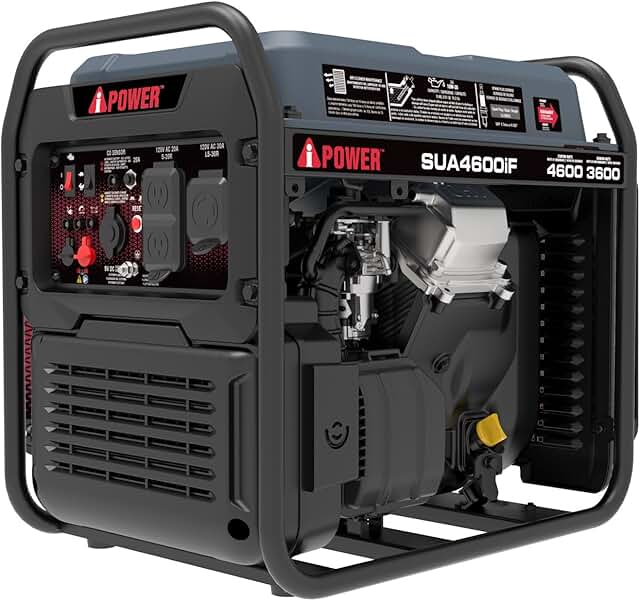
The A-iPower unit delivers 4600 starting watts and 3600 running watts, ideal for RV appliances and home backup. It weighs 56 lbs, emphasizing portability for tailgating or off-grid use. Its pure power output includes a 3% THD inverter design, ensuring stable, clean power suitable for sensitive electronics like laptops, TVs, and chargers. The model combines sufficient power with lightweight handling for convenient transport.
Power Equipment 4400 Watts Inverter Generator

Powered by a gasoline engine, this 4400-watt peak / 3400-watt running inverter generator supports RV readiness with a 14-hour runtime at 25% load and a two-gallon fuel tank. It includes multiple outputs: two 120V AC ports, one 12V DC port, and an RV outlet. The unit emphasizes long runtime, ECO mode for efficiency, and overload protection to maintain safe operation during extended use.
Oxseryn 4400 Watts Inverter Generator
This 4400 peak / 3400 running-watts inverter generator features two 120V outlets and a 30A RV port. Runs up to 14 hours at 25% load on a 2-gallon tank. It includes ECO mode, inverter technology, and EPA compliance. The unit is designed for RV use, emergency home backup, and quiet operation with practical overload protection and oil shutdown safety features.
Buying Guide
- Power needs: Match running watts to your essential loads. For home backup, prioritize higher running watts and transfer-switch compatibility. For RV use, ensure the unit has RV-ready outlets and stable inverter output.
- Fuel options: Dual-fuel models offer flexibility during fuel shortages. Consider propane availability and generator efficiency with each fuel type.
- Starting method: Electric start is convenient for frequent use, but recoil backup is valuable if the battery fails. Remote start adds convenience for larger setups.
- Portability: Wheel kits, compact frames, and lighter weights improve maneuverability. For frequent transport, inverter models with low noise are beneficial.
- Outlets and safety: Check the number and type of outlets (120V/240V, RV, and USB where applicable). Look for rubber outlet covers, low-oil shutdown, and overload protection for safety.
- Runtime and fuel tank: Longer runtimes reduce refueling, especially during outages. Compare fuel tanks and efficiency to estimate daily power availability.
- Monitoring features: A voltage and frequency display helps ensure steady power supply, reducing risk to sensitive electronics.
- Compliance and noise: Ensure EPA/compliance labels and consider noise levels for residential use, especially in campgrounds or neighborhoods.