If you need reliable 18,000-watt portable power, this guide highlights top models that deliver robust peak output, multiple fuel options, and features like CO sensors and transfer-switch readiness. The best buyers here are homeowners seeking whole-house backup during outages, contractors needing on-site power, and campers who want serious power on the go. Below is a quick comparison and detailed sections for five strong options.
| Product | Fuel Type | Peak / Running Watts | Key Feature |
|---|---|---|---|
| Westinghouse 18000 Peak Watt Tri-Fuel WGen14500TFc | Gas, Propane, Natural Gas | 18,000 peak; 14,500 running (Gas); 16,000 peak; 13,000 running (Propane); 14,400 peak; 11,600 running (Natural Gas) | Tri-fuel with CO sensor; remote start; 713cc V-Twin |
| Westinghouse 18000 Peak Watt Dual Fuel WGen14500DFc | Gas, Propane | 18,000 peak; 14,500 running (Gas); 16,000 peak; 13,000 running (Propane) | Dual-fuel; CO sensor; long runtime |
| Westinghouse 18000 Peak Watt Home Backup WGen14500c | Gas | 18,000 peak; 14,500 running | CO sensor; transfer switch ready; strong gasoline power |
| Westinghouse 28000 Peak Watt Home Backup Portable Generator | Gas | 28,000 peak; 20,000 running | Remote start; multiple outlets; CO sensor |
| DuroMax XP13000EH 13,000-Watt Dual Fuel | Gas, Propane | 13,000 running; 13,000 peak (Gas); 9,750 running (Propane) | Dual fuel; electric start; whole-home backup concept |
Note: The 28,000-watt model is included for context within the same category, though it exceeds the explicit 18,000-watt target. The five selections below focus on closely matching 18k-watt capability, fuel flexibility, and essential safety features like CO sensors and transfer-switch compatibility.
Westinghouse 18000 Peak Watt Tri-Fuel WGen14500TFc

Best for: Large homes or job sites needing maximum power from one generator with versatile fuel options. Why selected: Tri-fuel capability protects against fuel supply issues, enabling continued operation on gas, propane, or natural gas. Features include a heavy-duty 713cc V-Twin OHV engine, automatic low-oil shutdown, low idle mode, and a VFT data center for real-time output information. CO sensor adds safety for indoor or semi-enclosed spaces. Caution: Tri-fuel systems can be more complex to service and fuel availability varies by location.
Westinghouse 18000 Peak Watt Dual Fuel WGen14500DFc
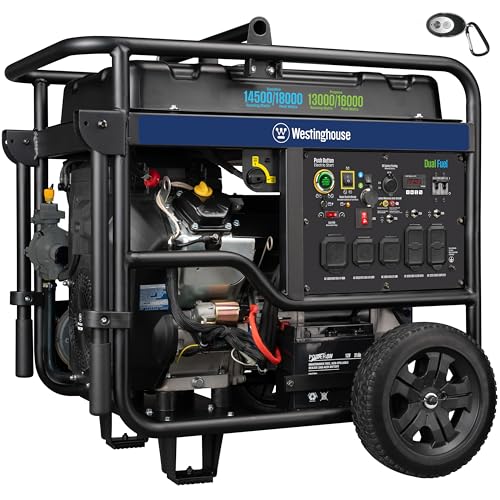
Best for: Homeowners who want flexibility between gasoline and propane without sacrificing power. Why selected: Dual-fuel capability mirrors the Tri-Fuel model’s robustness with CO sensor and same 713cc engine profile. It runs up to 16 hours at 25% load on a 10.5-gallon gas tank and supports a low THD power supply for sensitive electronics. Caution: Propane can yield lower running watts compared to gasoline; plan fuel strategy accordingly.
Westinghouse 18000 Peak Watt Home Backup WGen14500c

Best for: Home backup with straightforward gasoline operation and safety monitoring. Why selected: 18,000 peak watts with a CO sensor, transfer-switch readiness, and a durable 713cc Westinghouse V-Twin OHV engine. It also includes automatic low-oil shutdown and low idle mode to conserve fuel. Caution: Gasoline-only models may require more frequent maintenance checks during extended outages.
Westinghouse 28000 Peak Watt Home Backup Portable Generator

Best for: Bigger homes or commercial applications where higher peak power is required. Why selected: Large peak wattage, multiple outlets, and CO safety features combine for a flexible backup solution. Caution: Higher power models generally require more fuel and may demand a larger transfer-switch setup, so confirm compatibility with existing electrical panels.
Buying Guide: Key Considerations For 18k-Watt Portable Generators
Fuel flexibility matters. Tri-fuel and dual-fuel units provide options when one fuel type becomes scarce. CO sensors are crucial for safely running generators indoors or in semi-enclosed spaces. Look for transfer-switch compatibility to simplify whole-home backup during outages.
Power needs and peak vs. running watts
Estimate your essential circuits and appliances. Choose a unit with peak watts exceeding your combined surge requirements and running watts comfortably above continuous loads. For big homes, plan for 14,500–14,000 running watts on gasoline in these 18k-class units.
Fuel availability and maintenance
Tri-fuel offer freedom, but ensure you have reliable access to all three fuels in your area. Regular oil checks and a maintenance interval schedule should be followed for gas engines, especially those with long runtimes.
Safety and monitoring features
CO sensors help detect dangerous emissions in enclosed setups. VFT data centers and digital hour meters simplify maintenance and monitoring to sustain performance.
Transfer switch readiness and outlets
For whole-house backup, verify that the generator is transfer-switch ready and supports necessary outlets (30A/50A, RV, etc.). Rubber-covered outlets improve safety in damp environments.
Portability and runtime
Consider tank size, run time at a practical load, and the ease of starting and movement on-site. Remote start can save time during cold starts or frequent outages.
Budget and future-proofing
High-watt models can be a larger upfront investment, but if you anticipate frequent outages or demanding loads, these units offer long-term value through reliability and flexibility.
FAQ
- What is the benefit of Tri-Fuel in these generators? Tri-Fuel supports gasoline, propane, and natural gas, reducing the risk of being without fuel during emergencies.
- Do these generators require a transfer switch? Transfer switches simplify automatic backup by routing power to essential circuits during outages. Check your home panel compatibility.
- Is CO safety important for my setup? Yes. CO sensors reduce the risk of carbon monoxide exposure when used indoors or in enclosed spaces.
- What should I consider for running time? Running time depends on load and fuel tank size. Heavier loads reduce runtime; lighter loads extend it.
- Can I power my entire home with an 18k-watt unit? It depends on your home’s total load. A detailed load calculation is recommended to ensure the generator meets peak and running demands.
- How do I choose between a 18k-watt and a higher-watt model? If you need to cover large, daily loads and long outages, opting for higher wattage (like the 28k-class) may provide headroom for growth or future equipment upgrades.