When selecting a propane generator around 1800 RPM, focus on steady performance, clean propane combustion, and practical runtimes for home, RV, or jobsite use. The following five models emphasize propane capability, reliable fuel efficiency, and user-friendly features. They’re suitable for homeowners, campers, small contractors, and anyone needing dependable backup power with propane fuel storage as a key advantage.
| Product | Fuel Type | Best For |
|---|---|---|
| Genkins 4500 Watt Dual Fuel Generator | Propane / Gas | Emergency backup and camping with strong output |
| Westinghouse 2550 Peak Watt Inverter | Gas or Propane | Quiet power for apartment or RV use |
| Westinghouse 4650 Peak Watt Dual Fuel | Gas or Propane | Home backup with multiple outlets |
| Generac 12,500 Starting Watt Tri-Fuel | Gas / Propane / Natural Gas | Whole-house emergency power |
| Pulsar 2700 Watt Portable Inverter | Gas or Propane | Camp, jobsite, and light home use |
Genkins 4500 Watt Dual Fuel Generator Propane & Gas

Best for: Home backup and outdoor work where flexibility matters. This model delivers up to 4500 peak watts on gasoline and 4200 peak watts on LPG, with corresponding rated outputs suitable for essential appliances and tools. Dual fuel capability supports flexible fuel storage, which helps during outages or remote work.
- Engine: 223cc OHV four-stroke engine running at 3600 RPM.
- Running on gasoline provides longer power for higher demand; LPG offers cleaner-burning operation.
- 4-gallon gasoline tank supports up to 6.5 hours at full load or 9 hours at half load.
Why selected: It combines robust output with propane flexibility, making it a solid pick for those who want reliable power without frequent refueling. Best for buyers who anticipate outages or require portable power on worksites or campsites. Caution: Keep in mind that propane fuel conversions may require careful handling and storage in accordance with instructions.
Westinghouse 2550 Peak Watt Inverter Generator

Best for: Quiet, portable backup power for small homes, apartments, or RV setups. It runs on gas or propane and is designed for low noise and fuel efficiency, with economy mode to maximize runtime on small tanks.
- Power output: 2550 peak watts, 1900 rated watts at under 3% THD.
- Weights about 42.4 lbs, with RV-ready and multiple outlets (TT-30R, 120V outlets, USB).
- Run time up to 12 hours on a 1.16 gallon gas tank; economy mode optimizes fuel use.
Why selected: Choose this if you need portable, low-noise power for essential electronics and short outages. Caution: Inverter units may have limited peak wattage compared to larger portable generators, so plan loads accordingly.
Westinghouse 4650 Peak Watt Dual Fuel Portable Generator
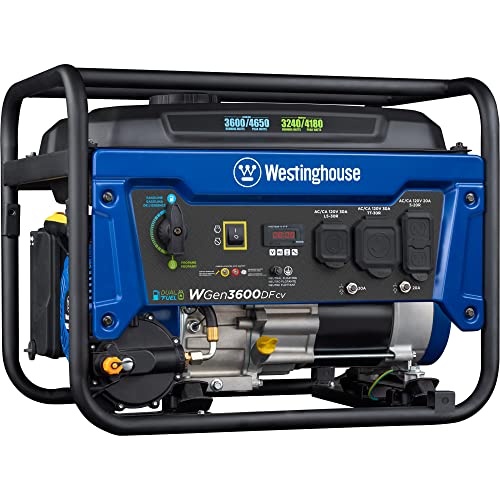
Best for: RV users or homeowners needing higher power with propane flexibility. This model offers a 4-gallon tank, up to 14 hours runtime per tank, and multiple outlets for comprehensive power delivery.
- Gas: 4650 peak watts, 3600 rated watts; Propane: 4650 peak watts, 3240 rated watts.
- Outlets: one 5-20R duplex, one TT-30R RV, one L5-30R 30A; outlets are protected with rubber covers for safety.
- Includes oil, funnel, tool kit, and manual for quick setup.
Why selected: It provides robust output with propane versatility and practical runtime. Caution: Heavier and bulkier than compact inverter models—consider transport and storage needs.
Generac 12,500 Starting Watt Tri-Fuel Portable Generator

Best for: Home backup requiring high power and fuel flexibility. This tri-fuel generator supports gasoline, propane, and natural gas with a simple fuel selector dial and electric start.
- Output: 9500 running watts and 12500 starting watts on gasoline; propane and natural gas options available.
- Electric start with rechargeable battery for quick power activation.
- Fuel tank and runtime designed for longer operation during outages; includes safety and control features.
Why selected: It offers maximum power with multi-fuel capability. Caution: Higher upfront cost and larger footprint; plan installation and storage accordingly.
DuroStar DS13000MX 13,000-Watt Dual Fuel

Best for: Whole-home backup with dual fuel capability. This model emphasizes high output with propane and gasoline, including a remote electric start for convenient operation.
- 13,000 watts total power; dual fuel for flexibility during outages and fuel storage considerations.
- Remote electric start and whole-home readiness; transfer switch compatibility enhances safety during outages.
- CO alert for safety; designed to provide steady power when the main supply fails.
Why selected: Choose this when you need high wattage and fuel flexibility for large homes or contractors needing extended power. Caution: Larger size and heavier weight require proper setup and ventilation.
Pulsar 2700 Watt Portable Inverter

Best for: Lightweight power for camping, job sites, or small outdoor setups where quiet operation and clean power matter.
- Gasoline: 2700 peak / 2200 running watts; Propane: 2400 peak / 1800 running watts.
- Up to 6 hours runtime at half load; CO sensor adds safety by shutting down if needed.
- Parallel capability allows pairing with another unit for extra power; includes duplex plug for flexible connections.
Why selected: It balances portability with dual-fuel flexibility and clean output suitable for sensitive electronics. Caution: Lower peak wattage means avoid powering high-demand appliances at the same time.
Buying Guide
Key considerations when choosing a propane generator around 1800 RPM:
- Output vs. load needs: Match peak and running watts to intended loads. For home backup, consider higher-watt models; for camping, lighter units may suffice.
- Fuel type and storage: Propane offers cleaner combustion and easier on-site storage; evaluate availability and tank capacity for expected runtimes.
- Run time and efficiency: Tank size and engine efficiency influence how long you can power essential devices between refuels.
- Portability and noise: Inverter models tend to be quieter and lighter, ideal for RVs and apartments, while traditional portable generators deliver higher wattage.
- Safety features: CO sensors, automatic shutdown, and sturdy enclosures improve safe operation in varied environments.
- Multiple outlets: Ensure outlets match your devices; RV-ready and standard household receptacles expand compatibility.
- Electric start and convenience: Electric start saves effort during outages; consider battery maintenance and charging.
FAQ
- Q: What does 1800 RPM mean for a generator? A: It refers to engine speed, often tied to smoother operation and efficiency in certain models, especially inverter types.
- Q: Is propane better than gasoline for generators? A: Propane generally burns cleaner and stores longer, reducing fuel degradation, but may be less energy-dense than gasoline in some larger units.
- Q: Can I run a whole-house load with a propane generator? A: Some dual- or tri-fuel models can support substantial loads, but sizing to your home’s needs and using a transfer switch is essential.
- Q: Do propane generators require special maintenance? A: Regular oil changes, spark plug checks, and air filter maintenance apply, plus proper propane storage and connection checks.
- Q: How do I choose between a dual-fuel and tri-fuel unit? A: Dual-fuel covers two fuels (gasoline and propane), while tri-fuel adds natural gas, offering broader fuel flexibility depending on your supply.
- Q: Are inverter generators louder than traditional ones? A: Inverter models tend to run quieter and with more stable power, suitable for electronics and sensitive devices.