Answering the needs of off-grid homeowners, RVers, and campers seeking reliable 180W solar solutions. These panels are ideal for compact roofs, portable setups, and quick-battery charging. Top picks favor durability, efficiency, and easy compatibility with common solar generators. This guide helps buyers choose panels that fit narrow spaces, provide steady output, and endure harsh environments.
Summary of chosen products:
- ZOUPW 180W Portable Solar Panel N-Type 16BB
- Callsun 180W N-Type Bifacial Solar Panel
- Topsolar Flexible Solar Panel 180W
- Renogy 175W N-Type Solar Panel
- Rvpozwer 200W N-Type Solar Panel
Product Comparisons At A Glance
- Best for: Rapid, plug-and-play charging with broad generator compatibility.
- Better for: Space-limited RV rooftops and flexible mounting options.
- Choose this if: You want higher efficiency with N-Type cells and anti-shading tech.
ZOUPW 180W Portable Solar Panel N-Type 16BB

Features: N-Type 16BB cells deliver 25% high efficiency with reduced light-induced degradation. It includes a comprehensive 5-in-1 cable kit (XT-60, Anderson, DC7909, DC8020, DC5521) for broad compatibility with Jackery 1000V2, EcoFlow DELTA 2/3, Bluetti EB/AC, and Anker Solix generators. IP68 waterproofing with ETFE surface supports rugged use in rain, dust, and marine environments.
Best for: RVers and campers who need a portable, weatherproof panel that works with multiple power stations without extra adapters. This panel is especially strong for off-grid setups where space is at a premium and harsh conditions are common.
Caution: Ensure your power station supports 20V+ to maximize compatibility. The heavier build is still portable but requires stable mounting for high-wind environments.
Callsun 180W N-Type Bifacial Solar Panel
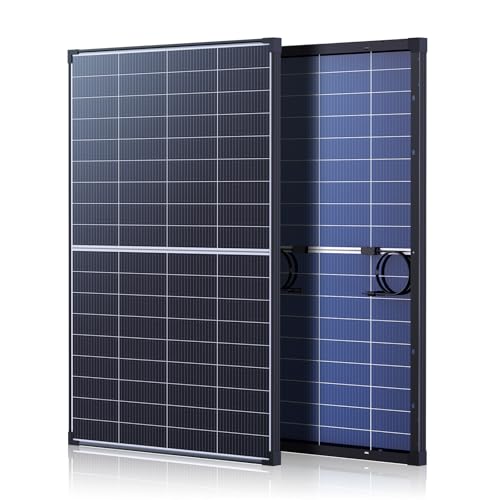
Features: 180W output from a single module with 16BB cells and bifacial design. The 30% extra dual-sided output comes from reflected light, while a slim frame helps fit tight roof spaces like Teardrop trailers and Sprinter vans. The design targets higher amperage for RV, van, and home battery banks without extra panels.
Best for: Anyone with narrow roof space who wants higher total yield from a single panel, especially in reflective settings (white roofs, light decks, or sand).
Limitation: Bifacial performance depends on reflective surroundings; in uniform shaded or non-reflective environments, gains may be modest.
N-Type 16BB 360W Dual-Module Kit

Note: This is a dual 180W module kit delivering 360W total. It’s designed for off-grid systems with space for two panels and supports 12V operation with parallel wiring. IP68-rated protection plus bifacial gain potential from ground-mounted setups.
Best for: Off-grid builds that can accommodate two panels for a compact, high-output array on RV roofs or cabins.
Caution: Requires adequate space and mounting hardware for two panels; installation complexity is higher than a single 180W panel.
Topsolar Flexible Solar Panel 180W

Features: Flexible, bendable monocrystalline design suitable for uneven surfaces and curved roofs. Compatible with multiple voltage systems (12V/24V). Sealed construction minimizes maintenance, and the flexible form reduces weight and wind resistance compared to rigid panels.
Best for: Vehicles and vessels with curved or irregular surfaces where rigid panels won’t fit, such as RV awnings, boats, or cabin roofs.
Limitation: Flex panels often have a reduced impact resistance compared to tempered glass panels; care needed during handling and mounting.
Rvpozwer 200W N-Type 18BB Panel

Features: 200W output using N-Type 18BB cells, 25% efficiency with EL testing claims. Pre-drilled back for quick mounting and compatibility with common RV brackets. Durable with robust construction for off-grid roofs, farms, and marine deployments.
Best for: Buyers who want higher power output in a single module to boost daily energy production on larger off-grid setups.
Caution: The 200W rating provides strong output but may require stronger mounting and shading considerations to optimize daily production depending on location.
Buying Guide
- What does 180W mean in real-world use? Look for panel efficiency, real-world sun hours, and how the watt rating translates to daily energy, typically watt-hours per day.
- Should you pick monocrystalline or bifacial cells? Monocrystalline with N-Type cells offer higher efficiency and durability; bifacial designs can add extra yield when there is reflective surface nearby.
- How important is IP rating? IP68 panels perform better in rain and dusty environments, ideal for RVs, boats, and outdoor installations.
- How to choose mounting compatibility? Check pre-drilled holes and frame design to fit your roof, rack, or ground-mount hardware; verify wattage per panel relative to required system size.
- What about portability? Flexible panels are lighter and easier to mount on curved surfaces but may be less rugged than rigid panels on rough terrain.
- System integration considerations: ensure voltage compatibility with your solar generator or battery bank, and plan for parallel or series wiring if combining multiple panels.
FAQ
- Q: Are 180W panels suitable for RVs? A: Yes, when space is limited, 180W panels offer a good balance of output and fit, especially with compact roof layouts.
- Q: Do bifacial panels require special mounting? A: They benefit from reflective surroundings but still work well in standard mounting; performance depends on surface reflectivity.
- Q: Can I use 180W panels with a 12V battery system? A: Many 180W panels are compatible with 12V systems via charge controllers or compatible solar generators.
- Q: Do I need weatherproof panels for marine use? A: Yes, IP68 or higher ratings provide better protection against rain, salt spray, and corrosion in marine environments.
- Q: Is flexibility better than rigidity for off-grid roofs? A: Flexible panels fit curved surfaces and light applications, but rigid panels typically offer higher durability and efficiency in rugged settings.
- Q: Should I buy more panels than a single 180W unit? A: If you need higher daily energy, consider adding a second module in parallel or series, depending on voltage requirements and controller capacity.