Yes, a 175 watt power inverter is suitable for charging laptops, small appliances, and multiple devices while on the road. This guide highlights top options designed for vehicles, focusing on reliability, safety features, and USB charging versatility. Ideal buyers include commuters needing phone and tablet charging, families on road trips requiring light appliances, and travelers seeking backseat power for laptops or fans. Below is a quick comparison table, then detailed product sections to help you choose.
| Product | Output Power | Best For | Notable Limitation |
|---|---|---|---|
| Duracell DRINVPS175 | 175W continuous | Everyday car use, backseat charging | Limited to 175W—watch for higher-watt devices |
| BESTEK 300W Car Inverter | 300W continuous | Laptops, multiple devices, PD/QC fast charging | Higher price; Tesla Model Y mention in design notes |
| Pro Chaser 400W Power Inverters | 400W continuous | Road trips with laptops and small appliances | Higher wattage; check outlet needs |
| vansoet 400W Car Power Inverter | 400W continuous | PD USB-C charging, multiple ports | Fan noise may vary with load |
| Pro Chaser 400W (USB-C PD 65W) | 400W continuous | USB-C PD and USB-A for fast charging | Same brand variant as above; verify ports meet your devices |
Duracell DRINVPS175 Black 175 Watt Portable Power Inverter

The Duracell 175 Watt Portable Power Inverter converts vehicle DC power to AC for standard outlets and USB charging. It includes 2 three-prong AC outlets, 2 USB ports (2.1A each), and a single LED indicator to show when power is on. The 3-foot cord provides reach to front or backseat passengers. Best for users who need simple, compact power for devices like phones, tablets, or small laptops during commutes or short trips. Caution: Do not run high-wattage appliances that exceed 175W continuous output.
BESTEK 300W Car Power Inverter

This 300W continuous inverter is designed for versatile car charging with two US outlets and dual USB ports. Notably, it features input voltage considerations and PD30W fast charging via USB-C and QC18W via USB-A, enabling rapid charging for many phones and tablets. It’s positioned for travelers who need laptop or camera charging on the go, plus fast USB charging for phones. Best for road trips and drivers who want both AC outlets and fast USB charging. Caution: Some Tesla-specific usage notes are included in its feature list; verify compatibility with your vehicle’s socket.
Pro Chaser 400W Power Inverters for Vehicles
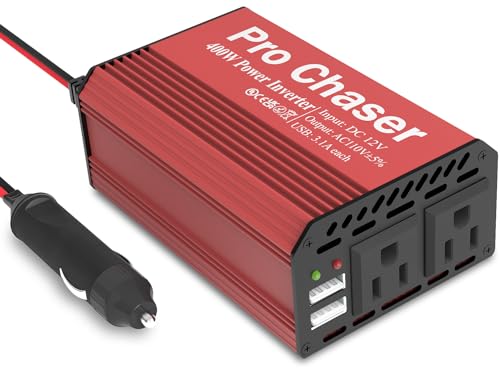
The Pro Chaser 400W inverter delivers 400W continuous power with 800W peak, dual 110V outlets, and dual USB ports (one USB-A 18W and one USB-C). It suits road trips and family use where devices such as laptops, breast pumps, or tablets require reliable power. Best for families needing simultaneous AC and USB charging. Choose this if you want helpful USB-C PD and standard USB charging in one compact unit. Caution: Verify if your devices approach the 400W limit to avoid overload on peak startup.
vansoet 400W Car Power Inverter

The vansoet inverter provides 400W continuous power with two AC outlets and a robust USB-C/USB-A charging hub, including a 30W PD Type-C port and a 15W Type-C plus two 15W USB-A ports. It features a dedicated AC switch and an intelligent cooling fan for reduced heat buildup. It’s well-suited for travelers who need fast PD charging for newer devices while sharing outlets among multiple devices. Caution: Cooling fan activates only when needed, which might affect performance during prolonged high-load use.
Pro Chaser 400W Power Inverter (USB-C PD 65W)

This model extends the Pro Chaser lineup with a USB-C PD 65W port alongside USB-A and dual AC outlets. It’s ideal for users who want faster charging for laptops and phones, plus multiple device support during car trips. Better for devices that benefit from higher wattage PD charging. Caution: The combined use of high-wattage devices may necessitate careful load management to prevent overloading the inverter.
300W Portable Charger Car Power Inverters for Vehicle (YSOLX)

The YSOLX 300W inverter features four USB ports (including USB-C) and dual 110V outlets, enabling plenty of simultaneous charging and powered devices. This model is useful for longer trips where multiple devices require charging and moderate power. Best for travelers who prioritize USB-C and multiple USB ports in a compact unit. Caution: Monitor total load to avoid exceeding 300W continuous output.
ALLWEI 300W Power Inverter with PD USB-C & USB-A

ALLWEI’s 300W inverter emphasizes a PD USB-C 27W port and an 18W USB-A port, plus two AC outlets for laptops, TVs, and other devices. It uses a durable metal housing for heat dissipation and automatic protection features. Best for road trips where USB-C PD charging is a priority and multiple devices require simultaneous charging. Caution: Ensure battery wiring is appropriate for extended loads to avoid overheating.
Buying Guide
What wattage do you actually need? For laptops and small appliances, aim for 300–400W if you expect frequent use of more than one device at once. If you mostly charge phones and tablets, 175–300W models may suffice.
Do you need USB-C PD or USB-A fast charging? If you rely on newer smartphones or USB-C laptops, prioritize PD ports (prefer 30–65W). USB-A ports are still useful for older devices and accessories.
How many outlets and which outlets? Look for models with at least two AC outlets and multiple USB ports to support several devices without swapping plugs.
Is in-vehicle heat management important? Inverters with smart cooling fans or heat-dissipation features offer longer runtimes with less risk of overheating.
Safety features and protection. Overload, short-circuit, overvoltage, and low-voltage protections help prevent damage to your vehicle and devices. If you frequently drive in extreme conditions, choose models with robust protection.
FAQ
- What is the difference between continuous and peak power in inverters?
Continuous power is the steady power the inverter can supply, while peak (surge) power is the short-term power available during startup or heavy load. Choose a model whose peak exceeds the startup requirements of the devices you plan to run.
- Can a 175W inverter run a laptop?
Some laptops may draw more than 175W, especially during startup. For laptops with modest power needs or for charging tablets and small devices, 175W can work, but for reliability choose a model with higher continuous wattage.
- Should I prefer USB-C PD ports?
Yes, PD ports allow faster charging for compatible devices, particularly newer phones, tablets, and some laptops. Look for PD ports with 30W or higher when possible.
- Is it safe to use these inverters in back seats?
Most compact inverters include a long enough cord and rear-seat reach. Ensure the inverter is placed away from heat sources and not blocking air vents, with proper ventilation.
- What should I do if the inverter hums or overheats?
Turn off devices, allow the inverter to cool, and reduce load. Use models with built-in cooling fans and protection features to minimize risks.
- Are there models designed specifically for Teslas or unique sockets?
Some Inverters advertise compatibility with specific vehicle sockets. Verify your car’s outlet type and any vehicle-specific notes before purchase.