For homeowners seeking reliable backup power, a 14,000-watt generator can handle essentials like sump pumps, refrigerators, HVAC, and more during outages. This guide highlights five top options that balance power, fuel flexibility, and safety features. Designed for different needs—remote start, dual-fuel capability, and transfer-switch readiness—these models suit larger homes, weekend cabins, or job sites. The table below summarizes key specs to help you compare quickly.
| Product | Fuel Options | Peak / Running Watts | Best For |
|---|---|---|---|
| Westinghouse 14500 Peak Watt Tri-Fuel | Gas, Propane, Natural Gas | 14,500 / 11,500 (Gas) | |
| DuroStar DS13000MX 13,000-Watt | Gasoline, Propane | 13,000 / depends on fuel type | |
| Westinghouse 13500 Peak Watt Dual Fuel | Gas, Propane | 13,500 / 10,500 (Gas) | |
| Westinghouse 14500 Peak Watt Dual Fuel | Gas, Propane | 14,500 / 11,500 (Gas) | |
| Westinghouse 12500 Watt Dual Fuel | Gas, Propane | 12,500 / 8,500 (Gas) |
Westinghouse 14500 Peak Watt Tri-Fuel
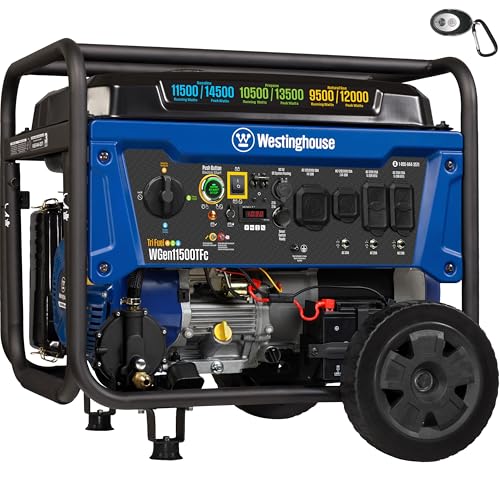
This model blends high output with three-fuel flexibility: gasoline, propane, and natural gas. It runs up to 19 hours on a 9.5-gallon tank with a fuel gauge and delivers up to 11,500 running watts on gas. Remote electric start and transfer-switch readiness simplify operation during outages. Best for large homes that require strong, versatile backup power and a longer run time on diverse fuel sources.
Who this is best for: homeowners with varying fuel access or a need for heavy-duty backup power. Why chosen: expands fuel options while maintaining robust output. Caution: heavier unit; ensure proper clearance and installation space.
DuroStar DS13000MX 13,000-Watt

Dual-fuel capability offers gasoline for maximum power or propane for extended run times and cleaner emissions. It includes CO safety alerts and a remote electric start, with transfer-switch readiness for smooth integration into home circuits. Best for users who want flexible fuel choices and enhanced safety during power events.
Who this is best for: households needing flexible fuel and strong, steady power. Why chosen: safety features and dual-fuel design provide dependable operation. Limitation: 13,000-watt rating is slightly below 14k on peak; plan for essential loads accordingly.
Westinghouse 13500 Peak Watt Dual Fuel

With 13,500 peak watts and 10,500 running watts on propane, it also features a key fob remote start and multiple outlets including transfer switch-ready options. Run time approaches 19 hours on a full 9.5-gallon tank, and it includes safety features like shutoffs and a digital hour meter. Best for mid-to-large homes needing reliable power with convenient starting options.
Who this is best for: users prioritizing remote ease of use and safe operation. Why chosen: strong dual-fuel capability and transfer-switch compatibility. Caution: keep outlets covered when not in use to prevent weather exposure.
Westinghouse 14500 Peak Watt Dual Fuel

This dual-fuel model offers 14,500 peak watts and 11,500 running watts when fueled by gasoline, with equivalent dual-fuel performance and a long, 19-hour runtime on a full tank. It includes a remote electric start and multiple outlets for household and RV use. Best for those who want maximum peak power with flexible fuel options.+
Who this is best for: larger homes or jobsites needing robust, flexible power. Why chosen: high peak power with dual-fuel capability. Limitation: heavier weight may require a stable, level installation site.
Westinghouse 12500 Watt Dual Fuel

Rated for 12,500 peak watts on gasoline and 8,500 running watts, with 6.6 gallons and a fuel gauge for run-time awareness. It features two GFCI outlets, transfer-switch readiness, and an RV-ready outlet. Best for medium-to-large homes seeking substantial power with a practical fuel tank size.
Who this is best for: homeowners who want solid power without excessive size. Why chosen: balanced output and practical tank size. Caution: propane performance may vary with weather and temperature; plan for contingency fuel access.
Buying Guide: Key Purchase Considerations
- Power needs: List essential appliances and their wattages to determine whether you need 11k-13k running watts or support for higher peak loads during startup.
- Fuel flexibility: Dual- or tri-fuel units offer resilience if gas lines or propane supplies are interrupted. Consider natural gas compatibility if you have a nearby gas line.
- Transfer switch readiness: A transfer-switch-ready generator simplifies connecting to your home’s electrical system, reducing backfeed risk and enabling automatic or manual shutoff.
- Starting method: Remote or electric start improves convenience during outages, especially in cold weather or large setups.
- Run time and tank size: Larger tanks extend operation but add weight; consider your typical outage duration and the placement space.
- Safety features: CO sensors, automatic shutdowns, and weather-resistant outlets protect your family and equipment during use.
- Portability vs. stationary needs: For home backup, a transfer-switch-capable unit with appropriate mounting space is often preferred; for job sites, portability matters less than sustained power.
- Warranty and service: Check coverage and availability of local service centers to minimize downtime after purchase.
FAQ
- What is the difference between peak watts and running watts?
- Can a 14k-watt generator run a whole house?
- Is diesel a common fuel option for these generators?
- How do I determine the right transfer switch size?
- What maintenance steps are essential after a power outage?
Answers: Peak watts indicate maximum surge power during startup, while running watts refer to steady operation. A 14k-watt unit can support many, but not all, home loads; it depends on your appliance wattages. Diesel is less common in portable home backup models; most favored options are gasoline and propane, with some dual-fuel configurations. Transfer switch size depends on your main electrical panel and the circuits you plan to power. After outages, perform basic checks: oil level, battery status, spark plug condition, and {where applicable} air filter cleanliness to ensure readiness for the next use.