If you need high-output, reliable solar backup for home, business, or remote locations, a 12000-watt solar generator can cover essential loads during outages or off-grid periods. This guide highlights five top options, clarifies who each is best for, and explains how to compare capacity, output, inputs, and expandability. Ideal buyers include homeowners seeking whole-house backup, outdoor enthusiasts needing strong off-grid power, and preppers planning long-lasting energy resilience.
Buyer’s quick picks table:
- Best for whole-house resilience: EF ECOFLOW Delta Pro Ultra X
- Best for expandable, multi-unit setups: Anker SOLIX F3800 with Double Power Hub
- Best for single-unit, high-output with quick expansion: Anker SOLIX F3800 Plus
- Best value-per-watt with strong solar charging: OSCAL PowerMax 6000
- Best for modular EcoFlow ecosystem: EF ECOFLOW Delta Pro 3
EF ECOFLOW Power Station Delta Pro Ultra X

Best for: homeowners wanting seamless whole-home backup with fast response during outages. This unit supports 12–36 kW output and expandable capacity from 12 to 180 kWh, enabling practical long-run backup for critical circuits. It switches between solar, battery, and grid to maximize savings and keeps loads balanced automatically. It’s ideal for people who need reliable power with minimal downtime.
Why selected: The Delta Pro Ultra X combines fast response, broad expansion, and smart load management in one ecosystem. It prioritizes essential devices and reduces waste via surplus solar input. The system is designed to run major appliances and keep critical electronics online during outages.
Caution: The technology relies on compatible solar input and expansion batteries for full capability; verify expansion plans align with your home energy goals.
Anker SOLIX F3800 Dual-Power Hub Setup

Best for: households that want high output with the option to link two units for up to 12,000W and up to 53.8 kWh capacity. It’s suitable for homes needing strong simultaneous appliance support and the flexibility to scale as energy needs grow.
Why selected: Dual-module capability and a Double Power Hub allow scalable power for simultaneous use of heating, cooling, and large appliances. The 240V split-phase output broadens compatibility with more home circuits.
Caution: This configuration benefits from a matching solar and battery expansion plan; ensure electrical alignment at the service panel and with local codes.
Anker SOLIX F3800 Plus Portable Power Station

Best for: users needing extra power in a single unit and the option to pair two units for up to 12,000W total. The F3800 Plus provides 6,000W base output, with expansion possible via the Double Power Hub for heavier loads.
Why selected: This model emphasizes parallel scalability and clear paths to higher power without complex installations. It’s well suited to outages that require running multiple appliances at once.
Caution: The two-unit dispatch plan means shipments may arrive separately; plan for staggered delivery when building a backup system.
OSCAL PowerMax 6000 Solar Generator
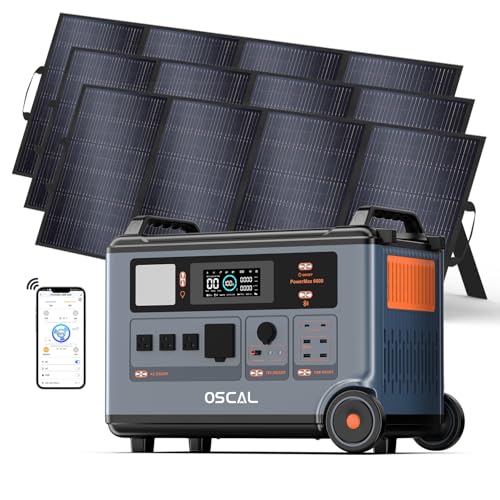
Best for: campers or households seeking robust, affordable solar power with rapid charging and strong bi-directional capabilities. It’s a practical option for temporary outages or off-grid living with a broad outlet spread.
Why selected: The 6000W solar generator pairs a solid capacity with 14 outlets and fast charging, enabling reliable backup for essential loads during outages and outdoor use.
Caution: While offering impressive peak output, ensure you have compatible solar input and ensure the system meets local electrical codes for long-term home use.
EF ECOFLOW Delta Pro 3 With Extra Batteries

Best for: EcoFlow fans seeking a modular, scalable solution with high-output potential. Delta Pro 3 supports 120V/240V and up to 12,000W with X-Boost, and expandable battery capacity with extra packs.
Why selected: The Delta Pro 3 emphasizes ecosystem integration, remote monitoring, and flexible charging methods, making it suitable for users who want a robust, configurable home backup that grows with needs over time.
Caution: Setup and expansion should follow EcoFlow guidance to maintain safe operation and proper load balancing across phases.
Buying Guide: Key Considerations And Comparisons
- Output vs. load needs: Higher continuous watts support more appliances simultaneously. If you run a central AC, water heater, and essential electronics at once, prioritize units with 6,000–12,000W continuous power and strong surge ratings.
- Expandable capacity: Look for modular or expandable battery packs. Whole-house backup often requires 12 kWh or more, with future expansion to 30–180 kWh depending on the model.
- Input options: Solar input efficiency, grid charging, and generator compatibility affect how fast you recharge. Panels, windfalls, or gas gens can all be used in different models.
- System monitoring: Apps and remote monitoring simplify operation and load balancing. Consider models with clear dashboards and auto-load balancing features.
- Safety and lifecycle: LiFePO4 chemistry often provides longer lifespans and stability in temperature changes. Check battery cycles and thermal protection features.
- Upgrade path and ecosystem: Some brands offer modular hubs and extra batteries that integrate with other devices. This matters for future expansion and cross-connection with home panels.
FAQ
- What is the main advantage of a 12kW solar generator?
It provides substantial power for many essential appliances during outages and off-grid periods, with the ability to scale capacity for longer duration backups. - How do you choose between single-unit high output and multi-unit expansions?
Single-unit units are simpler and compact; multi-unit setups offer higher total capacity and parallel operation for very large loads. - What should I consider about solar input capacity?
Higher solar input allows faster recharging, which is crucial during long outages or in variable sun conditions. - Are LiFePO4 batteries safer for home use?
LiFePO4 chemistry tends to offer longer life and robust safety characteristics under many operating conditions. - Is a back-up generator essential with solar?
It depends on your climate, energy needs, and grid reliability. Some setups rely entirely on solar and batteries, while others pair with gas or propane generators for extended blackouts. - Do these systems require professional installation?
Many models are designed for user-friendly setup with adapter circuits, but large installations may require professional wiring and permits per local codes.